


Metropolitan Museum- Special Exhibitions

Folder: Metropolitan Museum of Art
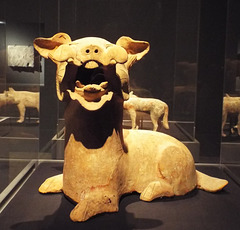
Dog Terracotta Sculpture in the Metropolitan Museu…
| |
|
Dog
Object Details
Period: Eastern Han dynasty (25–220)
Culture: China
Medium: Earthenware
Dimensions: H. 16 3/4 in. (42.5 cm); W. 13 in. (33 cm); L. 19 11/16 in. (50 cm)
Classification: Tomb Pottery
Credit Line: Lent by Henan Museum
This recumbent dog is captured at a moment of animation: with wide eyes and upright ears, it opens its mouth as though barking, its teeth bared in confrontation. Its compact, hollow body was molded, while its other parts, such as the ears, teeth, and eyes, were sculpted separately and applied to the body. Vividly detailed canines such as this one embodied the animus of a living animal and frequently appeared in burial complexes, where they warded off evil spirits and guarded both the tomb occupant and the material wealth that he or she brought into the afterlife.
Text from: www.metmuseum.org/art/collection/search/700572
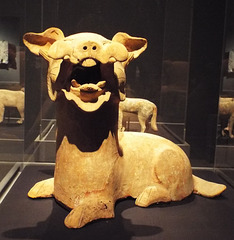
Dog Terracotta Sculpture in the Metropolitan Museu…
| |
|
Dog
Object Details
Period: Eastern Han dynasty (25–220)
Culture: China
Medium: Earthenware
Dimensions: H. 16 3/4 in. (42.5 cm); W. 13 in. (33 cm); L. 19 11/16 in. (50 cm)
Classification: Tomb Pottery
Credit Line: Lent by Henan Museum
This recumbent dog is captured at a moment of animation: with wide eyes and upright ears, it opens its mouth as though barking, its teeth bared in confrontation. Its compact, hollow body was molded, while its other parts, such as the ears, teeth, and eyes, were sculpted separately and applied to the body. Vividly detailed canines such as this one embodied the animus of a living animal and frequently appeared in burial complexes, where they warded off evil spirits and guarded both the tomb occupant and the material wealth that he or she brought into the afterlife.
Text from: www.metmuseum.org/art/collection/search/700572
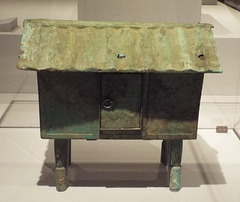
Han Barn Model in the Metropolitan Museum of Art,…
| |
|
Model of a Barn
Object Details
Period: Eastern Han dynasty (25–220)
Culture: China
Medium: Bronze
Dimensions: H. 21 1/4 in. (54 cm); W. 16 9/16 in. (42 cm); L. 22 13/16 in. (58 cm); approx. Wt. 70.5 lb. (32 kg)
Classification: Architectural Models
Credit Line: Lent by Hepu County Museum
This elevated building reflects a popular architectural style in southern China. The wavy surface of the roof evokes the structure and texture of tiles. Engraved pictorial decorations embellish all four facades. Mythical birds, animals, multibranch lamps, and human figures evoke a sacred atmosphere, implying the model’s function as a religious edifice.
Text from: www.metmuseum.org/art/collection/search/696841
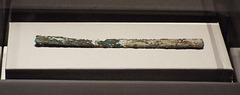
Han Ruler in the Metropolitan Museum of Art, July…
| |
|
Ruler
Object Details
Period: Eastern Han dynasty (25–220)
Culture: China
Medium: Bronze
Dimensions: W. 1/2 in. (1.2 cm); L. 6 5/16 in. (16 cm)
Classification: Metalwork
Credit Line: Lent by Gansu Provincial Museum
The Han government adopted the measurement system of the Qin. The basic unit for length, or chi, equaled approximately 9 inches, or 23 centimeters. Known examples vary slightly in length, from 21.7 to 24.1 centimeters. At the time of its discovery, the present example was more than eight-tenths intact, indicating that it was originally 23.4 centimeters long. Generally, rulers of the Eastern Han period were slightly longer, and the reason for this change remains unknown.
Text from: www.metmuseum.org/art/collection/search/734009
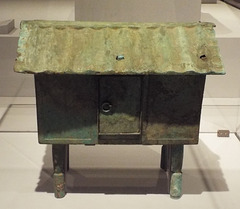
Han Barn Model in the Metropolitan Museum of Art,…
| |
|
Model of a Barn
Object Details
Period: Eastern Han dynasty (25–220)
Culture: China
Medium: Bronze
Dimensions: H. 21 1/4 in. (54 cm); W. 16 9/16 in. (42 cm); L. 22 13/16 in. (58 cm); approx. Wt. 70.5 lb. (32 kg)
Classification: Architectural Models
Credit Line: Lent by Hepu County Museum
This elevated building reflects a popular architectural style in southern China. The wavy surface of the roof evokes the structure and texture of tiles. Engraved pictorial decorations embellish all four facades. Mythical birds, animals, multibranch lamps, and human figures evoke a sacred atmosphere, implying the model’s function as a religious edifice.
Text from: www.metmuseum.org/art/collection/search/696841

Han Ruler in the Metropolitan Museum of Art, July…
| |
|
Ruler
Object Details
Period: Eastern Han dynasty (25–220)
Culture: China
Medium: Bronze
Dimensions: W. 1/2 in. (1.2 cm); L. 6 5/16 in. (16 cm)
Classification: Metalwork
Credit Line: Lent by Gansu Provincial Museum
The Han government adopted the measurement system of the Qin. The basic unit for length, or chi, equaled approximately 9 inches, or 23 centimeters. Known examples vary slightly in length, from 21.7 to 24.1 centimeters. At the time of its discovery, the present example was more than eight-tenths intact, indicating that it was originally 23.4 centimeters long. Generally, rulers of the Eastern Han period were slightly longer, and the reason for this change remains unknown.
Text from: www.metmuseum.org/art/collection/search/734009
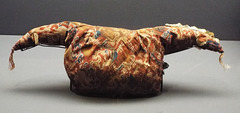
Pillow in the Shape of a Twin-Headed Bird in the M…
| |
|
Pillow in the Shape of a Twin-Headed Bird
Object Details
Period: Eastern Han dynasty (25–220)
Culture: China
Medium: Woven silk jin (warp-faced compound plain weave), two amber beads
Dimensions: H. 6 in.. (15.2 cm): W. 19 in. (48.3 cm): D. 3 3/4 in. (9.5 cm)
Classification: Textiles-Brocades
Credit Line: Lent by Xinjiang Uygur Autonomous Region Museum
Stuffed with plant stalks, this pillow features a pattern of stylized birds and beasts. Interspersed are Chinese characters reading, “extend years, increase longevity, and benefit sons and grandsons.” The two tips forming bird’s heads have led to the pillow’s identification as a “rooster-crowing pillow” (jimingzhen), a burial item intended to carry the deceased into heaven, but no historical texts of the period can corroborate the term. The two-headed form more likely represents a mythical bird than an actual rooster.
Text from: www.metmuseum.org/art/collection/search/696821
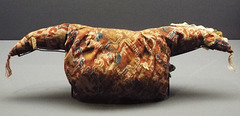
Pillow in the Shape of a Twin-Headed Bird in the M…
| |
|
Pillow in the Shape of a Twin-Headed Bird
Object Details
Period: Eastern Han dynasty (25–220)
Culture: China
Medium: Woven silk jin (warp-faced compound plain weave), two amber beads
Dimensions: H. 6 in.. (15.2 cm): W. 19 in. (48.3 cm): D. 3 3/4 in. (9.5 cm)
Classification: Textiles-Brocades
Credit Line: Lent by Xinjiang Uygur Autonomous Region Museum
Stuffed with plant stalks, this pillow features a pattern of stylized birds and beasts. Interspersed are Chinese characters reading, “extend years, increase longevity, and benefit sons and grandsons.” The two tips forming bird’s heads have led to the pillow’s identification as a “rooster-crowing pillow” (jimingzhen), a burial item intended to carry the deceased into heaven, but no historical texts of the period can corroborate the term. The two-headed form more likely represents a mythical bird than an actual rooster.
Text from: www.metmuseum.org/art/collection/search/696821
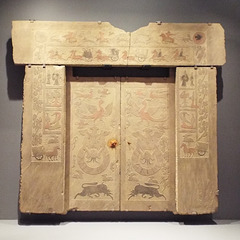
Han Tomb Gate in the Metropoiltan Museum of Art, J…
| |
|
Tomb Gate
Object Details
Period: Eastern Han dynasty (25–220)
Culture: China
Medium: Stone with pigment
Dimensions: a, right lintel: H. 16 1/8 in. (41 cm); W. 36 5/8 in. (93 cm); D. 2 3/4 in. (7 cm); Wt. 129 lbs (58.5 kg)
b, left lintel: H. 16 1/8 in. (41 cm); W. 44 1/8 in. (112 cm); D. 2 3/4 in. (7 cm); Wt. 145.5 lbs (66 kg)
c, right gate post: H. 52 3/4 in. (134 cm); W. 15 3/4 in. (40 cm); D 3 1/8 in. (8 cm); Wt. 185.2 lbs (84 kg)
d, left gate post: H. 52 3/8 in. (133 cm); W. 16 1/8 in. (41 cm); D. 3 1/8 in. (8 cm); Wt. 210.5 lbs (95.5 kg)
e, right gate: H. 54 5/16 in. (138 cm); W. 22 1/16 in. (56 cm); D. 4 5/16 in. (11 cm); Wt. 26.8 lbs (121 kg)
f, left gate: H. 50 in. (127 cm); W. 21 5/8 in. (55 cm); D. 2 3/4 in. (7 cm); Wt. 253.5 lbs (115 kg)
Classification: Sculpture
Credit Line: Lent by Shaanxi Provincial Institute of Archaeology
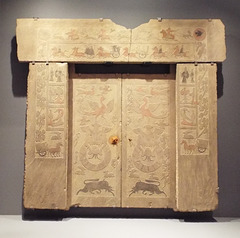
These five stone slabs—a lintel, two posts, and two door panels—stood at the entrance to a tomb. Their decoration was achieved through a combination of carving and painting. Since pigments deteriorate once stones are unearthed and exposed to air, these rare examples permit a look at the full chromatic glory of Han stone carvings.
The pictorial program brings together several symbolic needs of the deceased. Two gigantic doorknockers and a pair of bulls protect the tomb against evil. Patterns on the lintel and posts, including the sun, the moon, and auspicious animals, signal the heavenly domain. On the right-hand door, an immortal following a string of clouds stands ready to guide the deceased into Heaven. Taken together, the decoration transforms this tomb gate into the gate of Heaven.
Text from: www.metmuseum.org/art/collection/search/696827
Han Tomb Gate in the Metropoiltan Museum of Art, J…
| |
|
Tomb Gate
Object Details
Period: Eastern Han dynasty (25–220)
Culture: China
Medium: Stone with pigment
Dimensions: a, right lintel: H. 16 1/8 in. (41 cm); W. 36 5/8 in. (93 cm); D. 2 3/4 in. (7 cm); Wt. 129 lbs (58.5 kg)
b, left lintel: H. 16 1/8 in. (41 cm); W. 44 1/8 in. (112 cm); D. 2 3/4 in. (7 cm); Wt. 145.5 lbs (66 kg)
c, right gate post: H. 52 3/4 in. (134 cm); W. 15 3/4 in. (40 cm); D 3 1/8 in. (8 cm); Wt. 185.2 lbs (84 kg)
d, left gate post: H. 52 3/8 in. (133 cm); W. 16 1/8 in. (41 cm); D. 3 1/8 in. (8 cm); Wt. 210.5 lbs (95.5 kg)
e, right gate: H. 54 5/16 in. (138 cm); W. 22 1/16 in. (56 cm); D. 4 5/16 in. (11 cm); Wt. 26.8 lbs (121 kg)
f, left gate: H. 50 in. (127 cm); W. 21 5/8 in. (55 cm); D. 2 3/4 in. (7 cm); Wt. 253.5 lbs (115 kg)
Classification: Sculpture
Credit Line: Lent by Shaanxi Provincial Institute of Archaeology
These five stone slabs—a lintel, two posts, and two door panels—stood at the entrance to a tomb. Their decoration was achieved through a combination of carving and painting. Since pigments deteriorate once stones are unearthed and exposed to air, these rare examples permit a look at the full chromatic glory of Han stone carvings.
The pictorial program brings together several symbolic needs of the deceased. Two gigantic doorknockers and a pair of bulls protect the tomb against evil. Patterns on the lintel and posts, including the sun, the moon, and auspicious animals, signal the heavenly domain. On the right-hand door, an immortal following a string of clouds stands ready to guide the deceased into Heaven. Taken together, the decoration transforms this tomb gate into the gate of Heaven.
Text from: www.metmuseum.org/art/collection/search/696827
Carnelian Animal-Shaped Ornaments in the Metropoli…
| |
|
Assembly of Animal-Shaped Ornaments,ca. 300–100 BC
Object Details
Date: ca. 300–100 BC
Culture: India or Southeast Asia
Medium: Carnelian
Dimensions: Each approx. H. 1/2 in. (1.3 cm): L. 3/8 in. (1.4 cm)
Classification: Hardstone
Credit Line: Lent by Guangxi Zhuang Autonomous Region Museum
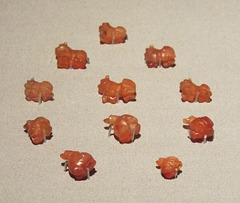
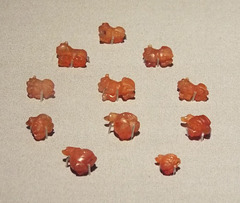
These ornaments were likely imported. They are made of carnelian, a stone native to India that first came to China via the steppes and the Silk Road and later via maritime trade. The city of Hepu, where these carvings were found, was a busy seaport, from which merchants’ ships set sail for the Indian Ocean.
Text from: www.metmuseum.org/art/collection/search/696811
Carnelian Animal-Shaped Ornaments in the Metropoli…
| |
|
Assembly of Animal-Shaped Ornaments,ca. 300–100 BC
Object Details
Date: ca. 300–100 BC
Culture: India or Southeast Asia
Medium: Carnelian
Dimensions: Each approx. H. 1/2 in. (1.3 cm): L. 3/8 in. (1.4 cm)
Classification: Hardstone
Credit Line: Lent by Guangxi Zhuang Autonomous Region Museum
These ornaments were likely imported. They are made of carnelian, a stone native to India that first came to China via the steppes and the Silk Road and later via maritime trade. The city of Hepu, where these carvings were found, was a busy seaport, from which merchants’ ships set sail for the Indian Ocean.
Text from: www.metmuseum.org/art/collection/search/696811
Han Model of a Dyeing Workshop in the Metropolitan…
| |
|
Model of a Dyeing Workshop
Object Details
Period: Eastern Han dynasty (25–220)
Culture: China
Medium: Earthenware
Dimensions: H. 8 7/16 in. (21.5 cm); W. 7 3/8 in. (18.8 cm); L. 11 in. (28 cm)
Classification: Architectural Models
Credit Line: Lent by Guangxi Zhuang Autonomous Region Museum
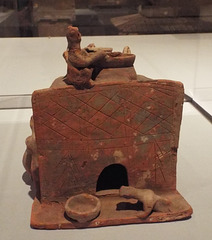
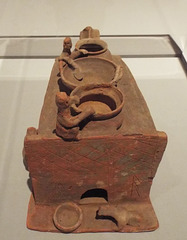
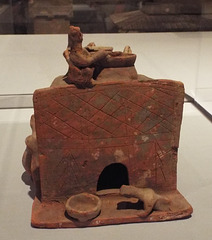
This miniature stove model takes the form of a rectangular prism with a sloped top. The facade at the taller end of the slope has an arched opening into the fire chamber, which is attended by a worker. The facade on the shorter end has a rectangular vent and is topped by a chimney. Three hearths crown the model, each heating a cauldron tended by two toiling figures. That the workers are stirring and scooping water suggests that this model may have replicated one used in a dyeing workshop.
Text from: www.metmuseum.org/art/collection/search/640930
Han Model of a Dyeing Workshop in the Metropolitan…
| |
|
Model of a Dyeing Workshop
Object Details
Period: Eastern Han dynasty (25–220)
Culture: China
Medium: Earthenware
Dimensions: H. 8 7/16 in. (21.5 cm); W. 7 3/8 in. (18.8 cm); L. 11 in. (28 cm)
Classification: Architectural Models
Credit Line: Lent by Guangxi Zhuang Autonomous Region Museum
This miniature stove model takes the form of a rectangular prism with a sloped top. The facade at the taller end of the slope has an arched opening into the fire chamber, which is attended by a worker. The facade on the shorter end has a rectangular vent and is topped by a chimney. Three hearths crown the model, each heating a cauldron tended by two toiling figures. That the workers are stirring and scooping water suggests that this model may have replicated one used in a dyeing workshop.
Text from: www.metmuseum.org/art/collection/search/640930
Han Model of a Dyeing Workshop in the Metropolitan…
| |
|
Model of a Dyeing Workshop
Object Details
Period: Eastern Han dynasty (25–220)
Culture: China
Medium: Earthenware
Dimensions: H. 8 7/16 in. (21.5 cm); W. 7 3/8 in. (18.8 cm); L. 11 in. (28 cm)
Classification: Architectural Models
Credit Line: Lent by Guangxi Zhuang Autonomous Region Museum
This miniature stove model takes the form of a rectangular prism with a sloped top. The facade at the taller end of the slope has an arched opening into the fire chamber, which is attended by a worker. The facade on the shorter end has a rectangular vent and is topped by a chimney. Three hearths crown the model, each heating a cauldron tended by two toiling figures. That the workers are stirring and scooping water suggests that this model may have replicated one used in a dyeing workshop.
Text from: www.metmuseum.org/art/collection/search/640930
Strongman in the Metropolitan Museum of Art, July…
| |
|
Strongman
China
Object Details
Period: Qin dynasty (221–206 B.C.)
Culture: China
Medium: Earthenware
Dimensions: H. 61 3/4 in. (156.8 cm); W. at shoulders 29 1/2 in. (74.9 cm); W. at waist 20 1/2 in. (52.2 cm); Wt. 456.4 lb. (207 kg)
Classification: Sculpture
Credit Line: Lent by Emperor Qinshihuang's Mausoleum Site Museum
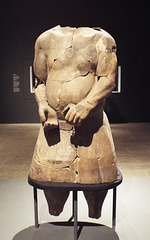
Acrobatics in China originated in antiquity and by the Qin–Han era had developed a full repertoire of moves, including rope walking and sword swallowing. This large figure was found with ten others in a pit near the First Emperor’s tomb. The group is believed to have represented an acrobatics troupe performing at the imperial court.
The figure has an imposing physique and brawny hands, which together with his wide stance suggest his role as a strongman. He and a partner once held a pole, atop which another performer could swing, balance, and twist. The striking accuracy of his anatomy, hitherto unknown in Chinese figural art, has led to speculation that he was inspired by the Hellenistic sculptures that Alexander the Great introduced into Central Asia a century earlier.
Text from: www.metmuseum.org/art/collection/search/738808
Strongman in the Metropolitan Museum of Art, July…
| |
|
Strongman
China
Object Details
Period: Qin dynasty (221–206 B.C.)
Culture: China
Medium: Earthenware
Dimensions: H. 61 3/4 in. (156.8 cm); W. at shoulders 29 1/2 in. (74.9 cm); W. at waist 20 1/2 in. (52.2 cm); Wt. 456.4 lb. (207 kg)
Classification: Sculpture
Credit Line: Lent by Emperor Qinshihuang's Mausoleum Site Museum
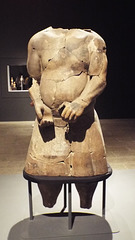
Acrobatics in China originated in antiquity and by the Qin–Han era had developed a full repertoire of moves, including rope walking and sword swallowing. This large figure was found with ten others in a pit near the First Emperor’s tomb. The group is believed to have represented an acrobatics troupe performing at the imperial court.
The figure has an imposing physique and brawny hands, which together with his wide stance suggest his role as a strongman. He and a partner once held a pole, atop which another performer could swing, balance, and twist. The striking accuracy of his anatomy, hitherto unknown in Chinese figural art, has led to speculation that he was inspired by the Hellenistic sculptures that Alexander the Great introduced into Central Asia a century earlier.
Text from: www.metmuseum.org/art/collection/search/738808
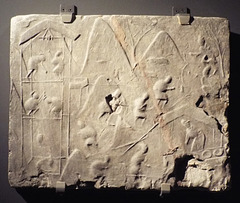
Brick with a Scene of Salt Production in the Metro…
| |
|
Brick with Scene of Salt Production
Object Details
Period: Eastern Han dynasty (25–220)
Culture: China
Medium: Earthenware
Dimensions: H. 18 3/8 in. (46.6 cm); W. 14 7/16 in. (36.6 cm); Th. 1 15/16 in. (5 cm); Wt. 32.2 lbs (14.6 kg)
Classification: Sculpture
Credit Line: Lent by Sichuan Provincial Museum
This brick records a rare scene of salt production. At the far left is a roofed, shafted structure containing four toiling figures. A pulley block identifies the structure as a salt well. Moving to the right, one can identify a set of evaporation pans over a furnace tended by a seated figure, as well as two additional figures, both with baskets on their backs, who transport salt from the well to the pans.
Text from: www.metmuseum.org/art/collection/search/640970
Jump to top
RSS feed- Latest items - Subscribe to the latest items added to this album
- ipernity © 2007-2025
- Help & Contact
|
Club news
|
About ipernity
|
History |
ipernity Club & Prices |
Guide of good conduct
Donate | Group guidelines | Privacy policy | Terms of use | Statutes | In memoria -
Facebook
X
