


Metropolitan Museum- Special Exhibitions

Folder: Metropolitan Museum of Art
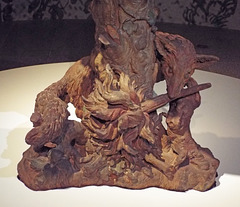
Detail of the Fox Setting Fire Fountain from Versa…
| |
|
Fox Setting Fire to the Tree with the Eagle’s Nest,1673–74
Date: 1673–74
Culture: French
Medium: Painted lead
Dimensions: 47 1/4 × 33 1/16 in., 2204.6 lb. (120 × 84 cm, 1000 kg)
Classification: Sculpture
Credit Line: Musée National des Châteaux de Versailles et de Trianon (MV 7946.1)
The sixth fountain in the Labyrinth represented "The Eagle and the Fox" fable. Made of lead painted in naturalistic colors, the sculptures spurted jets of water that animated the scenes and created a sense of interaction among the various animals.
Text from: www.metmuseum.org/art/collection/search/699592
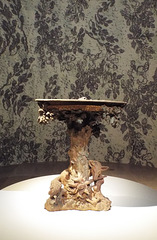
Fox Setting Fire Fountain from Versailles in the M…
| |
|
Fox Setting Fire to the Tree with the Eagle’s Nest,1673–74
Date: 1673–74
Culture: French
Medium: Painted lead
Dimensions: 47 1/4 × 33 1/16 in., 2204.6 lb. (120 × 84 cm, 1000 kg)
Classification: Sculpture
Credit Line: Musée National des Châteaux de Versailles et de Trianon (MV 7946.1)
The sixth fountain in the Labyrinth represented "The Eagle and the Fox" fable. Made of lead painted in naturalistic colors, the sculptures spurted jets of water that animated the scenes and created a sense of interaction among the various animals.
Text from: www.metmuseum.org/art/collection/search/699592
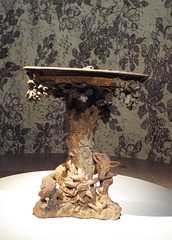
Fox Setting Fire Fountain from Versailles in the M…
| |
|
Fox Setting Fire to the Tree with the Eagle’s Nest,1673–74
Date: 1673–74
Culture: French
Medium: Painted lead
Dimensions: 47 1/4 × 33 1/16 in., 2204.6 lb. (120 × 84 cm, 1000 kg)
Classification: Sculpture
Credit Line: Musée National des Châteaux de Versailles et de Trianon (MV 7946.1)
The sixth fountain in the Labyrinth represented "The Eagle and the Fox" fable. Made of lead painted in naturalistic colors, the sculptures spurted jets of water that animated the scenes and created a sense of interaction among the various animals.
Text from: www.metmuseum.org/art/collection/search/699592
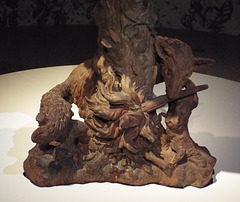
Detail of the Fox Setting Fire Fountain from Versa…
| |
|
Fox Setting Fire to the Tree with the Eagle’s Nest,1673–74
Date: 1673–74
Culture: French
Medium: Painted lead
Dimensions: 47 1/4 × 33 1/16 in., 2204.6 lb. (120 × 84 cm, 1000 kg)
Classification: Sculpture
Credit Line: Musée National des Châteaux de Versailles et de Trianon (MV 7946.1)
The sixth fountain in the Labyrinth represented "The Eagle and the Fox" fable. Made of lead painted in naturalistic colors, the sculptures spurted jets of water that animated the scenes and created a sense of interaction among the various animals.
Text from: www.metmuseum.org/art/collection/search/699592
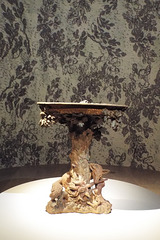
Fox Setting Fire Fountain from Versailles in the M…
| |
|
Fox Setting Fire to the Tree with the Eagle’s Nest,1673–74
Date: 1673–74
Culture: French
Medium: Painted lead
Dimensions: 47 1/4 × 33 1/16 in., 2204.6 lb. (120 × 84 cm, 1000 kg)
Classification: Sculpture
Credit Line: Musée National des Châteaux de Versailles et de Trianon (MV 7946.1)
The sixth fountain in the Labyrinth represented "The Eagle and the Fox" fable. Made of lead painted in naturalistic colors, the sculptures spurted jets of water that animated the scenes and created a sense of interaction among the various animals.
Text from: www.metmuseum.org/art/collection/search/699592
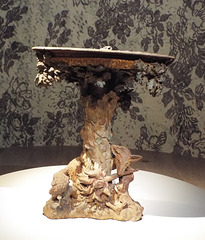
Fox Setting Fire Fountain from Versailles in the M…
| |
|
Fox Setting Fire to the Tree with the Eagle’s Nest,1673–74
Date: 1673–74
Culture: French
Medium: Painted lead
Dimensions: 47 1/4 × 33 1/16 in., 2204.6 lb. (120 × 84 cm, 1000 kg)
Classification: Sculpture
Credit Line: Musée National des Châteaux de Versailles et de Trianon (MV 7946.1)
The sixth fountain in the Labyrinth represented "The Eagle and the Fox" fable. Made of lead painted in naturalistic colors, the sculptures spurted jets of water that animated the scenes and created a sense of interaction among the various animals.
Text from: www.metmuseum.org/art/collection/search/699592
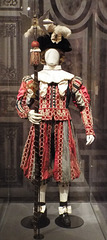
Ceremonial Uniform of the Cent-Suisses in the Metr…
| |
|
Ceremonial Uniform of the Cent-Suisses,18th century
Date: 18th century
Culture: French
Medium: Silk and velvet (uniform), gold-plated iron (halberd), linen and flax (collar), leather and gold embroidery (gloves)
Dimensions: Halberd: 93 5/16 × 11 5/8 × 4 3/4 in., 130.146oz. (237 × 29.5 × 12 cm, 3.7 kg)
Length (of jacket sleeve): 27 9/16 in. (70 cm)
Length at CB (of jacket): 23 5/8 in. (60 cm)
Width (of jacket waist): 35 7/16 in. (90 cm)
Length (of trousers): 39 3/8 in. (100 cm)
Width (of trouser waist): 33 7/16 in. (85 cm)
Classification: Main dress-Uniform
Credit Line: Swiss National Museum, Zurich (LM-16618.1-.2 [uniform], LM 70591 [halberd], LM 450-c [collar], AG–2419 [gloves], AD–2248 [wig])
This gala uniform for the Cent-Suisses, an elite unit of one hundred Swiss mercenaries charged with protecting the king inside the palace, would have been worn during the king’s public audiences with foreign ambassadors and on other special occasions. Its elaborate design—including a starched and pleated ruff, a doublet and trunk hose richly decorated with braid, and a plumed hat—dated back to the sixteenth century.
Text from: www.metmuseum.org/art/collection/search/776399
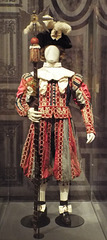
Ceremonial Uniform of the Cent-Suisses in the Metr…
| |
|
Ceremonial Uniform of the Cent-Suisses,18th century
Date: 18th century
Culture: French
Medium: Silk and velvet (uniform), gold-plated iron (halberd), linen and flax (collar), leather and gold embroidery (gloves)
Dimensions: Halberd: 93 5/16 × 11 5/8 × 4 3/4 in., 130.146oz. (237 × 29.5 × 12 cm, 3.7 kg)
Length (of jacket sleeve): 27 9/16 in. (70 cm)
Length at CB (of jacket): 23 5/8 in. (60 cm)
Width (of jacket waist): 35 7/16 in. (90 cm)
Length (of trousers): 39 3/8 in. (100 cm)
Width (of trouser waist): 33 7/16 in. (85 cm)
Classification: Main dress-Uniform
Credit Line: Swiss National Museum, Zurich (LM-16618.1-.2 [uniform], LM 70591 [halberd], LM 450-c [collar], AG–2419 [gloves], AD–2248 [wig])
This gala uniform for the Cent-Suisses, an elite unit of one hundred Swiss mercenaries charged with protecting the king inside the palace, would have been worn during the king’s public audiences with foreign ambassadors and on other special occasions. Its elaborate design—including a starched and pleated ruff, a doublet and trunk hose richly decorated with braid, and a plumed hat—dated back to the sixteenth century.
Text from: www.metmuseum.org/art/collection/search/776399
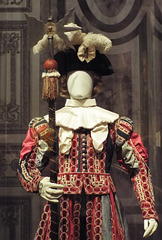
Detail of the Ceremonial Uniform of the Cent-Suiss…
| |
|
Ceremonial Uniform of the Cent-Suisses,18th century
Date: 18th century
Culture: French
Medium: Silk and velvet (uniform), gold-plated iron (halberd), linen and flax (collar), leather and gold embroidery (gloves)
Dimensions: Halberd: 93 5/16 × 11 5/8 × 4 3/4 in., 130.146oz. (237 × 29.5 × 12 cm, 3.7 kg)
Length (of jacket sleeve): 27 9/16 in. (70 cm)
Length at CB (of jacket): 23 5/8 in. (60 cm)
Width (of jacket waist): 35 7/16 in. (90 cm)
Length (of trousers): 39 3/8 in. (100 cm)
Width (of trouser waist): 33 7/16 in. (85 cm)
Classification: Main dress-Uniform
Credit Line: Swiss National Museum, Zurich (LM-16618.1-.2 [uniform], LM 70591 [halberd], LM 450-c [collar], AG–2419 [gloves], AD–2248 [wig])
This gala uniform for the Cent-Suisses, an elite unit of one hundred Swiss mercenaries charged with protecting the king inside the palace, would have been worn during the king’s public audiences with foreign ambassadors and on other special occasions. Its elaborate design—including a starched and pleated ruff, a doublet and trunk hose richly decorated with braid, and a plumed hat—dated back to the sixteenth century.
Text from: www.metmuseum.org/art/collection/search/776399
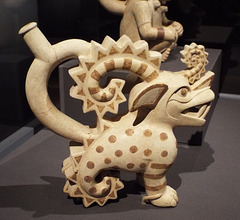
Vessel in the Shape of a Crested Animal in the Met…
| |
|
Vessel in the Shape of a Crested Animal,A.D. 525–550
Object Details
Date: A.D. 525–550
Geography: Peru
Culture: Moche
Medium: Ceramic
Dimensions: H. 8 9/16 × W. 8 1/4 in. (21.7 × 21 cm)
Classification: Ceramics-Vessels
Credit Line: Museo de Sitio de Chan Chan, Huanchaco, Peru, Ministerio de Cultura del Perú (13-01-04/IV/A-1/13, 453)
The vessel in the shape of a creature often referred to as the Crested Animal includes the claws, fangs, and spots and stripes of a feline as well as characteristics of other animals. One of three serrated crests resembles the lower half of a sea horse and curls under the body to serve as the hindquarters.
Text from: www.metmuseum.org/art/collection/search/722395
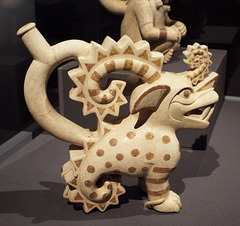
Vessel in the Shape of a Crested Animal in the Met…
| |
|
Vessel in the Shape of a Crested Animal,A.D. 525–550
Object Details
Date: A.D. 525–550
Geography: Peru
Culture: Moche
Medium: Ceramic
Dimensions: H. 8 9/16 × W. 8 1/4 in. (21.7 × 21 cm)
Classification: Ceramics-Vessels
Credit Line: Museo de Sitio de Chan Chan, Huanchaco, Peru, Ministerio de Cultura del Perú (13-01-04/IV/A-1/13, 453)
The vessel in the shape of a creature often referred to as the Crested Animal includes the claws, fangs, and spots and stripes of a feline as well as characteristics of other animals. One of three serrated crests resembles the lower half of a sea horse and curls under the body to serve as the hindquarters.
Text from: www.metmuseum.org/art/collection/search/722395
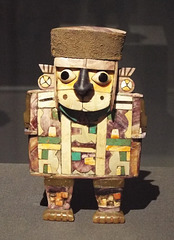
Figurine in the Shape of a Dignitary in the Metrop…
| |
|
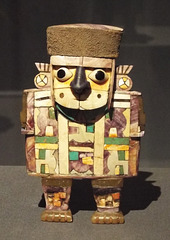
Figurine in the Shape of a Dignitary,A.D. 600–1000
Date: A.D. 600–1000
Geography: Peru, South Coast
Culture: Wari
Medium: Wood, shell and stone inlay, silver
Dimensions: H. 4 × W. 2 1/2 × D. 1 in. (10.2 × 6.4 × 2.6 cm)
Classification: Wood-Sculpture
Credit Line: Kimbell Art Museum, Fort Worth, Texas (AP 2002.04)
Rendered using highly valued imported materials, this standing figurine portrays a Wari lord wearing a tunic, ear ornaments, and a headdress. Holes drilled into the shoulders allowed the figurine to be suspended from a cord and worn as a necklace.
Text from: www.metmuseum.org/art/collection/search/722265
Figurine in the Shape of a Dignitary in the Metrop…
| |
|
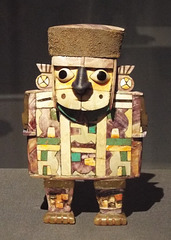
Figurine in the Shape of a Dignitary,A.D. 600–1000
Date: A.D. 600–1000
Geography: Peru, South Coast
Culture: Wari
Medium: Wood, shell and stone inlay, silver
Dimensions: H. 4 × W. 2 1/2 × D. 1 in. (10.2 × 6.4 × 2.6 cm)
Classification: Wood-Sculpture
Credit Line: Kimbell Art Museum, Fort Worth, Texas (AP 2002.04)
Rendered using highly valued imported materials, this standing figurine portrays a Wari lord wearing a tunic, ear ornaments, and a headdress. Holes drilled into the shoulders allowed the figurine to be suspended from a cord and worn as a necklace.
Text from: www.metmuseum.org/art/collection/search/722265
Figurine in the Shape of a Dignitary in the Metrop…
| |
|
Figurine in the Shape of a Dignitary,A.D. 600–1000
Date: A.D. 600–1000
Geography: Peru, South Coast
Culture: Wari
Medium: Wood, shell and stone inlay, silver
Dimensions: H. 4 × W. 2 1/2 × D. 1 in. (10.2 × 6.4 × 2.6 cm)
Classification: Wood-Sculpture
Credit Line: Kimbell Art Museum, Fort Worth, Texas (AP 2002.04)
Rendered using highly valued imported materials, this standing figurine portrays a Wari lord wearing a tunic, ear ornaments, and a headdress. Holes drilled into the shoulders allowed the figurine to be suspended from a cord and worn as a necklace.
Text from: www.metmuseum.org/art/collection/search/722265
Chariot Driver in the Metropolitan Museum of Art,…
| |
|
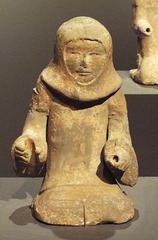
Chariot warrior
Object Details
Period: Western Han dynasty (206 B.C.–A.D. 9)
Culture: China
Medium: Earthenware with pigments
Dimensions: Each: H. 9 13/16 in. (25 cm); W. 7 1/16 in. (18 cm)
Classification: Sculpture
Credit Line: Lent by Xuzhou City Museum
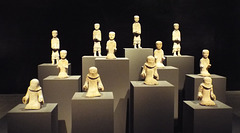
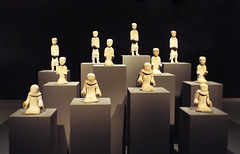
These twelve figures were among the roughly 2,400 terracotta warriors excavated from the tomb of Liu Yue, prince of a Han fief state. Made of fine clay, the figures were originally brightly painted, as indicated by surviving traces of pigment. The charioteers assume seated postures, as they would on their vehicles, while the foot soldiers, arms extended, probably once held long-handled dagger-axes or spears. They represent the two major components of the Han army during the early years of the dynasty: the chariot division and the infantry.
Text from: www.metmuseum.org/art/collection/search/640840

Chariot Driver in the Metropolitan Museum of Art,…
| |
|
Chariot warrior
Object Details
Period: Western Han dynasty (206 B.C.–A.D. 9)
Culture: China
Medium: Earthenware with pigments
Dimensions: Each: H. 9 13/16 in. (25 cm); W. 7 1/16 in. (18 cm)
Classification: Sculpture
Credit Line: Lent by Xuzhou City Museum
These twelve figures were among the roughly 2,400 terracotta warriors excavated from the tomb of Liu Yue, prince of a Han fief state. Made of fine clay, the figures were originally brightly painted, as indicated by surviving traces of pigment. The charioteers assume seated postures, as they would on their vehicles, while the foot soldiers, arms extended, probably once held long-handled dagger-axes or spears. They represent the two major components of the Han army during the early years of the dynasty: the chariot division and the infantry.
Text from: www.metmuseum.org/art/collection/search/640840
Group of Chariot Drivers, Chariot Riders, and Infa…
| |
|
Group of Chariot Drivers, Chariot Riders, and Infa…
| |
|
Jump to top
RSS feed- Latest items - Subscribe to the latest items added to this album
- ipernity © 2007-2025
- Help & Contact
|
Club news
|
About ipernity
|
History |
ipernity Club & Prices |
Guide of good conduct
Donate | Group guidelines | Privacy policy | Terms of use | Statutes | In memoria -
Facebook
X
