

Justfolk's photos
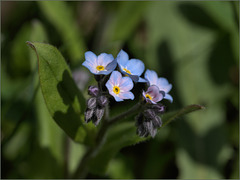
Summer's return reminder
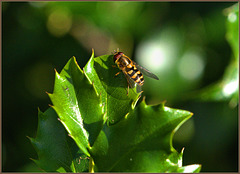
Hoverfly, I think
| |
|
|
|
I try each year to learn more bugs. And I've started again this year.
I thought this was some small bee. It and each of its brothers and sisters were about 8mm long as they hovered over and hung out on our holly bush today.
I got this one good picture and then studied my field guide and what I could find on line for the specific bee. However I've decided it is no bee, but a hoverfly. I do await confirmation or correction from my insectish betters.
-----------------------
EDIT, a little later same day: it is confirmed: a hoverfly it is.
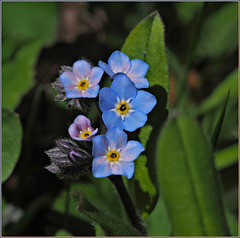
Maybe summer. Maybe.
| |
|
|
|
The latest snowfall in this city that I remember was about 15 cm on a June fifteenth. So I never take the signs of summer, nor even of spring, as givens. Things can change.
But today, the 29th of May, it is almost thirty degrees in our backyard. We've dried not just one but two loads of wet laundry on the line. And, my favourite harbinger of summer, the forget-me-nots have started to bloom.
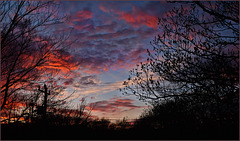
Brushing my teeth, I look up and see this
| |
|
|
|
I'm not one to take pictures of sunset skies. But I was struck by the colour of the light around me while brushing my teeth a few minutes ago. So I looked out the window and saw this.
Juniper, frisky
| |
|
|
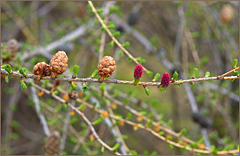
Late May is a typical time around here for the larches to get frisky. Being monoecious, their friskiness can be taken care of entirely in their own company. "Ah," you say.
Thus, here, you can see two of the female "flowers" on one twig while somewhat behind and below are whole rows of male "flowers."
This was yesterday. Let us hope they found satisfaction.
"Juniper" is what I grew up calling this tree; its Latin name is Larix laricina and other English names include tamarack and hackmatack.
And of course they are not "flowers" by any rigorous botanical system; they are conelets.
Maple opening
| |
|
|
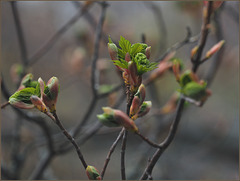
I'm no fan of maple trees. They are weedy and attract plagues of spanworms. But I do spend time most days looking for a few minutes at this one right outside the bathroom window. This time of year, late May month, is when it is prettiest -- just as the leaf buds are opening.
Juniper. . . . Oh, okay: "larch"
| |
|
|
|
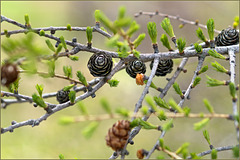
The juniper trees (Larix laricina, I understand, and what people elsewhere call larch or tamarack) are still budding out here. I found out just the other day that they produce both the bright red female conelets and the rather less flashy tan-coloured male conelets. It's not very sharp in this picture, but near the centre is such a male "flower."
And you can see a last-year's cone, plus several from a previous year. And the new leaves appearing.
I shoulda been more patient and got a picture like this with the female conelet, too. But I wasn't. And I didn't.
As good a whale picture as I could get
| |
|
|
|
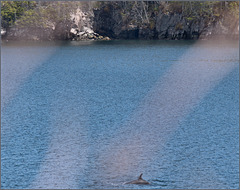
On Sunday afternoon, two days ago, I was in the front garden and heard what was the unmistakeable sound of a whale breaching and blowing. I ran inside for my camera and alerted my wife. Getting to the edge of the garden, looking down, we saw this guy moving along up the cove to our right and then back again out into the open bay. He was moving too quickly for me to get any picture than this one, through the branches.
I think he was a minke whale, and he was probably scouting for herring which is in some abundance in the bay right now.
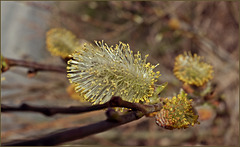
Pussycat tree
| |
|
The term pussy willow is very widespread in English, and -- despite not being *very* old (the OED suggests it was an Americanism that was first reported in the early 19th century), its basic metaphor (soft as a kitten's fur) is shared with several European languages, plus the somewhat older English term "catkin."
About fifty years ago it was reported from one part of Newfoundland that they were known as "pussycat trees." I don't know if that term is still used.
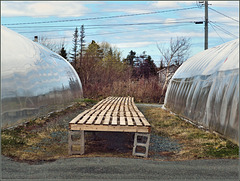
Plant nursery, starting up for spring
| |
|
Nursery plants are pictured here more by absence than presence. But then, much of life is like that.

Kissing his mentor's fore-brain
| |
|
|
|
Two or three seconds after I took this picture in 1996, my former teacher, from 25 years before, kissed a mentor of his, from 35 years before.
It's my favourite picture of both of them. It was at the official reception for Folktales of Newfoundland, the two-volume work co-edited by Herbert Halpert (on the right).
Harold Paddock, on the left, was telling the people present how much he admired Halpert and his works. He raised himself a little from the chair, lifted his hands to the sides of Halpert's head, and gave him a loud kiss on the forehead, a kiss – he said – to Halpert's fore-brain. It was, he went on, in recognition of how influential Halpert had been in building a strong scholarship around the culture of this province.
Halpert died four years later, in 2000.
And Harold Paddock died this week.
They are both missed.
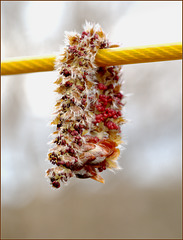
Catkin caught on the clothesline
| |
|
I think this fell from the European poplar tree that fills a lot of the sky above our backyard. Its leaves have not come out yet, but at its top are a few catkins. The poplar is the most likely source, but some other neighbouring trees produce catkins, too.
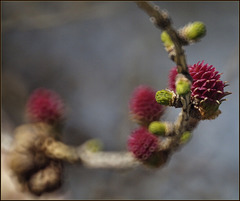
Larch flowers
| |
|
i went out walking today with only my EP-2 camera and the (I think weird) Tokina 300mm catadioptric lens I often attach to it. That's not really a good combination for close-ups of little budding growth. But I tried it anyway because I like the look of larch buds.
Magnolia
| |
|
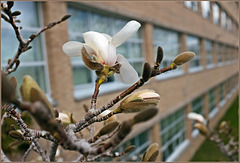
The local university campus is nearly deserted these days, so we took advantage of the quiet to walk around a bit and see how the magnolia next to the Science Building is doing. I know magnolias are a wild and even weedy thing in other places, but here they are a wonder of spring.
This magnolia was the first I ever saw in the city, 35 years or more ago. It grows in a very sheltered spot and is a remnant of a garden planted there about fifty years ago when the building behind it was constructed.
Some years it reaches this bud-breaking point at the beginning of May, even late April. Other years it is just reaching this point in late May. So, this is definitely not an early year, but it's not its latest either.
Coralberry flower
| |
|
About ten years ago a friend of mine gave me a slip of her big coralberry plant. I grew it in my office successfully -- until I accidentally killed it. I had left it unattended through several very cold nights in December.
But I had a dozen or so berries on it, and I planted them around the roots. After about six months, a green shoot came up and it eventually grew into a bigger plant than my original. I don't think it actually came from a berry. More likely it came from the original roots. It was big and healthy and it had dozens of bright red berries.
I brought the plant home two summers ago when I vacated my office at work and I immediately put it on the sunny back deck. In a few hours, birds had eaten every berry. Awww.
I waited for it to bloom again, and it did so pretty often. But no flowers turned into berries.
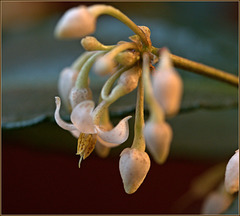
Last year, a friend suggested dusting the flowers myself, to manually fertilise them. I did so and it worked. This year, I have a ring of bright red berries around the plant (they never fall off or rot), plus a new flush of flowers. Like this one, and these buds waiting to open. The open one is about 7mm across from tip to tip.
And I'm still dusting the flowers by hand.
Nineteen years ago
| |
|
|
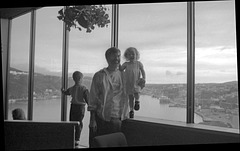
We've all grown up somewhat since July 2001 when this picture of me with my grand-niece and grand-nephew was taken in my Minolta Hi-Matic, by, I think, my wife. A crowd of family members were at a local restaurant with a great view over the harbour. No longer a restaurant, that building is now a part of the provincial university.
The picture was taken on Afgapan APX 100. I scanned it a few months ago but just noticed today how much I like the picture.
Beer for those who don't like beer
| |
|
I'm pretty finicky about my beer. To start with I have never liked beer from tins -- for whatever reason, it tastes flat compared to bottled beer. But then I don't like much draft beer either, for the same reason. For thirty years, I made my own beer and could make it taste the way I thought beer should taste. Sadly, I rely on bought beer nowadays.
(And, by the way, if you're finicky about your beer terminology, in my vocabulary "beer" is the generic term including all others, like ales and stouts and lagers and so on.)
In the past twenty or thirty years, our local beer market has had a lot of imported items from other markets; some of them strike me as beer for people who don't like beer. That concept of course makes perfect marketing sense: if you are a beer manufacturer and you think all the current beer drinkers have already decided what kind of beer they like, but you still want to extend your sales, you need to open new markets for beer. That extension necessarily is among people who don't currently like beer. So you make beer for people who don't like beer.
The prime form of beer for people who don't like beer is the fizzy-water sort that people in Canada always used to call "American beer." That term is unfair since many good beers are made in the USA, but the biggest sellers in that country, and the prime imports from there too, to my mind certainly fall into the category of beer for people who don't like beer.
When "lite" beer started to be a popular item, manufactured locally as well as at distance, it also fell into that category in my mind. And then beers started appearing that had interesting names but which were insipid fizzy-water types too. Sigh.
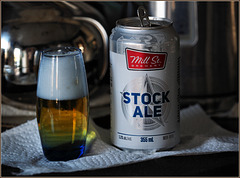
Mill Street, when I first started buying its beers a decade or more ago, made delicious bottled beer. (And they still produce some very good beer, though lately it's become hard to get them in bottles! ) Mill Street has always had a few products of insipid nearly-beer beers. I saw a box of this interestingly named Stock Ale at the store a couple of months ago (when I was still allowed to shop inside the liquor stores) and bought the box on spec. Small box, just six tins.
It looks very nice. Good colour. Good head. Sparkles nicely on the tongue. Not bad in that regard for a tinned beer.
But it is beer for people who don't like beer.
And, after two months, I've only drunk three tins. But maybe it's an acquired taste. . .
First lungworts
| |
|
|
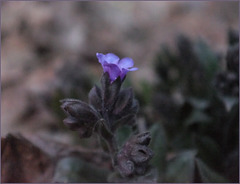
It was already mostly dark when I saw our lungworts are up and starting to bloom. This is about four metres from the last little pile of snow from our very hard winter. I expect that pile will melt by morning since we are expecting 20mm of rain overnight.
I jacked the ISO up as high as it would go and got a nice expired-film look. :)
