

Justfolk's photos
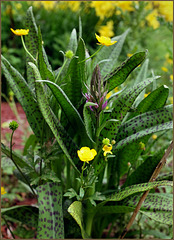
My favourite European Leopard Marsh Orchid
| |
|
I retired three years ago so I no longer have much opportunity to check on this, my favourite European Leopard Marsh Orchid, which wasn't far from my office. I used to check it almost every day this time of year, and when I drive by now I wonder about it. So today I stopt and went in search of it.
Due, I suppose, to the lack of gardening work through the pandemic shut-down, it is surrounded by other plant volunteers, like the buttercup (Ranunculus) around it in the picture. There are also "stinger nettles" (really a thistle) in close proximity. but the orchid is doing well. It is about 30 cm tall and showing some cheeky colour in its flower buds.
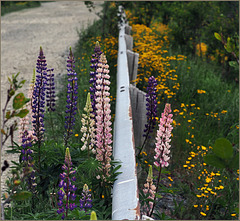
Something will break your fall
| |
|
Along a gravel road we walk from time to time, a bunch of lupins and more of hawkweed.
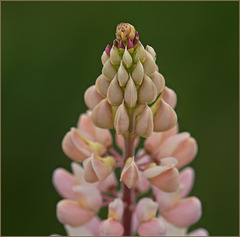
Lupin
| |
|
|
My grandfather-in-law used to plant many flowers in the meadows above his house. Today two roads, a main arterial highway and a gravel access road, cut through what used to be his land. And many flowers still seem to thrive there, along the gravel road.
Like lupins -- hundreds of them, probably the descendants of flowers he planted seventy years ago or more.
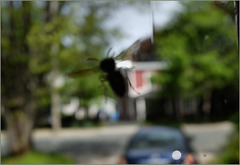
Focus? Why?
| |
|
|
|
I was in my garage, looking out, when I saw a big wasp-like creature on the window, trying to get out. My camera wouldn't focus, but, really, what do I care?

On display
| |
|
|
|
In January 2004, I was walking down the corridor near my office and saw this. Well, what was I supposed to do? I had to take the picture.
Reala film in Rollei 35TE.
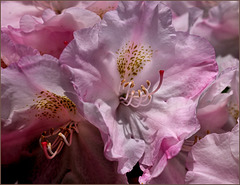
Oneof our rhododendrons
| |
|
|
We have grown rhododendrons in our backyard for forty years and none of the others has been as lush as this one is.
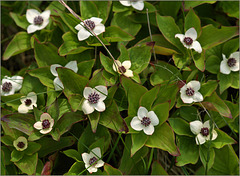
Crackers going crackers
| |
|
|
|
Crackers, or crackerberries, or bunchberries, are part of the dogwood family. They aren't trees; they lie low on the ground, not much more than 12cm or so high. Cornus canadiensis is how they are most unambiguously known. Elsewhere, they have other names too, like creeping dogwood. But hereabouts they are mostly known as crackers: if you chew too hard on their berries, they'll crack your teeth.
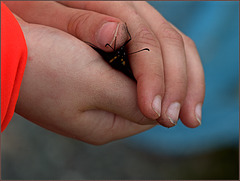
Boy and butterfly
| |
|
|
|
The little boy, about six years old, noticed me taking pictures of butterflies and wanted to show me the one he had just caught, a short-tailed swallowtail.
He did it no apparent harm and a few minutes later, on his mother's advice, he let it go.
It continued to evade my camera.
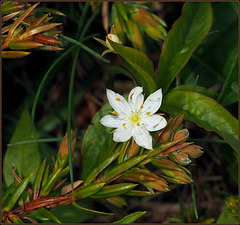
Star flower
| |
|
|
|
We were out walking today, like most people who can, walking where there are few people. Luckily, there are bugs and plants to look at. Like some lovely star flowers.
Potted, not quite forgotten, azalea
| |
|
|
|
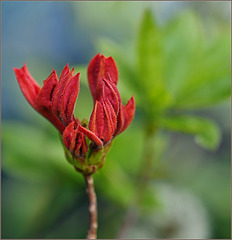
This azalea has been in a pot a decade or more in a corner of the backyard, waiting for me to find a spot to dig a hole for it. Still no sign of that.
But I like its being in a pot anyway, because I can bring it out of its small corner and put it in mine from time to time. Like now, when it's starting to bloom.
--------------
(But, believe me, though I know lots of hymns to quote, there's not a religious bone under my skin.)
And so it goes.
| |
|
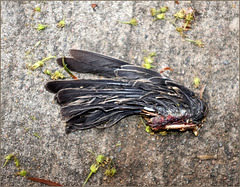
"And so it goes." That's what Kurt Vonnegut wrote every time someone died in his book filled with deaths, Slaughterhouse Five.
Among the leftovers of a maple tree's flowers, and a few needles dropt from a yew, there was this bouquet of junco feathers on the sidewalk in front of our house this evening. Something killed it. Perhaps the same thing pulled it apart, and carried the meatier portion somewhere else, maybe to share with its young. I dunno. But it's all a circle. And that's how it goes.
My moss-and-liverwort garden
Fresh leaves
| |
|
|
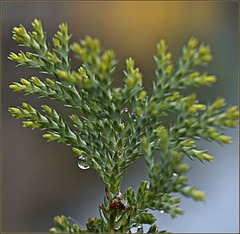
We've had two cedars in pots for three or four years, waiting for the right spot and time to put them in the ground. They are holding up well to the abuse of being pot-bound and this one has about three cm of fresh growth at its top.
Bluejay, grateful
| |
|
|
|
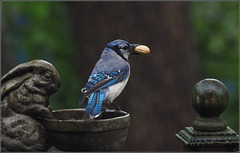
It's been raining for days. That's good for greening up but the bluejays tend to look bedraggled. This one, more tidy than most, came by, called for nuts, and waited in the tree while I put some out. Then he came down and started carting them away.
Maybe he wasn't grateful. Maybe he just takes us for granted.
Dandy Longlegs
| |
|
|
|
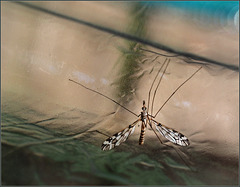
When I was a kid, 60 or 65 years ago, these were called Dandy Longlegs. By the time I reached high-school, I knew that a lot of my friends preferred Daddy Longlegs, and some friends were adamant that the only "real" name was crane fly. For the most part, I gave in.
But I've gone back to calling them Dandy Longlegs. Reclaiming the authenticity of my childhood, like.
This was the first I saw this season. It was inside a plastic tent we overnight plants in. I suspect the higher temperature in there awoke this guy.
My pet pine, my pine apple
| |
|
|
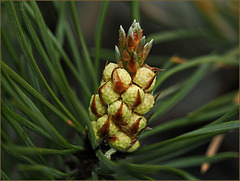
My almost-forty-year-old pet pine is still readying to produce its fruit.
Hundreds of years before Europeans first saw the bromeliad Ananas ("pineapples") in South America, English speakers referred to the young pine conelet, and to the pine cone with its nutty fruit, as "pineapple." What we call pine nuts today are the original pineapple.
The Anana fruit looked so much like the pine conelet that -- at least in English -- it came to be called pineapple.
Holding up against the rains
| |
|
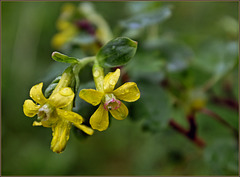
We're in the middle of a couple of days of sustained rain. Between showers, I stepped outside to see how things are doing. The yellow currant is holding up.
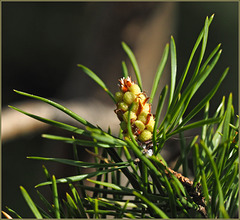
My pet pine
| |
|
I have had this pine growing in a pot, or a series of pots, since the early 1980s. It's only about a metre tall -- short not for lack of thriving, but a result of my keeping it pot-bound.
It is now, in early June, producing its annual crop of conelets, from which in a couple of days clouds of pollen will issue.
