

John FitzGerald's photos
| |
|
|
|
Installation
| |
|
|
|

| |
|
|
|
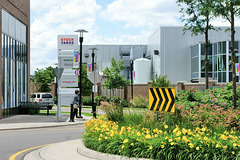
Ceci n'est pas un parc à bestiaux
| |
|
|
|
In fact, there are no stockyards anywhere nearby, and haven't been since 1995. Stock Yards Village opened in 2014.
That is a slaughterhouse in back, though. I suppose Slaughter House Village didn't have a ring to it.
Selfie
| |
|
|
|
Happy Fence Friday
| |
|
|
|
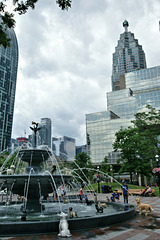
Berczy Park, Toronto
| |
|
|
|
This is a new fountain, part of a renovation of Berczy Park by Claude Cormier + Associés. I haven't found a source that reveals who designed the fountain or the figures of 27 dogs, one cat., and a giant bone. I put a note over the cat, who has been distracted by two sculpted birds on a lamppost.
I didn't have high hopes for the fountain while it was building, but it's quite agreeable now that the water's on.
The chief reason for renovating the park was that many of the trees were dying because of lack of space. Many of the trees are new, but in a few years the park should be shady again.
Berczy Park is named for William Berczy, who was extensively involved in the development of early York (as Toronto was then known). He helped clear and developed the townsite, built 15 miles of Yonge Street, cleared the Rouge River, and founded Markham, Ontario, among other work as an architect and surveyor. He also was a successful painter and writer.
\================
A more recent photo is in the note at top left.

| |
|
|
|
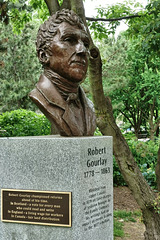
Robert Gourlay
| |
|
|
|
St. James Park, Toronto. The bust is by Adrienne Alison.
The inscription on the right reads:
Robert Gourlay
1778-1863
Banished from Upper Canada in 1819 on false charges of sedition brought by the Family Compact. His writing had an impact on events leading to the 1837 rebellion.
The plaque reads:
Robert Gourlay championed reforms ahead of his time.
In Scotland -- a vote for every man who could read and write.
In England -- a living wage for workers.
In Canada -- fair land distribution.
The Family Compact was a caste established in Upper Canada by Lt.-Gov. John Graves Simcoe with the intent of establishing a Canadian aristocracy. The Rebellion of 1837 was provoked by Lord John Russell, whose Ten Resolutions removed any trace of responsible government in the British North American colonies.
The aristocracy never took root, the rebellion failed (Gourlay didn't support it, by the way), and the British North American colonies started winning responsible government in 1848. Full independence for their federation -- Canada -- came in 1931.
All of this explains, by the way, why Canada is the only one of the former Dominions not to play cricket. Cricket was the game of the Family Compact and the other colonial oligarchies in British North America, so the people played baseball instead.
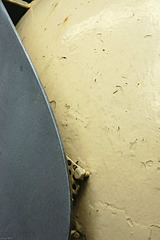
Two solitudes
| |
|
|
|
I believe this is derivative of a print, drawing, or engraving that is related to this quote of Rilke's:
Darin besteht die Liebe: Daß sich zwei Einsame beschützen und berühren und miteinander reden (usually translated into English as "Love consists in this, that two solitudes protect and touch and greet each other"),
I haven't been able to find the print, drawing, engraving, etc., though. If anyone can suggest a possible source I will be grateful.
Canadians often refer to anglophones and francophones* as two solitudes. This usage comes from Hugh MacLennan's novel Two Solitudes . I'm convinced that keeping anglophones and francophones isolated/insulated from each other is a major Canadian industry.
I suggest you click the photo for the big view.
*Canadianspeak for English and French-speakers.
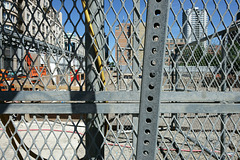
Happy Fence Friday
| |
|
|
|
| |
|
|
|
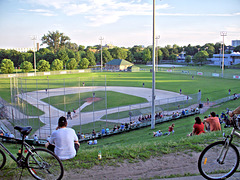
It's the Pits!
| |
|
|
|
Christie Pits, Toronto. Toronto Maple Leafs at home in the Intercounty Baseball League, a sandlot league in Central and Southwestern Ontario. Since 2009, when this game was played, I have lost my notes about who the opponent was. The Leafs are in the field here, and I still remember that they won.
In 1909 the city converted an old sandpit at the corner of Bloor and Christie and called it Willowvale Park. Everybody else called it Christie Pits, though, and in 1983 the city finally gave in and renamed it Christie Pits Park.

| |
|
|
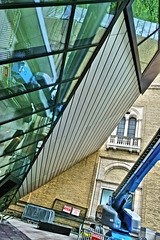
Royal Ontario Museum, Toronto
| |
|
|
|
The older section is by Frank Darling and John A. Pearson (1912). The new section to the left is by Daniel Libeskind (2007).
Not as grainy big.
Happy Fence Friday
| |
|
|
|
| |
|
|
|
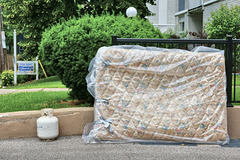
Installation
| |
|
|
|
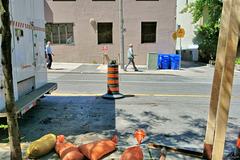
Toronto Engineering and Construction Services (TECS) is an artistic collective that mainly works with land art. By rejecting any subjective conception of truth as well as global cultural narratives, TECS creates intense personal moments masterfully composed by means of rules and omissions, acceptance and refusal, luring the viewer round and round in circles.
TECS’ land art installations are based on formal associations which open a unique poetic vein. Multilayered images arise in which the fragility and instability of our seemingly certain reality is questioned. By applying abstraction, TECS creates, with daily, recognizable elements, an unprecedented situation in which the viewer is confronted with the conditioning of his own perception and has to reconsider his biased position.
TEC’ relentlessly references recognizable form. The results are deconstructed to the extent that meaning is shifted and possible interpretation becomes multifaceted. By choosing mainly formal solutions, TECS tries to develop forms that do follow logical criteria and formal parallels, but which incite the viewer to make new personal associations to this logic and form.
TECS’ work urges us to renegotiate land art as being part of a reactive or – at times – revolutionary medium, commenting on liberating themes in our contemporary society.
[Based on an artist statement generated by 500 Letters ]
