SV1XV's photos
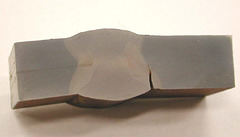
Crack in weld
| |
|
|
A large crack at the toe of a weld.
This work is licensed under a Creative Commons Attribution 4.0 International License .
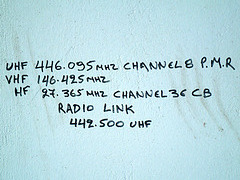
Freebanders in action
| |
|
A small handwritten note on the wall, near the exit of Nomismatokopeio Metro station. Frequencies used by freebanders in the area. (P6080076)

GoogleMaps streetview car
| |
|
|
|
The camera car of Google Maps Street View in our neighborhood, in downtown Athens, Greece.
These guys drive fast, possibly for security reasons, and it is quite difficul to manage a good shot. In this case the Street View car was blocked by a truck and had to stop for a few seconds, so I had my chance. (DSCN0031)
This work is licensed under a Creative Commons Attribution 4.0 International License .

Maybach VL1-12
| |
|
|
2231: Testing a Maybach VL1 12 cylinder diesel engine (1926).
Compression ratio:5.3:1
Power: 400 HP
RPM: 1400
Weight: 2100 lb
W/P: 5.2
Specific fuel consumption: 0.42 lb/ (hp-hr)
Maybach GmbH, founded in 1909, evolved into MTU Friedrichshafen. Today it is part of Rolls-Royce Power Systems AG.
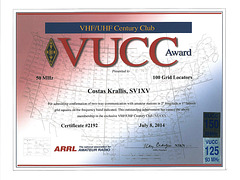
ARRL VUCC-50 MHz
| |
|
|
|
The VUCC (VHF-UHF Century Club) award certificate #2192, endorsed for 150 confirmed locator squares on 50 MHz (6 meters). All QSOs were confirmed via the Logbook of The World (LoTW) .

CQ WPX Mixed (1400 pfx)
| |
|
|
|
CQ WPX MIXED award certificate #2256, with 1400 prefixes, five bands and four continents endorsements.

CQ WPX Digital (900 pfx)
| |
|
|
CQ WPX DIGITAL award certificate #142, with 900 prefixes, 3 continents and five bands endorsements.

CQ WPX CW
| |
|
|
|
CQ WPX CW award certificate #3344, with "Europe" and 500 pfx endorsement.
Read full story in my blog: Patience is rewarded: CQ WPX CW at last !
STC150
| |
|
|
|
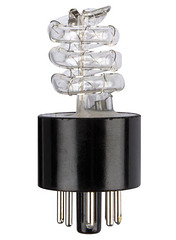
STC150 Xenon flash tube.
See also Flash and strobo tube data in my blog .
For a nice article about Xenon flash tubes see: Understanding Xenon Flash Tube Circuits by Lewis Loflin.
This work is licensed under a Creative Commons Attribution 4.0 International License .

Compact AIS antenna
| |
|
|
Released 15/01/2016 11:10 am
Copyright ESA–G. Porter, CC BY-SA 3.0 IGO
Description
What might look like an abstract artwork is actually a novel antenna, small enough for a minisatellite, to track global ship traffic from orbit.
Commercial vessels are mandated to transmit Automatic Identification System (AIS) signals, which are used to track maritime traffic – the oceangoing equivalent of air traffic control. The system relies on VHF radio signals with a horizontal range of just 40 nautical miles (74 km), useful within coastal zones and on a ship-to-ship basis, but leaving open ocean traffic largely uncovered.
However, in 2010 ESA fitted an experimental antenna to Europe’s Columbus module of the International Space Station, demonstrating for the first time that AIS signals could also be detected from up in orbit, opening up the prospect of global ship tracking from space.
“Based on our testing, this new prototype designs offers a four-fold increase in ship detection performance,” explains ESA antenna specialist Nelson Fonseca, overseeing the project.
“The AIS detection system on Columbus employs a low-gain ‘whip’ antenna, receiving signals within a very broad beam, with corresponding potential for signal overlap and interference.
“This antenna design combines higher-gain with a more reduced footprint, allowing more of a focus on regions of highest interest, and can also discriminate between polarisations, increasing the likelihood of detection for any individual AIS signal within the antenna field of view.”
In addition, clever engineering has shrunk the overall antenna size to a size where up to five could be hosted on a single cubic-metre minisatellite.
“Despite its name, VHF is quite a low wavelength in space terms, implying a bulky antenna of about 1 m across and half-a-metre thick to operate ideally at that frequency,” Nelson adds.
“But the patterned square-shaped structure on the underlying face of our antenna changes the signal behaviour, enabling us to shrink the design to 50 cm width and 3 cm thickness – making it suitable for hosting on a smaller platform.”
The antenna was developed through ESA’s ARTES Advanced Research in Telecommunications Systems – Advanced Technology programme with Italian companies CGS as prime contractor and MVG as subcontractor in charge of the electrical design.
“CGS and MVG are highly interested in moving forward with the optimisation and environmental qualification of this outstanding antenna element,” explains Andrea Di Cintio, managing the project at CGS. “The next step will be to identify a specific mission and then optimise the design and qualification accordingly.”
“Significant reduction of antenna dimensions and weight without compromising electrical performance was challenging,” adds Andrea Giacomini, lead antenna designer at MVG. “It required a radical change in the design and validation approach. We are proud to have been involved.”
(Id 353083)
HF-Fax 20160118 0303
| |
|
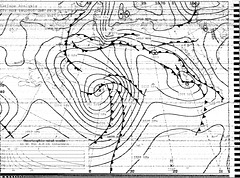
North Atlantic Surface Analysis meteo chart received on 7100 kHz. Possibly transmitted from Northwood, UK.

20151230-Heraklion (ΝΕΡ Α551)
| |
|
Three aspect railway signal "ΝΕΡ A551" at Heraklion suburban railway station. (DSCN0315)

S-band yagi antenna
| |
|
|
A S-band UHF Yagi antenna at "Panepistimio" metro station. (DSCN0316)
This work is licensed under a Creative Commons Attribution 4.0 International License .

San Marino IARU stamp 2002
| |
|
|
A cover with a San Marino commemorative postage stamp of €0.36 for the IARU Region 1 Conference of 2002. Also bearing a rubber stamp of the Amateur Radio Association of San Marino. (Associazione Radioamatori, della Repubblica di San Marino or ARRSM)
LF Marathon
| |
|
|
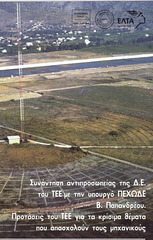
Rare aerial view of the antenna of Hellenic Navy LF transmitter SXV in Marathon (Kato Souli), Greece. The antenna consists of a 250 m tall guyed lattice mast and an extensive ground radial system.
In the background, part of the Olympic Rowing Course is visible. This rowing course was constructed in the exact location of the runway of the former Marathon Airfield for the 2004 Olympic Games.
From Wikipedia: Kato Souli Naval Transmission Facility (Greek: Κέντρο Εκπομπής Κάτω Σουλίου) is a facility used by the Greek Navy for transmitting messages to submarines in the LF-range at Kato Souli near Marathon, Greece. It was commissioned in 1989 and uses as tallest antenna tower a 250-metre-tall guyed mast with umbrella antenna, the tallest structure in Greece. The site has an area of 650 acres. Nearby there was a transmission site of the US Navy with several shortwave transmitters.
20091106-LGTT-Mirach 100
| |
|
|
|
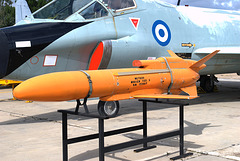
A Meteor Mirach 100 target UAV developed in Italy by Selex. It is powered by a Microturbo TRS-18-1 turbojet. (DSC_2158)
This work is licensed under a Creative Commons Attribution 4.0 International License .
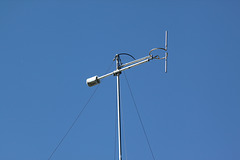
Antenna 94.1 WFHA-LP
| |
|
|
A cycloid broadcast antenna for low-power FM station.
Flickr: Antenna 94.1 WFHA-LP by ajmexico , under a CC-BY license.
Flickr file: www.flickr.com/photos/ajmexico/5149768708
Short URL: flic.kr/p/8R4UPE
This work is licensed under a Creative Commons Attribution 4.0 International License .