

Traktor 49's favorite photos
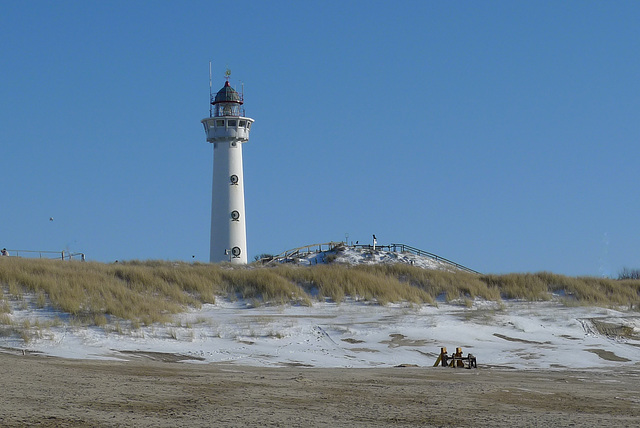

Nederland - Egmond aan Zee, vuurtoren J.C.J. van Speijk
There are still fifteen active lighthouses along the Dutch coast. The vuurtoren J.C.J. van Speijk (J.C.J. van Speijk lighthouse) in Egmond is one of the oldest active lighthouses. The treacherous sea near Egmond necessitated the construction of two lighthouses: a northern and a southern tower. Work started in 1833 and one year later the construction was completed, lightkeepers were appointed and the light was lit.
In IJmuiden - to the south of Egmond - also two lighthouses were built in 1876, after the construction of the North Sea Canal. In order to distinguish between the lighthouses of Egmond and IJmuiden, the lighthouses of Egmond were provided with red windows, which meant that the light emitted had a red colour.
In 1834 the northern tower at Egmond aan Zee was chosen as the J.C.J. van Speijkmonument , in honour of Lieutenant Commander “Jan Carel Josephus van Speijk”, who was a gunboat commander at the time of the Belgian uprising. Van Speijk achieved eternal fame by sacrificing himself and blowing up his boat to prevent it from falling into enemy hands during the Belgian uprising. In addition to Van Speijk, twenty-five other crew members were killed.
The lighthouse was equipped with a rotating light in 1891. The light in the southern tower was deactivated in the same year and finally demolished in 1915. To warn ships of dangerous shallows on the northern side of Egmond, the northern side of the light is red. The light turns white again when the ships are out of the danger zone.
The vuurtoren J.C.J. van Speijk is a national monument and still shines its light over Egmond aan Zee and the North Sea every evening. It is built of brick and subsequently plastered in white. The tower has a height of 28 meters; the focal height is 37 meters. The range of the white light is 18 nautical miles and for the red one 14 nautical miles.
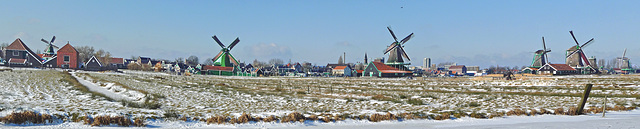
Nederland - Zaanse Schans
The Zaanse Schans is a residential neighbourhood in which the 18th and 19th centuries are brought to life. It is best known for its collection of well-preserved historic houses and windmills . The Zaanse Schans is a unique and one of the most visited places in the Netherlands, with green wooden houses, windmills, barns and typical Dutch crafts.
From 1961 to 1974 old buildings from all over the Zaanstreek were relocated using lowboy trailers to the area. Zaanse Schans derived its name from the river Zaan and its original function as sconce (schans in Dutch) against the Spanish troops during the Eighty Years' War.
Main image: panorama of some of the windmills
PiP1: De Huisman, a spice mill
PiP2: De Gekroonde Poelenburg, a saw mill
PiP3: De Kat, a paint mill
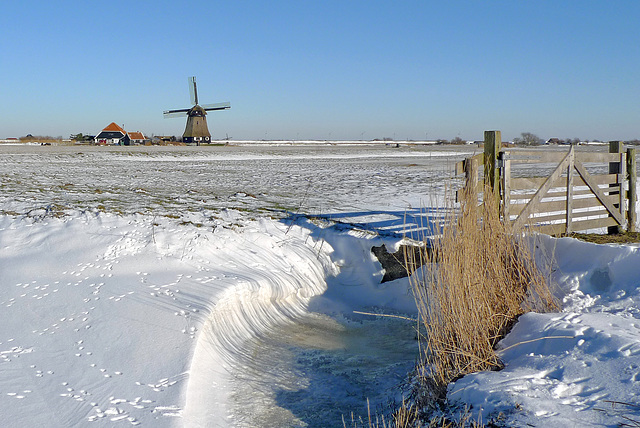
Nederland - Camperduin, Hargermolen
The Hargermolen (Harger Mill) is a polder drainage mill, which was built in 1804. The current mill replaced an earlier mill, which was destroyed during fighting between an Anglo-Russian army and the then French rulers of the Netherlands. This area has been home to a windmill since the early 15th century, but where the original mill was destroyed, the current structure has survived the ravages of storms and fire.
The reed-covered octagonal Hargermolen was used to drain the Harger- en Pettemerpolder . Until 1962 the mill was solely operated by wind. In that year a diesel engine was added. Nowadays the mill is still suitable for drainage the polder and is working on an occasional basis, manned by a volunteer.
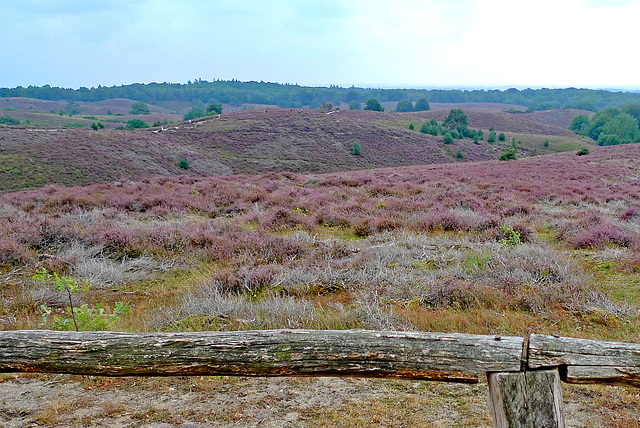
Nederland - Nationaal Park Veluwezoom, Posbank
Nationaal Park Veluwezoom (Veluwezoom National Park) is the oldest national park of the Netherlands. It has a surface area of 50 square kilometers at the southeastern edge of the Veluwe, a complex of terminal push moraines, dating back to the Saalian glaciation (150.000 years ago). For the Netherlands the park has a pronounced relief with the highest point in the park at (almost) 110 meters above sea level.
The landscape of the park - formed during the two most recent glacial periods - consists of forests, heathland and a small sand drift. The park has a large amount of heathlands. Especially the area around the Posbank - a 90 meters high hill - is one of the most popular destinations when the heather is blooming. From the top of the hill one has astounding views over the area.
The Vereniging Natuurmonumenten (Society for Preservation of Nature Monuments in the Netherlands) bought the first piece of the Veluwezoom in 1911. Since then it has acquired more areas. In 1930 it became the first national park in the Netherlands. The park is freely accessible.
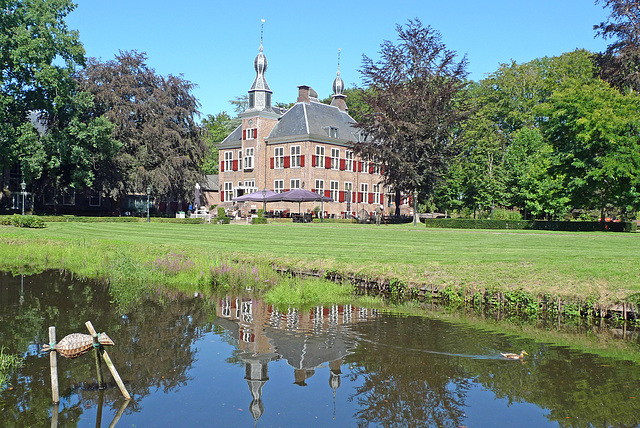
Nederland - Hierden, Kasteel De Essenburgh
In 1639 Johan Coolwagen bought part of an estate along the Hierdense Beek . In 1652, his son Maarten built a country house on this land called De Essenburg , probably named after the essen , which means farmland. The estate remained in the possession of this family until 1688.
In 1721 the estate experienced a golden age when it came into the hands of Mr Antony van Westervelt, a large landowner and mayor of Harderwijk, a city nearby the castle. He enlarges the house and turned the surroundings into a park, inspired by the gardens of the Louvre. The estate subsequently had various owners, until it was bought by the Norbertines in 1950 to establish a monastery. They still use a part of the buildings.
Today, Kasteel de Essenburgh - a national monument - houses a hotel and restaurant.
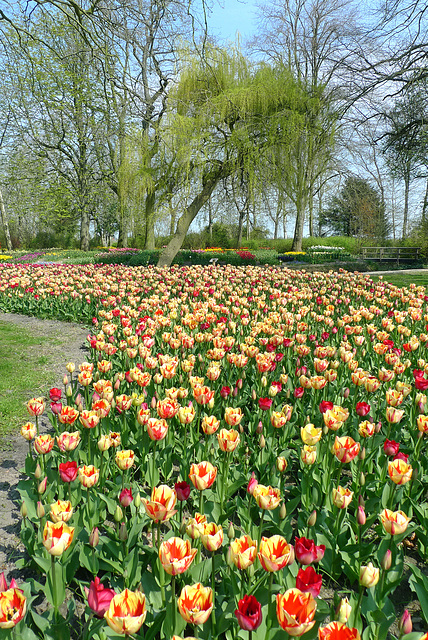
Nederland - Anna Paulowna, Poldertuin
After the construction of the Anna Paulownapolder an office of the water board was built. This stately home is locally known as Polderhuis . In 1885 the Poldertuin (Polder Garden) around the house was designed by landscape architect Jan David Zocher jr., who also designed the well known Vondelpark in Amsterdam and the garden of Soestdijk Palace. His gardens are characterized by winding paths and water features with bridges.
Polderhuis (nowadays privately owned) and Poldertuin were sold to the municipality. The garden is still owned by the municipality of Hollands Kroon, but since 2014 it is managed by a foundation. In autumn volunteers plant 220.000 flower bulbs, which are blooming between early April and mid May. The flower bulbs are donated by about hundred flower bulb growers in the region.
The Poldertuin with its large variety of springtime flowers like tulips, daffodils, hyacinths and special bulbs and tubers is also called ‘Little Keukenhof’ and can be visited free of charge. The garden is a real hidden gem in the Kop van Noord-Holland and not very known to tourists.
Jump to top
RSS feed- Latest favorites - Subscribe to the favorite docs of Traktor 49
- ipernity © 2007-2026
- Help & Contact
|
Club news
|
About ipernity
|
History |
ipernity Club & Prices |
Guide of good conduct
Donate | Group guidelines | Privacy policy | Terms of use | Statutes | In memoria -
Facebook
X
