


Bhutan

A visit to the kingdom of Bhutan in 2011
Our route:
Swissair to Delhi, Jet Airways to Guwahati, road transfer through Assam to Samdrup Jongkhar.
We traveled the whole length of Bhutan from East to West: Trashigang, Trashiyangtse, Rangjung, Mongar, Bumthang, Trongsa, Gangtey, Punakha, Thimphu, Paro.
Drukair to Delhi, Swissair back home.
Our route:
Swissair to Delhi, Jet Airways to Guwahati, road transfer through Assam to Samdrup Jongkhar.
We traveled the whole length of Bhutan from East to West: Trashigang, Trashiyangtse, Rangjung, Mongar, Bumthang, Trongsa, Gangtey, Punakha, Thimphu, Paro.
Drukair to Delhi, Swissair back home.
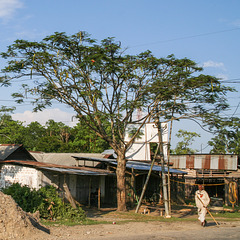
Rural Assam
| |
|
|
|
On the road from Guwahati to Darranga and the Bhutanese border. Our cars needed a break to cool off;-)

Bodo boy
| |
|
|
|
SC 184- portrait
We met these kids in Assam very near the border to Bhutan.
The Bodo/Boro are tibeto-burmese and have long fought for autonomy. Because of the conflict the border to Bhutan had been closed for years and after it opened again tourists could only travel with a military escort. When we were there these restrictions had ended and since 2020 the Bodo/Boro now have partial autonomy and their own territorial region "Bodoland".
en.wikipedia.org/wiki/Bodoland_Territorial_Region
The older girl in the note obviously is not Bodo but probably of Nepalese origin.
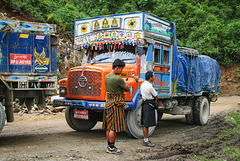
Tata trucks
| |
|
|
|
Road block on the lateral road between Samdrup Jongkhar and Trashigang. After the end of the monsoon season there were still a few landslides to clear away and all vehicles had to wait until the Dantak road crews opened up to let them through. Bhutanese paint their Tata trucks with all sorts of auspicious signs- for a safe journey:-)
Strassensperrung auf der "Hauptstrasse" zwischen Samdrup Jongkhar und Trashigang. Nach dem Ende des Monsuns gab es noch einige Erdrutsche zu beseitigen und alle Fahrzeuge mussten warten, bis die Strassenbau-Crews von Dantak sie durchliessen. Bhutaner bemalen ihre Tata-Lastwagen mit allen möglichen glücksbringenden buddhistischen Symbolen- für eine sichere Reise:-)
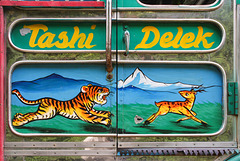
Tashi Delek- Blessings and good luck!
| |
|
|
|
Tibetan greeting, also translates as "May all auspicious signs come to this environment"
Painting on a Tata truck
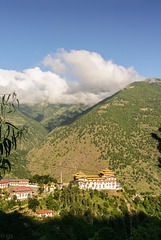
Trashigang Dzong
| |
|
|
|
Trashigang Dzong sits on a mountain spur overlooking the confluence of Drangme Chhu and Gamri Chhu rivers. Built by Mingyur Tenpa in the mid 17th century Eastern Bhutan has been governed from this dzong from the late 17th to the early 20th century. It is unique in that it has only a single courtyard (dochey) which is shared by the administrative and monastic bodies (usually they have their own courtyards).
In the September 2009 earthquake with the epicentre only 10 km away the dzong was badly damaged. It has subsequently been strengthened and repaired.
www.wmf.org/project/trashigang-dzong
Trashigang kids
| |
|
|
|
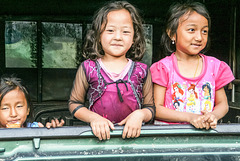
These girls were enjoying themselves in the back of a small van parked in the main square in Trashigang while the grown ups were doing some shopping.
Gom Kora
| |
|
|
|
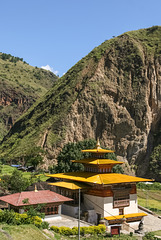
Gom Kora, a sacred meditation site of Guru Rinpoche (Padmasambhava), is a monastery in the valley of Drangme Chhu river (called Manas river once it crosses into Assam).
www.lonelyplanet.com/bhutan/gom-kora
Chorten Kora
| |
|
|
|
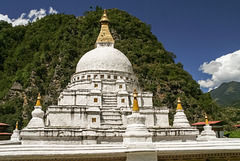
Chorten Kora was built in 1740 by Lama Ngawang Loday. It was modelled after Bodnath stupa in Kathmandu to save people in the far east of Bhutan the long pilgrimage to Nepal.
Chorten Kora is an important place not only to eastern Bhutanese (Sharchop) but also to the Dakpa of neighbouring Himachal Pradesh.
Kora
| |
|
|
|
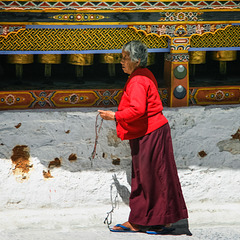
A nun at Trashyangtse's Chorten Kora turning prayer wheels and walking the kora. Kora is the ritual circumambulation round a stupa (tib. chorten) or other holy places. The kora is done clockwise by all Buddhists except members of the old Bon religion who walk anti clockwise. en.wikipedia.org/wiki/Kora_(pilgrimage)
Eine Nonne am Chorten Kora in Trashiyangtse dreht Gebetsmühlen und geht die Kora. Eine Kora ist die rituelle Umrundung eines Chörten ( sanskrit: Stupa ) oder anderer heiliger Stätten, die von Buddhisten im Uhrzeigersinn gegangen wird. EInzige Ausnahme sind die Angehörigen der alten Bön-Religion, die im Gegenzeigersinn laufen.
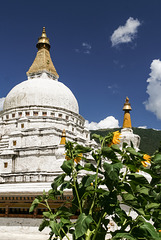
Chorten Kora
| |
|
|
|
Another take of Chorten Kora in Trashiyangtse. This district is in the northeast of Bhutan, bordered by Himachal Pradesh to the east and Tibet to the north. The road ends shortly after Trashiyangtse town, further north is the large Bumdeling Wildlife sanctuary.
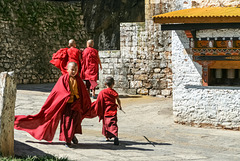
Novice monks at Gom Kora
| |
|
|
|
Novice monks hurrying to the temple to celebrate a puja for the King's forthcoming marriage. As the ceremony is rather repetitive some of the young ones fell asleep which resulted in lots of giggles from the others.
Gom Kora
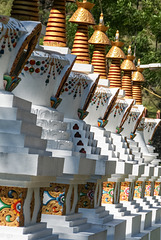
Eight chortens
| |
|
|
|
A row of 8 different chortens (Dewa Shedpai Chorten Gyed) can be seen at many temples- they symbolize the eight major events in the life of the Buddha. These chortens are at Gom Kora, the inset photo is from Ranjung, a newly built monastery in Trashigang district.

Rangjung Woesel Choling Dratshang
| |
|
|
|
Rangjung Woesel Choling is a new Nyingma monastery founded in 1989. The wall paintings in traditional style depict the eight manifestations of Padmasambhava.
SItuated in Rangjung town in the far East of Bhutan, this was the only monastery on our trip that allowed photography inside (The reason photography usually is forbidden has a lot to do with art theft).
Altar with statues of Padmasambhava (Guru Rinpoche) in the centre, flanked by Tibetan king Trisong Detsen and philosopher Shantarakshita, who in the 8th century together with Padmasambhava founded Samye, the first Tibetan monastery.
Dungchen- Tibetan trumpets that make a deep sound, widely used in Buddhist ceremonies
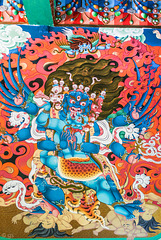
Vajrakilaya
| |
|
|
|
SC90: Unusually blue item
A wall painting at Rangjung Woesel Choling Dratshang.
en.wikipedia.org/wiki/Vajrakilaya
Buddhist deities take on various shapes, in their wrathful manifestation as protectors of faith they usually have blue bodies and three eyes (and sometimes multiple heads, legs and arms)
Other examples:
Part of a Zangdogpalri (Guru Rinpoche's "paradise") painting at Trongsa Dzong- the sinners must stay outside- very similar to Christian hell;-)
Protective deity (Vajrapani) guarding the entrance at Tamshing Lhakang
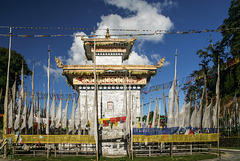
Kori La
| |
|
|
|
Kori La (ca. 2400m) is a pass in Eastern Bhutan between Trashigang and Mongar. The pass is marked by a Bhutanese style chorten and masses of prayer flags.
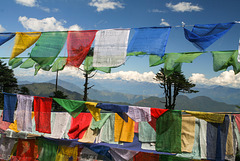
Thrumshing La
| |
|
|
|
Thrumshing La (3780m) is Bhutan's second highest mountain pass.
Connecting Mongar in the east to central Bumthang district, the lateral road climbs more than 3000m and has to navigate the most notorious stretch of road in the country at Namling Brak (Namling cliffs).
There the narrow road clings to the cliffside with a 300m sheer drop and no roadside protection to speak of except a few prayer flags above the waterfall. Every Bhutanese remembers the full bus that crashed down the cliff years ago...
No wonder Thrumshing La is covered in masses of prayer flags as everyone wants to say thank you for getting through safely. The incense burner is also well used.
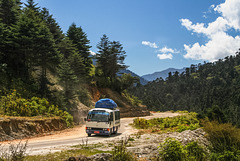
Vomit comet
| |
|
|
|
The public bus from Bumthang to Mongar climbing towards Thrumshing La mountain pass (3780m).
The locals named the buses vomit comet because of the incessant curves that make many passengers sick.
Thankfully the long distance between the valleys ensures that vehicles usually don't meet at the most critical stretch of road: Namling Brak, where the road crosses a rock wall with a sheer 300m drop.
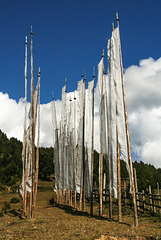
Lungdhar
| |
|
|
|
Lungdhar (Wind-Fahnen) in Ura-Tal, Bumthang.
Diese hohen Gebetsfahnen stehen an Bergflanken oder Höhenrücken. Sie werden für einzelne Personen errichtet und sollen Glück, Schutz etc. bringen. Sie sind mit dem Windpferd (lungta) und individuellen Texten, Name und Alter des Auftraggebers bedruckt. Das Aufstellen ist eine größere Zeremonie, für die zuvor ein Astrologe befragt wird.
Lungdhar (wind flags) in Ura Valley, Bumthang.
These tall prayer flags can be seen on hillsides and ridges. They are erected for specific persons to give good luck, protection etc and are printed with the lungta (wind horse),individual texts, name and age of the person. Putting them up involves astrologers and lots of ceremony.
HFF, folks, and may the flags bring continued good health to you!
Jump to top
RSS feed- Latest items - Subscribe to the latest items added to this album
- ipernity © 2007-2026
- Help & Contact
|
Club news
|
About ipernity
|
History |
ipernity Club & Prices |
Guide of good conduct
Donate | Group guidelines | Privacy policy | Terms of use | Statutes | In memoria -
Facebook
X
