


Languedoc-Roussillon - North

All photos were taken in the northern part of the Languedoc-Roussillon in France, in the departments Gard (30), Hérault (34) and Lozère (48). And yes, when I visited places a second or third time - I continued taking photos, so some of them may look like twins.
Since 2015 Languedoc-Roussillon et Midi-Pyrénées form the region "Occitanie".
Since 2015 Languedoc-Roussillon et Midi-Pyrénées form the region "Occitanie".
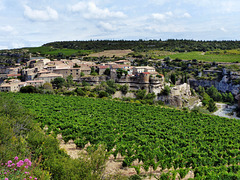
Minerve
| |
|
|
|
Not much had changed since my last visit here, only that a really large parking lot had been created. Minerve, already settled in Roman times ("Minerva"), has been the capital of the Minervois wine region. Vineyards surround the small village, that is known as one of the last strongholds of the Cathars, after the Massacre of Beziers.
In 1210 the village was besieged by the troops, led by infamous Simon de Montfort. After being cut off the water supply, Guilhem of Minerve, commander of the 200-strong garrison gave in and 140 Cathars, who refused to give up their faith, were burned to death at the stake.
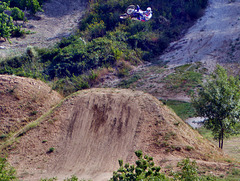
Minerve - Freestyle Motocross
| |
|
I had seen these "Magnificent Men and Their Flying Machines" doing "Freestyle Motocross" on TV. A spectacular indoor sports for professional riders. I never asked myself how these young daredevils train the tricks they perform. When I left Minerve, I passed a FMX training ground and could watch them doing incredible stunts.

Minerve - Freestyle Motocross
| |
|
I had seen these "Magnificent Men and Their Flying Machines" doing "Freestyle Motocross" on TV. A spectacular indoor sports for professional riders. I never asked myself how these young daredevils train the tricks they perform. When I left Minerve, I passed a FMX training ground and could watch them doing incredible stunts.
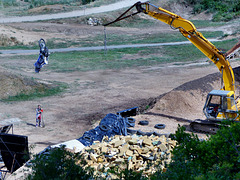
Minerve - Freestyle Motocross
| |
|
I had seen these "Magnificent Men and Their Flying Machines" doing "Freestyle Motocross" on TV. A spectacular indoor sports for professional riders. I never asked myself how these young daredevils train the tricks they perform. Near to Minerve, I passed a FMX training ground and could watch them doing incredible jumps.
Even more spectacular stunts were tried here. Next to the landing pit, filled with foam blocks, stands a crane, ready to lift driver and motorbike out of the pit.
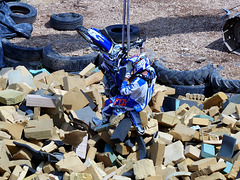
Minerve - Freestyle Motocross
| |
|
I had seen these "Magnificent Men and Their Flying Machines" doing "Freestyle Motocross" on TV. A spectacular indoor sports for professional riders. I never asked myself how these young daredevils train the tricks they perform. Near to Minerve, I passed a FMX training ground and could watch them doing incredible jumps.
Even more spectacular stunts were done into a landing pit, filled with foam blocks. Next to the pit stands a crane, to lift driver and motorbike out of the pit. "Beam me up, Scotty!"
Pont du Gard
| |
|
|
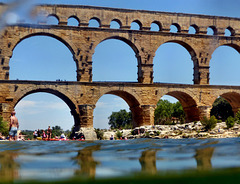
Pont du Gard is a Roman aqueduct that crosses the Gardon River. It is one of the best preserved aqueducts and part of the Nîmes aqueduct, a 50-kilometre system built in the first century AD to carry water from a spring at Uzès to Nîmes, a Roman colony named Nemausus.
After the Roman Empire collapsed, the aqueduct fell into disuse. The Pont du Gard remained largely intact, due to the importance of its secondary function. It was used as a toll bridge, so for centuries the local lords and bishops were responsible for its upkeep.
Starting in the 18th century the Pont du Gard became a tourist destination. Today it is one of France's most popular tourist attractions with about 1.4 million visitors per year, who all take photos...
After I had swum through the Pont d'Arc the day before, I decided to do that again here - and it is possible. Easy!
Pont du Gard
| |
|
|
|
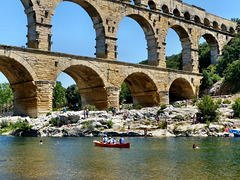
Pont du Gard is a Roman aqueduct that crosses the Gardon River. It is one of the best preserved aqueducts and part of the Nîmes aqueduct, a 50-kilometre system built in the first century AD to carry water from a spring at Uzès to Nîmes, a Roman colony named Nemausus.
After the Roman Empire collapsed, the aqueduct fell into disuse. The Pont du Gard remained largely intact, due to the importance of its secondary function. It was used as a toll bridge, so for centuries the local lords and bishops were responsible for its upkeep.
Starting in the 18th century the Pont du Gard became a tourist destination. Today it is one of France's most popular tourist attractions with about 1.4 million visitors per year, who all take photos...
After I had swum through the Pont d'Arc the day before, I decided to do that again here - and it is possible. Easy!
Pont du Gard
| |
|
Pont du Gard is a Roman aqueduct that crosses the Gardon River. It is one of the best preserved aqueducts and part of the Nîmes aqueduct, a 50-kilometre system built in the first century AD to carry water from a spring at Uzès to Nîmes, a Roman colony named Nemausus.
After the Roman Empire collapsed, the aqueduct fell into disuse. The Pont du Gard remained largely intact, due to the importance of its secondary function. It was used as a toll bridge, so for centuries the local lords and bishops were responsible for its upkeep.
Starting in the 18th century the Pont du Gard became a tourist destination. Today it is one of France's most popular tourist attractions with about 1.4 million visitors per year, who all take photos...
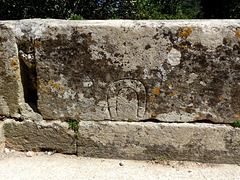
For centuries, Pont du Gard was a huge, unattended structure, so it is no surprise, that it is covered by graffiti. Most date from the 19th century, when tourists came here, and "left" names and dates. This "horseshoe" may be older, as this kind of graffiti was in medieval times often carved in by pilgrims.
Pont du Gard
| |
|
Pont du Gard is a Roman aqueduct that crosses the Gardon River. It is one of the best preserved aqueducts and part of the Nîmes aqueduct, a 50-kilometre system built in the first century AD to carry water from a spring at Uzès to Nîmes, a Roman colony named Nemausus.
After the Roman Empire collapsed, the aqueduct fell into disuse. The Pont du Gard remained largely intact, due to the importance of its secondary function. It was used as a toll bridge, so for centuries the local lords and bishops were responsible for its upkeep.
Starting in the 18th century the Pont du Gard became a tourist destination. Today it is one of France's most popular tourist attractions with about 1.4 million visitors per year, who all take photos...
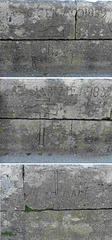
For centuries, Pont du Gard was a huge, unattended structure, so it is no surprise, that it is covered by graffiti. Most date from the 19th century, when tourists came here, and "left" names and dates. Here are three, that may have been carved by travelling smiths or roofers, as both guilds used a hammer as their symbol.
In medieval times the "journeymen" had to travel - and learn for years, before they were allowed to settle down. Some such guilds still exist.
"Die Freien Vogtländer" is a German guild
www.freie-vogtlaender.eu/de/
This guild is a member of the
"Conféderation Compagnonnages Europäische Gesellenzünfte"
cceg.eu/?lang=en
Pont du Gard
| |
|
Pont du Gard is a Roman aqueduct that crosses the Gardon River. It is one of the best preserved aqueducts and part of the Nîmes aqueduct, a 50-kilometre system built in the first century AD to carry water from a spring t Uzès to Nîmes, a Roman colony named Nemausus.
After the Roman Empire collapsed, the aqueduct fell into disuse. The Pont du Gard remained largely intact, due to the importance of its secondary function. It was used as a toll bridge, so for centuries the local lords and bishops were responsible for its upkeep.
Starting in the 18th century the Pont du Gard became a tourist destination. Today it is one of France's most popular tourist attractions with about 1.4 million visitors per year, who all take photos...
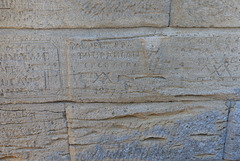
For centuries, Pont du Gard was a huge, unattended structure, so it is no surprise, that it is covered by graffiti. Most date from the 19th century, when tourists came here, and "left" names and dates.
More guild-symbols (maybe!), just like the three hammers (previous upload), here is another hammer (left). In the center is a hammer and two compasses. "Hammer and compass" was the guild symbol of bricklayers. It could as well be a Masonic symbol. The graffito is too old to stand for the national emblem of "East Germany" (GDR).
In medieval times the "journeymen" had to travel - and learn for years, before they were allowed to settle down. Some such guilds still exist.
"Die Freien Vogtländer" is a German guild
www.freie-vogtlaender.eu/de/
This guild is a member of the
"Conféderation Compagnonnages Europäische Gesellenzünfte"
cceg.eu/?lang=en
Saint-Jean-de-Fos - Saint-Géniès de Litenis
| |
|
|
|
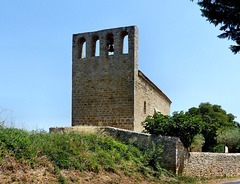
The chapel "Saint-Géniès de Litenis" is located south of Saint-Jean-de-Fos. Today very isolated it was once the center of a settlement near a ford of the river Herault. In 804 the place was given by Charlemagne to his cousin Guillaume de Gellone (Saint Guilhem) . The church of today was erected within the 11th century on a spot, where a paleochristian sanctuary had been.
As the settlement around the church got abandoned, the unattended church crumbled and after the French Revolution it was sold as a quarry. So half of the nave and the apse got demolished. The reconstruction started end of the 19th century.
Unfortunately the chapel was locked.
Saint-Jean-de-Fos - Saint-Géniès de Litenis
| |
|
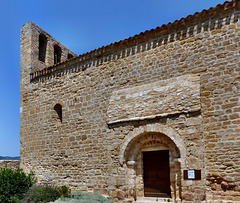
The chapel "Saint-Géniès de Litenis" is located south of Saint-Jean-de-Fos. Today very isolated it was once the center of a settlement near a ford of the river Herault. In 804 the place was given by Charlemagne to his cousin Guillaume de Gellone (Saint Guilhem) . The church of today was erected within the 11th century on a spot, where a paleochristian sanctuary had been.
As the settlement around the church got abandoned, the unattended church crumbled and after the French Revolution it was sold as a quarry. So half of the nave and the apse got demolished. The reconstruction started end of the 19th century.
Unfortunately the chapel was locked.
Saint-Jean-de-Fos - Saint-Géniès de Litenis
| |
|
|
|
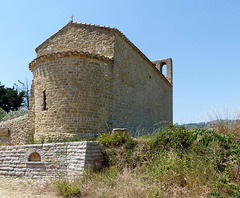
The chapel "Saint-Géniès de Litenis" is located south of Saint-Jean-de-Fos. Today very isolated it was once the center of a settlement near a ford of the river Herault. In 804 the place was given by Charlemagne to his cousin Guillaume de Gellone (Saint Guilhem) . The church of today was erected within the 11th century on a spot, where a paleochristian sanctuary had been.
As the settlement around the church got abandoned, the unattended church crumbled and after the French Revolution it was sold as a quarry. So half of the nave and the apse got demolished. The reconstruction started end of the 19th century.
Unfortunately the chapel was locked.
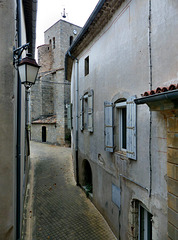
Saint-Saturnin-de-Lucian - Saint-Sernin
| |
|
|
Looking out of the window of our bedroom at 9 o'clock in the morning in Saint-Saturnin-de-Lucian. About 300 people live in this very quiet village.
www.le-mimosa.com/EN/index.html
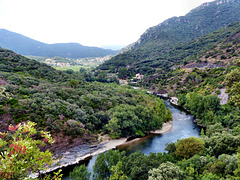
The valley of the Orb
| |
|
|
|
The valley of the Orb river. Seen in the backdrop is the village Vieussan. The area is part of the "Parc naturel régional du Haut-Languedoc".
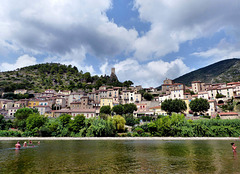
Roquebrun
| |
|
|
A donjon, dating back to Carolingian times, towers over Roquebrun, that has a nice panorama. The Orb river is a public swimming pool.
Jump to top
RSS feed- Latest items - Subscribe to the latest items added to this album
- ipernity © 2007-2026
- Help & Contact
|
Club news
|
About ipernity
|
History |
ipernity Club & Prices |
Guide of good conduct
Donate | Group guidelines | Privacy policy | Terms of use | Statutes | In memoria -
Facebook
X
