


Languedoc-Roussillon - North

All photos were taken in the northern part of the Languedoc-Roussillon in France, in the departments Gard (30), Hérault (34) and Lozère (48). And yes, when I visited places a second or third time - I continued taking photos, so some of them may look like twins.
Since 2015 Languedoc-Roussillon et Midi-Pyrénées form the region "Occitanie".
Since 2015 Languedoc-Roussillon et Midi-Pyrénées form the region "Occitanie".
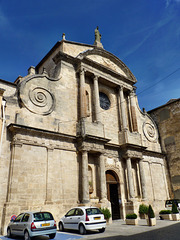
Aniane - Abbey Church Saint-Sauveur
| |
|
The 17th century baroque facade of the former abbey church in Aniane does not look spectacular.
The spectacluar is the place. Benedict of Aniane founded a "reform-monastry" here. He had sucess, gained influence and founded and reformed a number of monasteries. 817 he headed a council of abbots at Aix-la-Chapelle (Aachen), creating a "Codex regularum" binding on all abbey within the Carolingian Empire. Charlemagnes´ son "Louis the Pious", his friend and patron built Marmoutier (Maursmünster) Abbey for Benedict in Alsace, that is where we "met" him earlier this year. Benedict died at Kornelimünster, a monastery next to Aix-la-Chapelle (Aachen) in 821. He reformed the order, Benedict of Nursia had created around 530, and so gave it a base for the influence it had over the next centuries.
The old monastry was totally destroyed during the War of Relgions, rebuilt in the 17th century and "remodeled" into a prison after the French Revolution, but at least the place is still the same.
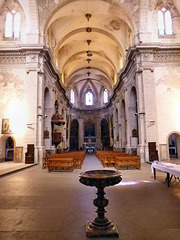
Aniane - Abbey Church Saint-Sauveur
| |
|
The light-flooded nave of the 17th century baroque church, built where around 780 Benedict of Aniane founded a "reform-monastry".
Benedict had sucess, gained influence and founded and reformed a number of monasteries. 817 he headed a council of abbots at Aix-la-Chapelle (Aachen), creating a "Codex regularum" binding on all abbey within the Carolingian Empire. Charlemagnes´son "Louis the Pious", his friend and patron built Marmoutier (Maursmünster) Abbey for Benedict in Alsace, that is where we "met" him earlier this year. Benedict died at Kornelimuenster, a monastery next to Aix-la-Chapelle (Aachen) in 821. He reformed the order, Benedict of Nursia had created around 530, and so gave it a base for the infuencve it had over the next centuries.
The old monastry was destroyed during the Wars of Relgions, rebuilt in the 17th century and "remodeled" into a prison after the French Revolution, but at least the place is still the same.
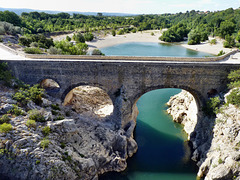
Saint-Jean-de-Fos - Pont du Diable
| |
|
The distance between the abbey in Aniane and the abbey in Saint-Guilhem-le-Désert may only be about 8kms, but you have to cross the Hérault river. So this bridge was constructed probably in the first half the 11th century, making this bridge to one of the oldest medieval bridges in France. It is an architectural masterpiece, and -not surprisingly- a legend grew, that this could only be done with the support of the devil. This bridge, that was in "full use" upto a new bridge was built in 1932, shares this legend with many other devil´s - bridges worldwide.
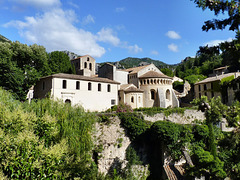
Saint-Guilhem-le-Désert - Abbey
| |
|
The "Abbey of Gellone" in Saint-Guilhem-le-Désert was founded 806 by Saint William of Gellone, known in France as Guillaume d'Aquitaine or Guillaume au Court Nez (William Short Nose).
William, born 754 in Autun was a grandson of Charles Martel, and so a cousin of Charlemagne, who made him his paladin. As a commander William took part in numerous wars and battles against the Maurs in Spain and Southern France and from 790 on, he was "Count of Toulouse" and "Duke of Aquitaine". 804, he withdrew from "public life" and joined the monastry, Bernard of Aniane had founded in Aniane. Two years later, he left Aniane and founded with Bernard´s support the Abbey of Gellone in what is the village of Saint-Guilhem-le-Désert today.
Charlemagne presented his cousin a piece of the True Cross for the Abbey of Gellone. William died in 812. His tomb and the piece of the True Cross, shown in the abbey, made this place to a major stop for the pilgrims on their way to Santiago de Compostella.
Saint-Guilhem-le-Désert - Abbey
| |
|
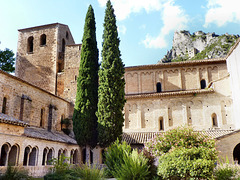
The cloister of the abbey - or maybe better, what is left of it.
At the end of the medieval times, the community was not in a really good shape. In 1569, during the wars of religion, protestant troops pillaged the abbey, that later was the property of the "Congregation of St. Maur". 1789, during the French Revolution, only six monks lived here. They had to leave, as the buildings were sold as national property. The church became parish church at that time. Small enterprises moved in, most of the buildings were used as a quarry. Half of the cloister "vanished", only two sides are still there. A citizen of Aniane bought the carved capitals of the cloister for his garden. When he died, his son sold them to an art-dealer in Paris. In the end, most of these carvings were sold to New York, where John D. Rockefeller II., bought them in 1905 for some 60.000$, forming with them (and others) "The Cloisters", now a branch the Metropolitan Museum of Art. So if you want to see the original medieval capitals from this cloister - fly to New York.
Here are the details:
www.metmuseum.org/Works_Of_Art/department.asp?dep=7
Meanwhile a small collection of artwork found later in and around the abbey, including the tomb of St. Guilhelm, are in a little "lapidarium" next to this cloister.
Aniane - Accent Sud
| |
|
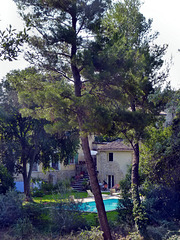
As we had met friends, we needed a little more room over the first days, so we chose a chambres d'hôtes in Aniane. I had crossed the small town, known since Saint Benedict of Aniane, last year, heading to Saint-Guilhem-le-Désert. The stay in "Accent Sud" was very enjoyable, there was even
a pool. Merci beaucoup, Robert!
www.accentsud.com/
Saint-Jean-de-Fos - Rue de Caminol
| |
|
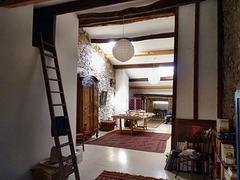
... stayed at Mr. et Mme du Boullay´s wonderful chambre d'hôtes. Merci beaucoup, Jaqueline!
We really recommend that place. For an excellent dinner try "Le Zanzibar" on the central square...
Here are the details:
www.saintguilhem-valleeherault.fr/1-15158-Details-d-un-ac...
Saint-Jean-de-Fos - Gorge de Hérault
| |
|
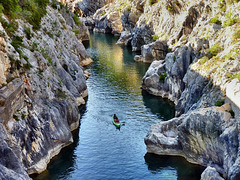
The Hérault river forms a narrow gorge. Very romantic. The trail runs next to the road to Saint-Guilhem-le-Désert. This photo is taken from the bridge over the river on an early evening. From here to St. Guilhem is just about an hour walk.
Saint-Guilhem-le-Désert - Abbey
| |
|
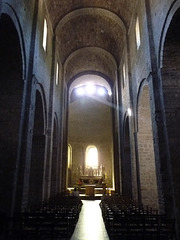
A sunbeam crossing the nave of the abbey-church in the arly monring. A pure and sober structure. A
barrel-vaulted central nave, two aisles, a transept, a main and two side apses. Below the choir is a crypt from the 12th century, that for centuries was filled and forgotten.
Approaching Saint-Gervais-sur-Mare
| |
|
|
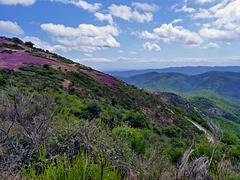
Back to brilliant weather! Within a few days, the landscape had changed. From Saint-Guilhem-le-Désert to Lodeve the chemin crossed the garrigue, a kind of semi desert. Now the mountain ranges were densely forested. The highest point that day was the Mont de Troi Terres (944m). For the next 50kms the chemin would pass through the "Parc naturel régional du Haut-Languedoc". It was pretty windy that day. We passed Mecle and approaching Saint-Gervais-sur-Mare we saw "wuthering heights" with the typical heather.
www.parc-haut-languedoc.fr/
Saint-Guilhem-le-Désert - Abbey
| |
|
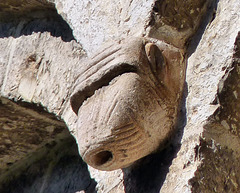
The carved head of a monkey - or maybe an ape. The carving are is different in style and material from the surrounding capitals. I could not find out, how much "restaurantion" was done here in the late 19th century. This carving seems to be much older. It may - like some others - originate from an older structure - and reused here.
Soumont
| |
|
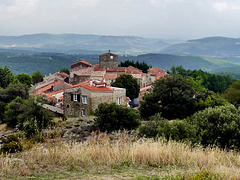
Approaching Lodeve, I passed the hamlet of Soumont. I took a rest on a nearby hill. Bushfires can be devasting in the garrigue-area and as this was a spot for a a fire lookout, and I met a fire man on duty with his binoculars.
It was very hot and humid. Next night had a heavy thunderstorm and torrential rain. Temperture had dropped to a "frosty" 18C, when I continued.
Lodève - St. Fulchran
| |
|
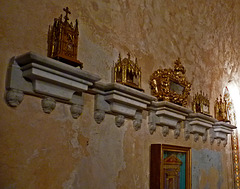
I had visited Lodève before and have uploaded photos of St. Fulchran last year.
This time, I was on a mission! About a year ago, widely read Baubo/Sonja had mentioned (protestant!) german satirist Georg Christoph Lichtenberg (1742-1799). In one of the "Sudelbuecher" Lichtenberg claims "Monks in Lodève sainted a mouse, after it had eaten from a Host."
So I tried to find somebody in Lodève, who knew about this. I asked three Lodevians, but even
the guide inside St. Fulchran had never ever heard of Mr. Lichtenberg. Then I took photos of the
reliquaries. Some were small, but most reliquaries are small. There was not a single trace of Lichtenberg´s mouse....
Well, for me this was a "Mission Impossible".
Here is the quote (in German), see [169].
books.google.de/books?id=Y4m5S_RkI0cC&pg=PA187&dq...
Here is what Wikipedia knows about Lichtenberg:
en.wikipedia.org/wiki/Georg_Christoph_Lichtenberg
.. and here is another photo of Lodève:
www.flickr.com/photos/martin-m-miles/5041083843/
Approaching Villetelle
| |
|
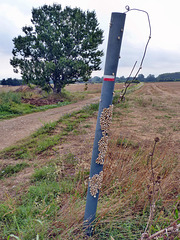
This red/white mark is the navigation-system, as it indicates the "Grande Randonnée" (here GR653)
I was on. But I was not the only creature using this kind of navigation . Hundreds of small snails had followed the sign as well - vertically.
Villetelle - Pont d'Ambrussum
| |
|
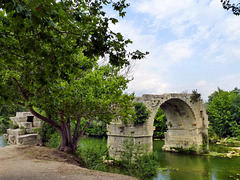
An arch of a Roman bridge crossing the Vidourle near Villetelle. Built within the 1. century BC - and once consisting out of upto eleven arches, this bridge was part of the Via Domitia linking Italy and Spain. The ruins of the Roman Oppidum of Ambrussum are being excavated currently. When Gustave Courbet painted this bridge in 1857, two arches were left. The second one got lost in a flooding 1933 - so this is the last.

Near Baillargues
| |
|
For many kilometers the GR653 runs parallel to the A9-Motorway (Languedocienne), so the "singing" of the cicadas mixes with the noise of the cars. I had to cross this ford, but the little stream was dried out. Just a few minutes later a pretty long Green Whip Snake crossed my way. I was way too slow, to portray the snake.
Baillargues
| |
|
|
|
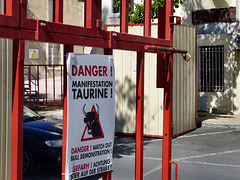
Stayed in Baillargues and learned that not only Pamplona in Spain has a "Running of the Bulls". Baillargues has that too - and many other villages in the Languedoc. When the bulls run, the inner part of the village is secured by iron grills. When I took that photo, the gates were still open - and no bulls around.
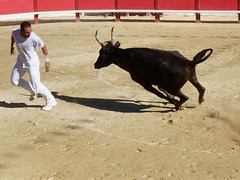
Baillargues - "Course Camarguaises"
| |
|
|
|
The "Course Camarguaises", we could see in the arena of Baillagues, has nothing to do with Spanish-style bullfighting. This is a bloodless spectacle. The "raseteur" has to snatch a rosette from the head and small bands from the horns of the bull. The "raseteurs" have to be very fast and pretty smart.
Jump to top
RSS feed- Latest items - Subscribe to the latest items added to this album
- ipernity © 2007-2026
- Help & Contact
|
Club news
|
About ipernity
|
History |
ipernity Club & Prices |
Guide of good conduct
Donate | Group guidelines | Privacy policy | Terms of use | Statutes | In memoria -
Facebook
X
