


Brittany / Bretagne


Tréguier - Cathédrale Saint-Tugdual
| |
|
The Welsh monk Saint Tugdual (of Tréguier) founded a monastery here in 535. Soon later Saint Tugdual was named "Bishop", though this may have been rather an "Abbot", as it took Tréguier to 848 to became a real bishopric. Soon after the Normans invaded the area, looted and ravaged the church and the town around, so that for decades there was no Bishop here. Around 970 the building of a new Romanesque cathedral started, of which only some pillars and the left tower still exist. Strange that this tower is named "Tour Hasting" after the leader of the Norman troops, who had destroyed the town a century ago. The cathedral may have been completed around 1100.
Work on today's Gothic building began in 1339 and lasted until the middle of the 15th century. The southern transept tower with its pierced top was not completed until 1785.
During the French Revolution, the diocese of Tréguier was dissolved. The cathedral was sacked by of revolutionaries and converted into a horse stable.
In 1801 it returned to being a place of worship. The cathedral was restored and Prosper Mérimée took an active part in the cathedral's rebuilding process.
This wall of the northern transept dates to the Romanesque church.
Tréguier - Cathédrale Saint-Tugdual
| |
|
The Welsh monk Saint Tugdual (of Tréguier) founded a monastery here in 535. Soon later Saint Tugdual was named "Bishop", though this may have been rather an "Abbot", as it took Tréguier to 848 to became a real bishopric. Soon after the Normans invaded the area, looted and ravaged the church and the town around, so that for decades there was no Bishop here. Around 970 the building of a new Romanesque cathedral started, of which only some pillars and the left tower still exist. Strange that this tower is named "Tour Hasting" after the leader of the Norman troops, who had destroyed the town a century ago. The cathedral may have been completed around 1100.
Work on today's Gothic building began in 1339 and lasted until the middle of the 15th century. The southern transept tower with its pierced top was not completed until 1785.
During the French Revolution, the diocese of Tréguier was dissolved.
The cathedral was sacked by of revolutionaries and converted into a horse stable.
In 1801 it returned to being a place of worship. The cathedral was restored and Prosper Mérimée took an active part in the cathedral's rebuilding process.
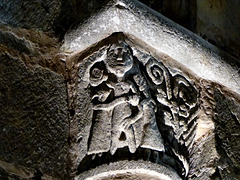
This wall of the northern transept dates to the Romanesque church. There are even some Romanesque capitals. Here is one of them.
Tréguier - Cathédrale Saint-Tugdual
| |
|
The Welsh monk Saint Tugdual (of Tréguier) founded a monastery here in 535. Soon later Saint Tugdual was named "Bishop", though this may have been rather an "Abbot", as it took Tréguier to 848 to became a real bishopric. Soon after the Normans invaded the area, looted and ravaged the church and the town around, so that for decades there was no Bishop here. Around 970 the building of a new Romanesque cathedral started, of which only some pillars and the left tower still exist. Strange that this tower is named "Tour Hasting" after the leader of the Norman troops, who had destroyed the town a century ago. The cathedral may have been completed around 1100.
Work on today's Gothic building began in 1339 and lasted until the middle of the 15th century. The southern transept tower with its pierced top was not completed until 1785.
During the French Revolution, the diocese of Tréguier was dissolved.
The cathedral was sacked by of revolutionaries and converted into a horse stable.
In 1801 it returned to being a place of worship. The cathedral was restored and Prosper Mérimée took an active part in the cathedral's rebuilding process.
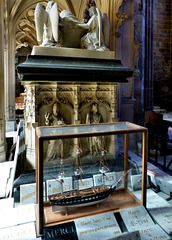
As Saint Tugdual is one of the seven founding saints of Brittany, who all came from Britain, Tréguier is one stage of the "Tro Breizh" a pilgrimage, known since the 13th century, linking the towns of the seven saints.
Here is even a votiv ship, floating in sea of other votivs.
Loguivy-lès-Lannion - St.-Ivy
| |
|
|
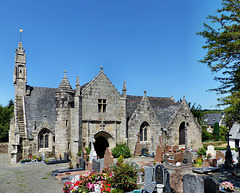
Legends tell, that where the church is now, Saint Ivy ("Yves de Tréguier"), another of the early Anglo-Celtic missionaries, erected a hermitage and a chapel in the 7th century. Saint Ivy is the patron saint of Brittany, lawyers and abandoned children.
The current church was built within fhe 16th and 17th centuries on the site of an older chapel. The building was funded by the Lords of Kergomar
Pleyben - Saint Germain
| |
|
|
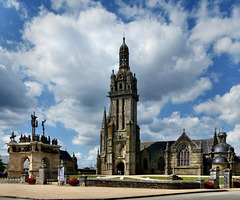
"Saint Germain" is in the center of the large "enclos paroissial" (Parish enclosure"), seen here. The enclosure comprises of the parish church, the calvary (left) and a funeral chapel/ ossuary (in the backdrop).
The construction of "Saint Germain" began in 1530. It was consecrated in 1583. Over the centuries, the church has undergone several restorations and reconstructions.

Pleyben - Saint Germain
| |
|
"Saint Germain" is in the center of the large "enclos paroissial".
The enclosure comprises of the parish church, the calvary and a funeral chapel/ ossuary.
The "Calvary on Pleyben" is the most massive calvary in Brittany. It was built in 1555 and at that time was attached to the narthex of the church. It was moved to this location in 1738. The calvary was constructed in the shape of a triumphal arch and has three crosses on it. It depicts 30 scenes from Christ´s life, staged on two levels.

Pleyben - Saint Germain
| |
|
"Saint Germain" is in the center of the large "enclos paroissial".
The enclosure comprises of the parish church, the calvary and a funeral chapel/ ossuary.
The "Calvary on Pleyben" is the most massive calvary in Brittany. It was built in 1555 and at that time was attached to the narthex of the church. It was moved to this location in 1738. The calvary was constructed in the shape of a triumphal arch and has three crosses on it. It depicts 30 scenes from Christ´s life, staged on two levels.
Pleyben - Saint Germain
| |
|
|
"Saint Germain" is in the center of the large "enclos paroissial".
The enclosure comprises of the parish church, the calvary and a funeral chapel/ ossuary.
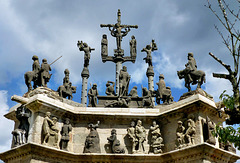
The "Calvary on Pleyben" is the most massive calvary in Brittany. It was built in 1555 and at that time was attached to the narthex of the church. It was moved to this location in 1738. The calvary was constructed in the shape of a triumphal arch and has three crosses on it. It depicts 30 scenes from Christ´s life, staged on two levels.
To the very left is a "Pieta" under a canopy, Jesus flanked by two soldiers, a person on his knees - the "Denial of Saint Peter", the flagellation, Christ is in the pillory, surrounded by guards, the "Crowning of thorns". Above are the crucification and the resurrection. The soldiers are sleeping.
Pleyben - Saint Germain
| |
|
"Saint Germain" is in the center of the large "enclos paroissial".
The enclosure comprises of the parish church, the calvary and a funeral chapel/ ossuary.
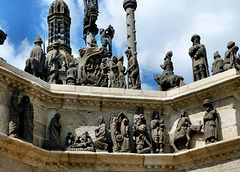
The "Calvary on Pleyben" is the most massive calvary in Brittany. It was built in 1555 and at that time was attached to the narthex of the church. It was moved to this location in 1738. The calvary was constructed in the shape of a triumphal arch and has three crosses on it. It depicts 30 scenes from Christ´s life, staged on two levels.
To the very left Mary´s visit at Elizabeth (= the Visitation, Luke 1:39–56), the Nativity of Jesus, the Adoration of the Magi and (right) the Flight into Egypt. Seen above is Christ´s descent into hell (= "Harrowing of Hell").

Pleyben - Saint Germain
| |
|
|
"Saint Germain" is in the center of the large "enclos paroissial".
The enclosure comprises of the parish church, the calvary and a funeral chapel/ ossuary.
The construction of "Saint Germain" began in 1530. It was consecrated in 1583. Over the centuries, the church has undergone several restorations and reconstructions.
Over the nave is panelled wooden vault surrounded, dated to 1571. All the beams have polychrome carvings.

Pleyben - Saint Germain
| |
|
"Saint Germain" is in the center of the large "enclos paroissial".
The enclosure comprises of the parish church, the calvary and a funeral chapel/ ossuary.
The construction of "Saint Germain" began in 1530. It was consecrated in 1583. Over the centuries, the church has undergone several restorations and reconstructions.
Over the nave is panelled wooden vault surrounded, dated to 1571. All the beams have polychrome carvings. Here is a detail.

Pleyben - Saint Germain
| |
|
|
"Saint Germain" is in the center of the large "enclos paroissial".
The enclosure comprises of the parish church, the calvary and a funeral chapel/ ossuary.
The construction of "Saint Germain" began in 1530. It was consecrated in 1583. Over the centuries, the church has undergone several restorations and reconstructions.
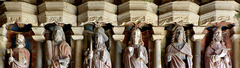
The way to the portal is flanked by the 12 apostles.
Here are the six statues of the left side.
Pleyben - Saint Germain
| |
|
"Saint Germain" is in the center of the large "enclos paroissial".
The enclosure comprises of the parish church, the calvary and a funeral chapel/ ossuary.
The construction of "Saint Germain" began in 1530. It was consecrated in 1583. Over the centuries, the church has undergone several restorations and reconstructions.
The way to the portal is flanked by the 12 apostles. Here are the heads of the six statues of the right side.
Pleyben - Renault 4CV
| |
|
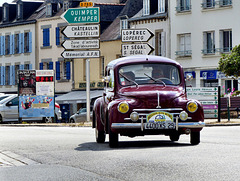
Members of "Melgven Auto Rétro" take a little sunday stroll with their neat and tidy favourites.
The car is probably a Renault 4CV. Renault produced these cars upto 1961. The Renault 4CV was very succesfull, more than 1 million cars were sold.
Bénodet - Harbour
| |
|
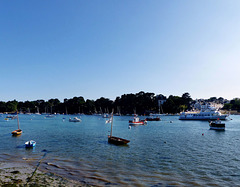
Benodet translates to the "Mouth" of the river "Odet" and since medieval times a commercial port existed here trading fish in exchange for wine with the Bordeaux area. Today the whole area is a "holiday region" so here are yachts and leisure boats now.
Bénodet - Saint-Thomas
| |
|
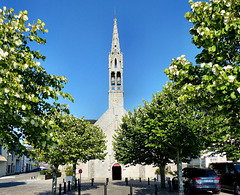
In Bénodet existed a priory founded probably in 1231. The chapel was built at the end of the thirteenth. It was dedicated to Saint Thomas of Canterbury.
This was a political statement. Thomas Becket, Archbishop of Canterbury, was murdered in 1170, after Henry II of England (aka "Henry Plantagenet") in a conflict with Becket had asked "Will no one rid me of this turbulent priest?". Thomas was canonized already three years later on 21 February 1173.
This small church is one of the oldest Gothic structures in Brittany. Of couse it got rebuilt and enlarged a couple of times. Last time after the bell tower was collapsed during a storm in 1836. The rebuilding took decades.

Bénodet - Saint-Thomas
| |
|
In Bénodet existed a priory founded probably in 1231. The chapel was built at the end of the thirteenth. It was dedicated to Saint Thomas of Canterbury.
This was a political statement. Thomas Becket, Archbishop of Canterbury, was murdered in 1170, after Henry II of England (aka "Henry Plantagenet") in a conflict with Becket had asked "Will no one rid me of this turbulent priest?". Thomas was canonized already three years later on 21 February 1173.
This small church is one of the oldest Gothic structures in Brittany. Of couse it got rebuilt and enlarged a couple of times. Last time after the bell tower was collapsed during a storm in 1836. While the widened nave is from the 15th the choir, seen here, is 13th century.
Bénodet - Saint-Thomas
| |
|
In Bénodet existed a priory founded probably in 1231. The chapel was built at the end of the thirteenth. It was dedicated to Saint Thomas of Canterbury.
This small church is one of the oldest Gothic structures in Brittany. Of couse it got rebuilt and enlarged a couple of times. Last time after the bell tower was collapsed during a storm in 1836. While the widened nave is from the 15th the choir, seen here, is 13th century.
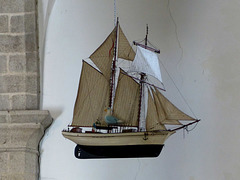
As Benodet had a commercial port trading fish in exchange for wine with the Bordeaux area it is not a surprise to find a votive chip here. It seem, that the church ship is squatted by a giant sea gull.
Jump to top
RSS feed- Latest items - Subscribe to the latest items added to this album
- ipernity © 2007-2026
- Help & Contact
|
Club news
|
About ipernity
|
History |
ipernity Club & Prices |
Guide of good conduct
Donate | Group guidelines | Privacy policy | Terms of use | Statutes | In memoria -
Facebook
X
