

Pablo Picasso


Liège - La Boverie
Liège is the center of the largest Walloon agglomeration, and the cultural center of the Walloon region of Belgium. The city, with a population of about 200.000, is located at the confluence of the Ourthe and Meuse rivers.
Around 705, Saint Lambert of Maastricht is credited with completing the Christianization of the region, but conversion may still not have been quite universal, since Lambert was murdered in Liège. To enshrine his relics, the successor, Hubertus (later St. Hubert), built a basilica which became the nucleus of the city.
In 1468, following an uprising of the inhabitants against Burgundian rule, xof Burgundy had the city plundered and systematically destroyed. The few survivors who had fled into the forests—Charles the Bold allegedly had more than 5,000 inhabitants murdered—were only able to return to the city for reconstruction after seven years.
In 1789, partly in connection with the French Revolution, the Liège Revolution occurred. It was directed against the absolutist rule of the Prince-Bishop and was crushed in early 1791 by troops commissioned by the Holy Roman Empire. In 1795, Liège was occupied by French troops and became part of the First French Republic. The Congress of Vienna annexed it to the Kingdom of the Netherlands, which in 1830 became the Kingdom of Belgium, to which Liège has belonged ever since.
Originally built for the 1905 Liège World Exhibition, the building has housed the collections of the Musée des beaux-arts de Liège since 2016. The collections of the Musée des beaux-arts de Liège include more than 700 paintings and sculptures, as well as more than 40,000 works on paper.
Pablo Picasso (1881 - 1973)
Deux têtes / Two heads
1909
Mainz - Landesmuseum
Mainz was founded around 20 BC by the Romans under the name “Mogontiacum” as a military camp. Today's capital of the state of Rhineland-Palatinate forms a metropolitan area with Wiesbaden, the neighboring capital of Hesse, with a combined population of around 500,000.
The "Republic of Mainz", a product of the French Revolution, was the first democratic state on German territory. The state was represented in Paris by the well-known naturalist Georg Forster, who had been in the Pacific with Captain Cook as a boy. The Mainz Republic ended after only five months in July 1793 following the conquest of the city by Prussian and Austrian troops. Georg Forster died in Paris in 1794.
The State Museum is one of the oldest museums in Germany. Its origins lie in a collection of 36 paintings that Napoleon gifted to the city of Mainz in 1803 to establish an art gallery.
Today the Landesmuseum has extensive art and cultural history collections, ranging from prehistory to modern art.
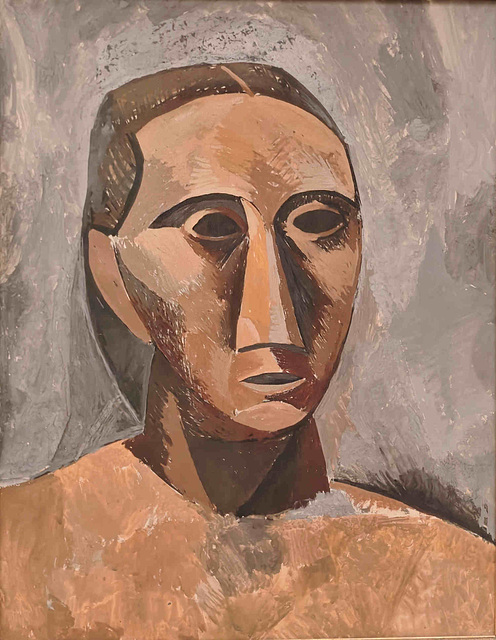
Pablo Picasso ( 1881 - 1973 )
Frauenkopf / 1908

Mainz - Landesmuseum
Mainz was founded around 20 BC by the Romans under the name “Mogontiacum” as a military camp. Today's capital of the state of Rhineland-Palatinate forms a metropolitan area with Wiesbaden, the neighboring capital of Hesse, with a combined population of around 500,000.
The "Republic of Mainz", a product of the French Revolution, was the first democratic state on German territory. The state was represented in Paris by the well-known naturalist Georg Forster, who had been in the Pacific with Captain Cook as a boy. The Mainz Republic ended after only five months in July 1793 following the conquest of the city by Prussian and Austrian troops. Georg Forster died in Paris in 1794.
The State Museum is one of the oldest museums in Germany. Its origins lie in a collection of 36 paintings that Napoleon gifted to the city of Mainz in 1803 to establish an art gallery.
Today the Landesmuseum has extensive art and cultural history collections, ranging from prehistory to modern art.
Pablo Picasso ( 1881 - 1973 )
Homme assis / 1970

Wuppertal - Von der Heydt-Museum
Wuppertal, a city with around 360,000 inhabitants, is located south of the Ruhr area. Wuppertal was one of the first highly industrialized regions in Germany.
The cityscape is dominated by the valley of the Wupper River which winds its way through the city for around 20 km. The "Schwebebahn", a suspension railway, in operation since 1901, is the city's landmark and most famous attraction. It is the oldest suspension railway still in operation. Most of the13km- route runs above the Wupper River.
The Von der Heydt Museum was founded in 1902 as a municipal museum. Since 1961, it has borne the name von der Heydt in memory of the banking family that played an important role in promoting the museum. During the Nazi era, numerous works in the Von der Heydt Museum were confiscated as “degenerate art” and subsequently sold or destroyed.
Pablo Picasso ( 1881 - 1973 )
Mann mit Pelerine / Man with cape / 1900
Wuppertal - Von der Heydt-Museum
Wuppertal, a city with around 360,000 inhabitants, is located south of the Ruhr area. Wuppertal was one of the first highly industrialized regions in Germany.
The cityscape is dominated by the valley of the Wupper River which winds its way through the city for around 20 km. The "Schwebebahn", a suspension railway, in operation since 1901, is the city's landmark and most famous attraction. It is the oldest suspension railway still in operation. Most of the13km- route runs above the Wupper River.
The Von der Heydt Museum was founded in 1902 as a municipal museum. Since 1961, it has borne the name von der Heydt in memory of the banking family that played an important role in promoting the museum. During the Nazi era, numerous works in the Von der Heydt Museum were confiscated as “degenerate art” and subsequently sold or destroyed.
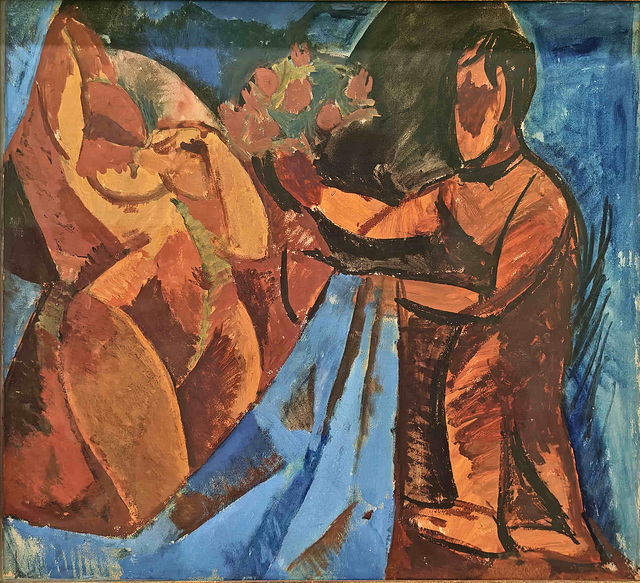
Pablo Picasso ( 1881 - 1973 )
Die Gabe / The Gift / 1908

Münster - LWL Museum für Kunst und Kultur
Muenster, the cultural centre of Westphalia, is a city with a population of more than 250.000 of which nearly 50.000 are students at the University of Muenster. This surely helped Muenster to gain the status of the "bicycle capital of Germany".
The "Westphalian State Museum of Art and Cultural History" dates back to the 19th century and owes its existence largely to the contributions of local art associations. The Westphalian Art Association, founded in 1831, played a crucial role in collecting and preserving regional art. The museum has undergone several renovations, including the construction of a new building, which opened in September 2014. The museum displays artworks from the early Middle Ages to the present day. Its collection comprises more than 300,000 exhibits.
Pablo Picasso ( 1881 - 1973 )
Jose Ruiz Blasco / 1895
(Picasso´s Father)

Münster - LWL Museum für Kunst und Kultur
Muenster, the cultural centre of Westphalia, is a city with a population of more than 250.000 of which nearly 50.000 are students at the University of Muenster. This surely helped Muenster to gain the status of the "bicycle capital of Germany".
The "Westphalian State Museum of Art and Cultural History" dates back to the 19th century and owes its existence largely to the contributions of local art associations. The Westphalian Art Association, founded in 1831, played a crucial role in collecting and preserving regional art. The museum has undergone several renovations, including the construction of a new building, which opened in September 2014. The museum displays artworks from the early Middle Ages to the present day. Its collection comprises more than 300,000 exhibits.
Pablo Picasso ( 1881 - 1973 )
Jeanne / 1901

Münster - LWL Museum für Kunst und Kultur
Muenster, the cultural centre of Westphalia, is a city with a population of more than 250.000 of which nearly 50.000 are students at the University of Muenster. This surely helped Muenster to gain the status of the "bicycle capital of Germany".
The "Westphalian State Museum of Art and Cultural History" dates back to the 19th century and owes its existence largely to the contributions of local art associations. The Westphalian Art Association, founded in 1831, played a crucial role in collecting and preserving regional art. The museum has undergone several renovations, including the construction of a new building, which opened in September 2014. The museum displays artworks from the early Middle Ages to the present day. Its collection comprises more than 300,000 exhibits.
Pablo Picasso ( 1881 - 1973 )
Zwei Personen / Two Figures / 1934

Münster - LWL Museum für Kunst und Kultur
Muenster, the cultural centre of Westphalia, is a city with a population of more than 250.000 of which nearly 50.000 are students at the University of Muenster. This surely helped Muenster to gain the status of the "bicycle capital of Germany".
The "Westphalian State Museum of Art and Cultural History" dates back to the 19th century and owes its existence largely to the contributions of local art associations. The Westphalian Art Association, founded in 1831, played a crucial role in collecting and preserving regional art. The museum has undergone several renovations, including the construction of a new building, which opened in September 2014. The museum displays artworks from the early Middle Ages to the present day. Its collection comprises more than 300,000 exhibits.
Pablo Picasso ( 1881 - 1973 )
Mutter und Kind / Mother and Child / 1921
Jump to top
RSS feed- Latest items - Subscribe to the latest items added to this album
- ipernity © 2007-2026
- Help & Contact
|
Club news
|
About ipernity
|
History |
ipernity Club & Prices |
Guide of good conduct
Donate | Group guidelines | Privacy policy | Terms of use | Statutes | In memoria -
Facebook
X
