


Ancient Octopuses


Ierapetra - Archaeological Collection
Ierapetra is the southernmost city in Europe (excluding Cyprus) and the fourth-largest city in Crete.
In ancient times, the city was called Hierapytna. The earliest remains of the city date back to the fifth century BC. It was an important Dorian city in eastern Crete. The city of Gortyn surpassed Hierapytna's importance as an independent state when Hierapytna was conquered by the Romans in 67 BC. The city was severely damaged during the Arab conquest in 824 but was subsequently rebuilt. It experienced a new period of prosperity during the Venetian period from the 13th to the 17th centuries.
The Archaeological Collection is housed in the building of an Ottoman School that was built in 1899.
Octopus Vessel
1500 - 1450 BC

Ierapetra - Archaeological Collection
Ierapetra is the southernmost city in Europe (excluding Cyprus) and the fourth-largest city in Crete.
In ancient times, the city was called Hierapytna. The earliest remains of the city date back to the fifth century BC. It was an important Dorian city in eastern Crete. The city of Gortyn surpassed Hierapytna's importance as an independent state when Hierapytna was conquered by the Romans in 67 BC. The city was severely damaged during the Arab conquest in 824 but was subsequently rebuilt. It experienced a new period of prosperity during the Venetian period from the 13th to the 17th centuries.
The Archaeological Collection is housed in the building of an Ottoman School that was built in 1899.
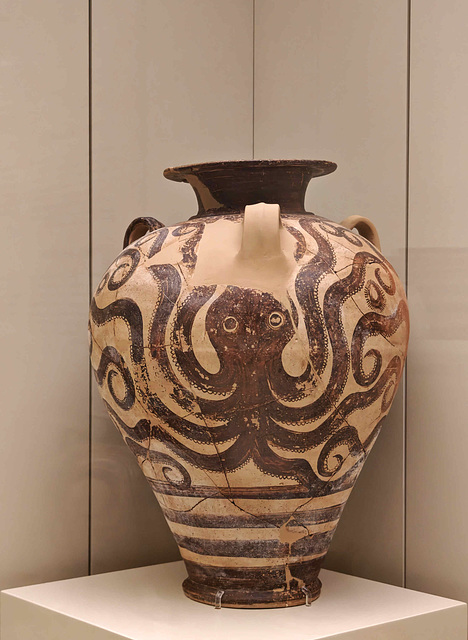
Octopus Stirrup Jar
1500 - 1450 BC

Ierapetra - Archaeological Collection
Ierapetra is the southernmost city in Europe (excluding Cyprus) and the fourth-largest city in Crete.
In ancient times, the city was called Hierapytna. The earliest remains of the city date back to the fifth century BC. It was an important Dorian city in eastern Crete. The city of Gortyn surpassed Hierapytna's importance as an independent state when Hierapytna was conquered by the Romans in 67 BC. The city was severely damaged during the Arab conquest in 824 but was subsequently rebuilt. It experienced a new period of prosperity during the Venetian period from the 13th to the 17th centuries.
The Archaeological Collection is housed in the building of an Ottoman School that was built in 1899.
Minoan Larnax
known as the Episkopi Larnax (named after the find spot).
It appears as though all the human figures are descendants of the Cyclopes. A chariot race is visible on the left, above the octopus. Shepherds appear at the bottom right and top left, and ibexes at the top right.
13th c BC.
Mycenae - Archaeological Museum
Mycene was inhabited already during neolithic and the early Bronze period. During the pre-classical period Mycenae was one of the most important cities in Greece. The Mycenaean culture (c. 1600 BC to c. 1100 BC) was named after it.
Over the centuries the population density increased, and by 1350 BC the citadel and the lower town had a population of 30,000 and covered an area of 32 hectares. At that time the fortifications on the acropolis and other surrounding hills were rebuilt in a style known as Cyclopean because the blocks of stone used were so massive that they were thought in later ages to be the work of the Cyclopes.
Within these walls successive monumental palaces were built. The final palace dates to the start of ca. 1390–1300 BC. Earlier palaces must have existed but they had been cleared away or built over. From 1200 BC onwards, Mycenae began to decline and lost its dominant position. Like all the palaces in southern Greece, the palace at Mycenae was destroyed. The settlement shrank, but the citadel and the lower town remained inhabited. During the Archaic period, a temple to Hera was built on the highest point.
In 480 BC 80 Mycenaeans took part in the Battle of Thermopylae. In 468 BC the Argives conquered Mycenae, deported the inhabitants and razed the walls. During the Hellenistic period, the city was resettled and a theatre was built. After that, the site was only resettled for a short time. In the 3rd century BC Mycenae was abandoned.
The excavations, which were begun in the 1870s by Heinrich Schliemann and Panagiotis Stamatakis, yielded incredible finds, particularly within the grave circles. The most spectacular of which are now housed in Athens, however, the exhibits on display at the Archaeological Museum, which forms part of the site, are also breathtaking.
Octopus Jug
1500 - 1450 BC
Mycenae - Archaeological Museum
Mycene was inhabited already during neolithic and the early Bronze period. During the pre-classical period Mycenae was one of the most important cities in Greece. The Mycenaean culture (c. 1600 BC to c. 1100 BC) was named after it.
Over the centuries the population density increased, and by 1350 BC the citadel and the lower town had a population of 30,000 and covered an area of 32 hectares. At that time the fortifications on the acropolis and other surrounding hills were rebuilt in a style known as Cyclopean because the blocks of stone used were so massive that they were thought in later ages to be the work of the Cyclopes.
Within these walls successive monumental palaces were built. The final palace dates to the start of ca. 1390–1300 BC. Earlier palaces must have existed but they had been cleared away or built over. From 1200 BC onwards, Mycenae began to decline and lost its dominant position. Like all the palaces in southern Greece, the palace at Mycenae was destroyed. The settlement shrank, but the citadel and the lower town remained inhabited. During the Archaic period, a temple to Hera was built on the highest point.
In 480 BC 80 Mycenaeans took part in the Battle of Thermopylae. In 468 BC the Argives conquered Mycenae, deported the inhabitants and razed the walls. During the Hellenistic period, the city was resettled and a theatre was built. After that, the site was only resettled for a short time. In the 3rd century BC Mycenae was abandoned.
The excavations, which were begun in the 1870s by Heinrich Schliemann and Panagiotis Stamatakis, yielded incredible finds, particularly within the grave circles. The most spectacular of which are now housed in Athens, however, the exhibits on display at the Archaeological Museum, which forms part of the site, are also breathtaking.
Excavating the shaft graves in Grave Circles A and B, numerous objects made of various gold alloys were found. A total of around 15 kg of gold was recorded.
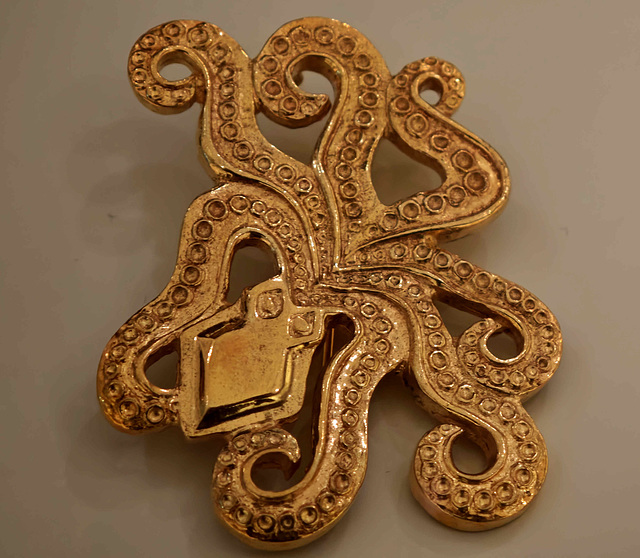
Octopus Brooch
Gold, 16th c BC

Mycenae - Archaeological Museum
Mycene was inhabited already during neolithic and the early Bronze period. During the pre-classical period Mycenae was one of the most important cities in Greece. The Mycenaean culture (c. 1600 BC to c. 1100 BC) was named after it.
Over the centuries the population density increased, and by 1350 BC the citadel and the lower town had a population of 30,000 and covered an area of 32 hectares. At that time the fortifications on the acropolis and other surrounding hills were rebuilt in a style known as Cyclopean because the blocks of stone used were so massive that they were thought in later ages to be the work of the Cyclopes.
Within these walls successive monumental palaces were built. The final palace dates to the start of ca. 1390–1300 BC. Earlier palaces must have existed but they had been cleared away or built over. From 1200 BC onwards, Mycenae began to decline and lost its dominant position. Like all the palaces in southern Greece, the palace at Mycenae was destroyed. The settlement shrank, but the citadel and the lower town remained inhabited. During the Archaic period, a temple to Hera was built on the highest point.
In 480 BC 80 Mycenaeans took part in the Battle of Thermopylae. In 468 BC the Argives conquered Mycenae, deported the inhabitants and razed the walls. During the Hellenistic period, the city was resettled and a theatre was built. After that, the site was only resettled for a short time. In the 3rd century BC Mycenae was abandoned.
The excavations, which were begun in the 1870s by Heinrich Schliemann and Panagiotis Stamatakis, yielded incredible finds, particularly within the grave circles. The most spectacular of which are now housed in Athens, however, the exhibits on display at the Archaeological Museum, which forms part of the site, are also breathtaking.
Excavating the shaft graves in Grave Circles A and B, numerous objects made of various gold alloys were found. A total of around 15 kg of gold was recorded.
Octopus Brooch
16th c BC

Patras - Archaeological Museum
The Archaeological Museum of Patras is the largest archaeological museum in Greece after the Acropolis Museum in Athens. The modern new building, designed by architect Theofanis Bobotis, was officially opened in 2009.
It houses collections about the history of Patras and the surrounding area from prehistory to the end of Roman times.
Burial larnax
that resembles the Minoan equivalent.
The decorations with the octopus and the fish are Minoan style
Terracotta, 13th c. BC
Jump to top
RSS feed- Latest items - Subscribe to the latest items added to this album
- ipernity © 2007-2026
- Help & Contact
|
Club news
|
About ipernity
|
History |
ipernity Club & Prices |
Guide of good conduct
Donate | Group guidelines | Privacy policy | Terms of use | Statutes | In memoria -
Facebook
X
