


Ancient Octopuses

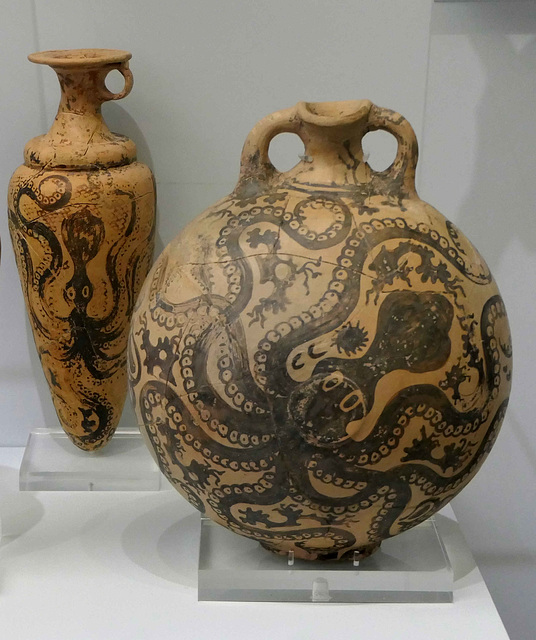

Heraklion - Archaeological Museum
Crete is the largest and most populous of the Greek islands, is located about 100 km south of the Peloponnese. Crete was the center of Europe's first advanced civilization, the Minoans, from 3000 to 1400 BC. The Minoan civilization was overrun by the Mycenaean civilization from mainland Greece. Crete was later ruled by Rome, then successively by the Byzantine Empire, Andalusian Arabs, the Byzantine Empire again, the Venetian Republic, and the Ottoman Empire. In 1898 Crete, whose people had for some time wanted to join the Greek state, achieved independence from the Ottomans, formally becoming the Cretan State. Crete became part of Greece in December 1913.
Heraklion is the largest city and the administrative capital of the island of Crete. With a municipal population of about 180.000 it is the fourth largest city in Greece. The greater area of Heraklion has been continuously inhabited since at least 7000 BCE, making it one of the oldest inhabited regions in Europe. As a major center of the Minoan civilization it often considered Europe's oldest city.
The Heraklion Archaeological Museum is one of the largest museums in Greeceand the best in the world for Minoan art, as it contains by far the most important and complete collection of artefacts of the Minoan civilization of Crete.
The museum began in 1883 as a simple collection of antiquities; it was about the time when the Minoan civilization was beginning to be rediscovered, and shortly before the first excavations using proper scientific methods. It was also during the period when Crete was a virtually autonomous part of the Ottoman Empire, after the Pact of Halepa of 1878, later followed by the independent Cretan State (1898-1913). The political situation helped to keep Cretan finds on the island during a crucial period of discoveries.
The museum is located in the town centre. It was built between 1937 and 1940 on a site previously occupied by the Roman Catholic monastery of Saint-Francis which was destroyed by earthquake in 1856.
Clay flask, decorated in "marine style".
I really like these "octopus vessels" with the particular naturalism. The tentacles writhe around the body of the vase.
Palaikastro, 1500 - 1450 BC
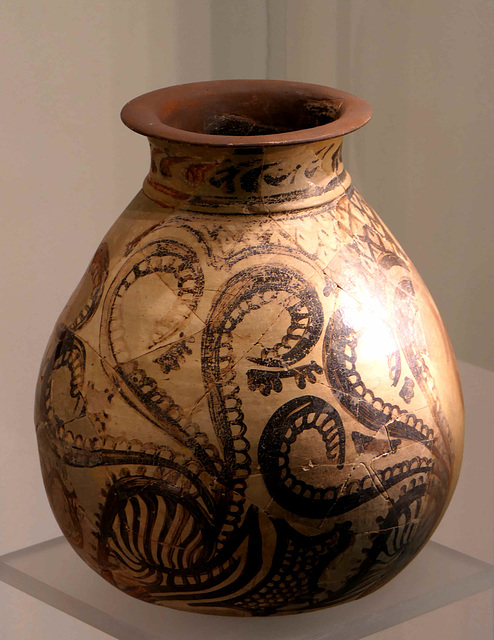
Agios Nikolaos - Archaeological Museum
Agios Nikolaos was settled in the late Bronze Age by Dorian occupants of Lato under the name Lato pros Kamara, often simply Kamara. It was the port of Lato for a long time. In the 2nd century BC, Lato was abandoned, and many citizens settled in Kamara. The name of the present-day town comes from the church of Agios Nikolaos, which dates back to the 9th or 10th century and is one of the oldest intact churches in Crete.
In 1970, the Archaeological Museum was opened to house finds from Eastern Crete that had previously been housed in Heraklion
Another stylized octopus on this vessel

Agios Nikolaos - Archaeological Museum
Agios Nikolaos was settled in the late Bronze Age by Dorian occupants of Lato under the name Lato pros Kamara, often simply Kamara. It was the port of Lato for a long time. In the 2nd century BC, Lato was abandoned, and many citizens settled in Kamara. The name of the present-day town comes from the church of Agios Nikolaos, which dates back to the 9th or 10th century and is one of the oldest intact churches in Crete.
In 1970, the Archaeological Museum was opened to house finds from Eastern Crete that had previously been housed in Heraklion
The jar, decorated with a stylized octopus, comes from a workshop in West Crete. Dated to the post palatial period - 1450 - 1150 BCE

Sitia - Archaeological Museum
Settlement in the city area dates back to the pre-Minoan period. Architectural remains have been found from the end of the Neolithic period to the Bronze Age.
The city flourished during the Classical, Hellenistic, Roman and Byzantine periods as one of the island's most important ports. During Venetian times, the city was destroyed three times: first by an earthquake in 1508, then by Turkish pirates in 1538, and finally by the Venetians themselves in 1651. This last destruction occurred during the Cretan War. Lacking the resources to withstand a prolonged siege by the Turks, the Venetians destroyed the fortifications and relocated the garrison to Heraklion. The inhabitants migrated west, and the town remained deserted for the next 200 years of Turkish rule. The city was rebuilt after the Cretan Revolt until 1870. Today it has almost 20,000 inhabitants.
The Archaeological Museum features finds from the wider area, dating back to the period between 3500 BC and 500 AD.
A Minoan tomb, decorated with the octopus pattern.
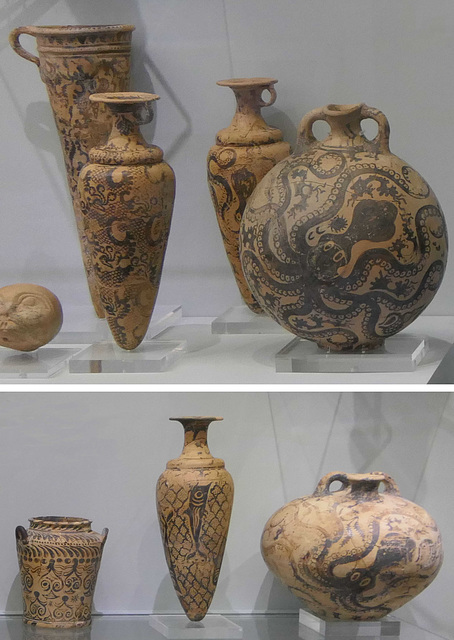
Heraklion - Archaeological Museum
Crete, the largest and most populous of the Greek islands, is located about 100 km south of the Peloponnese. Crete was the center of Europe's first advanced civilization, the Minoans, from 3000 to 1400 BC. The Minoan civilization was overrun by the Mycenaean civilization from mainland Greece. Crete was later ruled by Rome, then successively by the Byzantine Empire, Andalusian Arabs, the Byzantine Empire again, the Venetian Republic, and the Ottoman Empire. In 1898 Crete, whose people had for some time wanted to join the Greek state, achieved independence from the Ottomans, formally becoming the Cretan State. Crete became part of Greece in December 1913.
Heraklion is the largest city and the administrative capital of the island of Crete. With a municipal population of about 180.000 it is the fourth largest city in Greece. The greater area of Heraklion has been continuously inhabited since at least 7000 BCE, making it one of the oldest inhabited regions in Europe. As a major center of the Minoan civilization it often considered Europe's oldest city.
The Heraklion Archaeological Museum is one of the largest museums in Greeceand the best in the world for Minoan art, as it contains by far the most important and complete collection of artefacts of the Minoan civilization of Crete.
The museum began in 1883 as a simple collection of antiquities; it was about the time when the Minoan civilization was beginning to be rediscovered, and shortly before the first excavations using proper scientific methods. It was also during the period when Crete was a virtually autonomous part of the Ottoman Empire, after the Pact of Halepa of 1878, later followed by the independent Cretan State (1898-1913). The political situation helped to keep Cretan finds on the island during a crucial period of discoveries.
The museum is located in the town centre. It was built between 1937 and 1940 on a site previously occupied by the Roman Catholic monastery of Saint-Francis which was destroyed by earthquake in 1856.
Clay vessels decorated in "marine style"
1500 - 1450 BC

Sitia - Archaeological Museum
Settlement in the city area dates back to the pre-Minoan period. Architectural remains have been found from the end of the Neolithic period to the Bronze Age.
The city flourished during the Classical, Hellenistic, Roman and Byzantine periods as one of the island's most important ports. During Venetian times, the city was destroyed three times: first by an earthquake in 1508, then by Turkish pirates in 1538, and finally by the Venetians themselves in 1651. This last destruction occurred during the Cretan War. Lacking the resources to withstand a prolonged siege by the Turks, the Venetians destroyed the fortifications and relocated the garrison to Heraklion. The inhabitants migrated west, and the town remained deserted for the next 200 years of Turkish rule. The city was rebuilt after the Cretan Revolt until 1870. Today it has almost 20,000 inhabitants.
The Archaeological Museum features finds from the wider area, dating back to the period between 3500 BC and 500 AD.
Minoan tombs

Larnaca - Archaeological Museum
With a population of over 50,000, Larnaca is one of the largest cities in Cyprus.
The Larnaca District Archaeological Museum displays the development of the city of Kition up to Roman times, as well as finds from the Neolithic settlement of Chirokitia. It is one of two archaeological museums in Larnaca.
Large pithoid amphora, imported from Crete, and decorated with an octopus decor
13th c BC

Larnaca - Archaeological Museum
With a population of over 50,000, Larnaca is one of the largest cities in Cyprus.
The Larnaca District Archaeological Museum displays the development of the city of Kition up to Roman times, as well as finds from the Neolithic settlement of Chirokitia. It is one of two archaeological museums in Larnaca.
Amphoroid krater decorated with a painted octopus.
Imported from the Aegan / 14th - 13th c BC

Ierapetra - Archaeological Collection
Ierapetra is the southernmost city in Europe (excluding Cyprus) and the fourth-largest city in Crete.
In ancient times, the city was called Hierapytna. The earliest remains of the city date back to the fifth century BC. It was an important Dorian city in eastern Crete. The city of Gortyn surpassed Hierapytna's importance as an independent state when Hierapytna was conquered by the Romans in 67 BC. The city was severely damaged during the Arab conquest in 824 but was subsequently rebuilt. It experienced a new period of prosperity during the Venetian period from the 13th to the 17th centuries.
The Archaeological Collection is housed in the building of an Ottoman School that was built in 1899.
Octopus Vessels
1500 - 1450 BC
Jump to top
RSS feed- Latest items - Subscribe to the latest items added to this album
- ipernity © 2007-2026
- Help & Contact
|
Club news
|
About ipernity
|
History |
ipernity Club & Prices |
Guide of good conduct
Donate | Group guidelines | Privacy policy | Terms of use | Statutes | In memoria -
Facebook
X
