


Art Nouveau - Jugenstil - Modernisme

and even Bauhaus architecture.
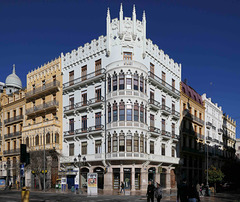
Valencia - Plaza del Ayuntamiento
| |
|
|
According to the Roman historian Titus Livius "Valentia" was founded by Consul Decimus Iunius Brutus Callaicus in the 4th century BC,
A century later "Valentia Edetanorum" became one of the first Hispanic cities to become a Roman colony.
The city made rapid progress after the Arab conquest in 711, reaching 15,000 inhabitants in the Caliphate of Córdoba. The Amirids and the Dhun Nunids ruled in “Balansiya”. In 1094, El Cid, a Castilian noble, conquered the city. The conquest was not carried out on behalf of one of the Christian kingdoms, but on the Cid's own account, who proclaimed himself "Señor de Valencia" and thus created a kind of private kingdom. He was able to defend the city against several Almoravid attacks, and after his death in 1099, his widow Jimena managed to hold Valencia until 1102, when it fell to the Almoravids, and a little later to the Almohads.
After the victory of the united Christian armies over the Almohads in the Battle of Las Navas de Tolosa (1212), Moorish Spain fell apart again into individual small kingdoms, including a Taifa from Valencia.
It was finally conquered in 1238 by Jaime I de Aragón (aka "el Conquistador"), after a five-month siege.
In the 15th century, the city grew rapidly and developed into one of the largest Mediterranean ports and an important trade and financial center. At the beginning of the 15th century the city had around 40,000.
The Plaza del Ayuntamiento is probably the most important and central square. All around are buildings in an eclectic, modernist, and rationalist style, built in the first half of the 20th century.
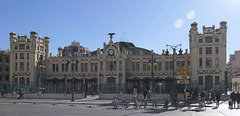
Valencia - Estacion del Norte
| |
|
|
According to the Roman historian Titus Livius "Valentia" was founded by Consul Decimus Iunius Brutus Callaicus in the 4th century BC,
A century later "Valentia Edetanorum" became one of the first Hispanic cities to become a Roman colony.
The city made rapid progress after the Arab conquest in 711, reaching 15,000 inhabitants in the Caliphate of Córdoba. The Amirids and the Dhun Nunids ruled in “Balansiya”. In 1094, El Cid, a Castilian noble, conquered the city. The conquest was not carried out on behalf of one of the Christian kingdoms, but on the Cid's own account, who proclaimed himself "Señor de Valencia" and thus created a kind of private kingdom. He was able to defend the city against several Almoravid attacks, and after his death in 1099, his widow Jimena managed to hold Valencia until 1102, when it fell to the Almoravids, and a little later to the Almohads.
After the victory of the united Christian armies over the Almohads in the Battle of Las Navas de Tolosa (1212), Moorish Spain fell apart again into individual small kingdoms, including a Taifa from Valencia.
It was finally conquered in 1238 by Jaime I de Aragón (aka "el Conquistador"), after a five-month siege.
In the 15th century, the city grew rapidly and developed into one of the largest Mediterranean ports and an important trade and financial center. At the beginning of the 15th century the city had around 40,000.
The North Station is in the city center. The station was opened as a terminal station in 1917 after eleven years of construction. The building is one of the main works of Valencian Art Nouveau and was declared a heritage site in 1987.
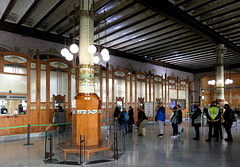
Valencia - Estacion del Norte
| |
|
|
According to the Roman historian Titus Livius "Valentia" was founded by Consul Decimus Iunius Brutus Callaicus in the 4th century BC,
A century later "Valentia Edetanorum" became one of the first Hispanic cities to become a Roman colony.
The city made rapid progress after the Arab conquest in 711, reaching 15,000 inhabitants in the Caliphate of Córdoba. The Amirids and the Dhun Nunids ruled in “Balansiya”. In 1094, El Cid, a Castilian noble, conquered the city. The conquest was not carried out on behalf of one of the Christian kingdoms, but on the Cid's own account, who proclaimed himself "Señor de Valencia" and thus created a kind of private kingdom. He was able to defend the city against several Almoravid attacks, and after his death in 1099, his widow Jimena managed to hold Valencia until 1102, when it fell to the Almoravids, and a little later to the Almohads.
After the victory of the united Christian armies over the Almohads in the Battle of Las Navas de Tolosa (1212), Moorish Spain fell apart again into individual small kingdoms, including a Taifa from Valencia.
It was finally conquered in 1238 by Jaime I de Aragón (aka "el Conquistador"), after a five-month siege.
In the 15th century, the city grew rapidly and developed into one of the largest Mediterranean ports and an important trade and financial center. At the beginning of the 15th century the city had around 40,000.
The North Station is in the city center. The station was opened as a terminal station in 1917 after eleven years of construction. The building is one of the main works of Valencian Art Nouveau and was declared a heritage site in 1987.
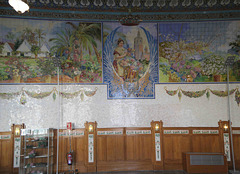
Valencia - Estacion del Norte
| |
|
|
According to the Roman historian Titus Livius "Valentia" was founded by Consul Decimus Iunius Brutus Callaicus in the 4th century BC,
A century later "Valentia Edetanorum" became one of the first Hispanic cities to become a Roman colony.
The city made rapid progress after the Arab conquest in 711, reaching 15,000 inhabitants in the Caliphate of Córdoba. The Amirids and the Dhun Nunids ruled in “Balansiya”. In 1094, El Cid, a Castilian noble, conquered the city. The conquest was not carried out on behalf of one of the Christian kingdoms, but on the Cid's own account, who proclaimed himself "Señor de Valencia" and thus created a kind of private kingdom. He was able to defend the city against several Almoravid attacks, and after his death in 1099, his widow Jimena managed to hold Valencia until 1102, when it fell to the Almoravids, and a little later to the Almohads.
After the victory of the united Christian armies over the Almohads in the Battle of Las Navas de Tolosa (1212), Moorish Spain fell apart again into individual small kingdoms, including a Taifa from Valencia.
It was finally conquered in 1238 by Jaime I de Aragón (aka "el Conquistador"), after a five-month siege.
In the 15th century, the city grew rapidly and developed into one of the largest Mediterranean ports and an important trade and financial center. At the beginning of the 15th century the city had around 40,000.
The North Station is in the city center. The station was opened as a terminal station in 1917 after eleven years of construction. The building is one of the main works of Valencian Art Nouveau and was declared a heritage site in 1987.
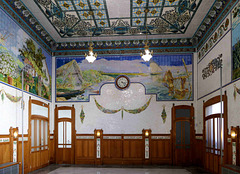
Valencia - Estacion del Norte
| |
|
|
According to the Roman historian Titus Livius "Valentia" was founded by Consul Decimus Iunius Brutus Callaicus in the 4th century BC,
A century later "Valentia Edetanorum" became one of the first Hispanic cities to become a Roman colony.
The city made rapid progress after the Arab conquest in 711, reaching 15,000 inhabitants in the Caliphate of Córdoba. The Amirids and the Dhun Nunids ruled in “Balansiya”. In 1094, El Cid, a Castilian noble, conquered the city. The conquest was not carried out on behalf of one of the Christian kingdoms, but on the Cid's own account, who proclaimed himself "Señor de Valencia" and thus created a kind of private kingdom. He was able to defend the city against several Almoravid attacks, and after his death in 1099, his widow Jimena managed to hold Valencia until 1102, when it fell to the Almoravids, and a little later to the Almohads.
After the victory of the united Christian armies over the Almohads in the Battle of Las Navas de Tolosa (1212), Moorish Spain fell apart again into individual small kingdoms, including a Taifa from Valencia.
It was finally conquered in 1238 by Jaime I de Aragón (aka "el Conquistador"), after a five-month siege.
In the 15th century, the city grew rapidly and developed into one of the largest Mediterranean ports and an important trade and financial center. At the beginning of the 15th century the city had around 40,000.
The North Station is in the city center. The station was opened as a terminal station in 1917 after eleven years of construction. The building is one of the main works of Valencian Art Nouveau and was declared a heritage site in 1987.
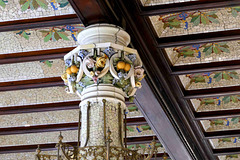
Valencia - Estacion del Norte
| |
|
|
According to the Roman historian Titus Livius "Valentia" was founded by Consul Decimus Iunius Brutus Callaicus in the 4th century BC,
A century later "Valentia Edetanorum" became one of the first Hispanic cities to become a Roman colony.
The city made rapid progress after the Arab conquest in 711, reaching 15,000 inhabitants in the Caliphate of Córdoba. The Amirids and the Dhun Nunids ruled in “Balansiya”. In 1094, El Cid, a Castilian noble, conquered the city. The conquest was not carried out on behalf of one of the Christian kingdoms, but on the Cid's own account, who proclaimed himself "Señor de Valencia" and thus created a kind of private kingdom. He was able to defend the city against several Almoravid attacks, and after his death in 1099, his widow Jimena managed to hold Valencia until 1102, when it fell to the Almoravids, and a little later to the Almohads.
After the victory of the united Christian armies over the Almohads in the Battle of Las Navas de Tolosa (1212), Moorish Spain fell apart again into individual small kingdoms, including a Taifa from Valencia.
It was finally conquered in 1238 by Jaime I de Aragón (aka "el Conquistador"), after a five-month siege.
In the 15th century, the city grew rapidly and developed into one of the largest Mediterranean ports and an important trade and financial center. At the beginning of the 15th century the city had around 40,000.
The North Station is in the city center. The station was opened as a terminal station in 1917 after eleven years of construction. The building is one of the main works of Valencian Art Nouveau and was declared a heritage site in 1987.
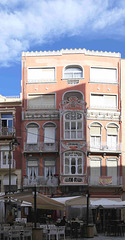
Cartagena - Calle Mayor
| |
|
|
|
The Iberian predecessor settlement of Cartagena was in 227 BC. naval and military base, de facto the capital of the Carthaginians on the Iberian Peninsula. From here Hannibal set off for Italy at the beginning of the Second Punic War (218 BC). The Romans conquered the city in 209 BC. BC and called it Carthago Nova. Carthago Nova was the most important silver mining region of the Roman Empire. According to Polybius, 40,000 people worked in the silver mines here.
It was destroyed by the Vandals in 425, was probably Visigothic in 475, and Byzantine in 554. Under the name Carthago Spartaria, it was the capital of the Eastern Roman province of Spania before it became Visigoth again in 625. From 711, after the fall of the Visigothic Empire, it became part of the Todmir Empire, and in 756 it became part of the Emirate of Córdoba. Conquered by King James I (Jaime el Conquistador) in 1269, it came to Aragon in the course of the Christian Reconquista, now called Cartagena.
The "Calle Mayor" is the old main street near the port. There are many restaurants and bars but also interesting buildings.
Jaén
| |
|
|
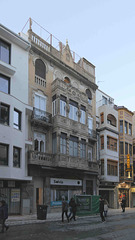
A town may have existed here since ancient times, it was seized by Scipio Africanus away from Carthage by 207 BC, in the context of the Second Punic War.
Following the Umayyad conquest of the Iberian Peninsula, the city became the head of an important territory with some similarities to the current province. Jaén was conquered by the Almoravids in 1091.
Taken in 1159 by Ibn Mardanīš (aka "Rey Lobo"), who was opposed to the spread of the Almohad Empire, it fell back to the Almohads in 1169. In 1225, Fernando III of Castile unsuccessfully laid siege to Jaén. The city was besieged again in 1230 by Fernand who lifted the siege after the news of the death of his father, Alfonso IX of León.
In 1246 Muhammad I of Granada surrendered to Fernndo. Following the conquest the Diocese of Baeza was moved to Jaén.
During the Spanish Civil War, the city remained loyal to the Second Spanish Republic and was therefore bombed by the infamous German Condor Legion flying squadron on April 1, 1937. Current estimates suggest that 159 residents were killed and several hundred injured in the bombing.
Jaén
| |
|
|
A town may have existed here since ancient times, it was seized by Scipio Africanus away from Carthage by 207 BC, in the context of the Second Punic War.
Following the Umayyad conquest of the Iberian Peninsula, the city became the head of an important territory with some similarities to the current province. Jaén was conquered by the Almoravids in 1091.
Taken in 1159 by Ibn Mardanīš (aka "Rey Lobo"), who was opposed to the spread of the Almohad Empire, it fell back to the Almohads in 1169. In 1225, Fernando III of Castile unsuccessfully laid siege to Jaén. The city was besieged again in 1230 by Fernand who lifted the siege after the news of the death of his father, Alfonso IX of León.
In 1246 Muhammad I of Granada surrendered to Fernndo. Following the conquest the Diocese of Baeza was moved to Jaén.
During the Spanish Civil War, the city remained loyal to the Second Spanish Republic and was therefore bombed by the infamous German Condor Legion flying squadron on April 1, 1937. Current estimates suggest that 159 residents were killed and several hundred injured in the bombing.
Art Nouveau
Córdoba - Plaza de las Tendillas
| |
|
|
Córdoba shares its history with many cities in Southern Spain. It was Carthaginian and Roman (from 260BC on), later it belonged to the Byzantine Empire for two decades, was looted by the Vandals before the Visigoths conquered it in 572. In 711 it was taken by the by the Umayyad army and became a provincial capital.
At that time a Christian church erected by the Visigoths was on the site, it was divided and shared by Muslims and Christians. In 784 the Christian half was purchased by Emir Abd al-Rahman I, who then demolished the church and started to build the grand mosque of Córdoba on its ground. The Mezquita reached its current dimensions in 987 with the completion of the outer naves and courtyard. It covers an area of more than 23.000 m².
But there is much more than the breathtaking Mezquita.
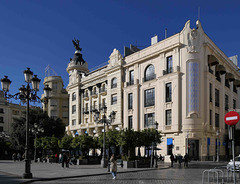
The Plaza de las Tendillas has been known since the 14th century. The current dimensions of the square were built in 1923. Most of the current buildings were built in this decade.
The "La Unión y el Fénix" building is the work of the architect Benjamín Gutiérrez Prieto and was built between 1926 and 1927 by the insurance company of the same name.
Córdoba - Plaza de las Tendillas
| |
|
|
Córdoba shares its history with many cities in Southern Spain. It was Carthaginian and Roman (from 260BC on), later it belonged to the Byzantine Empire for two decades, was looted by the Vandals before the Visigoths conquered it in 572. In 711 it was taken by the by the Umayyad army and became a provincial capital.
At that time a Christian church erected by the Visigoths was on the site, it was divided and shared by Muslims and Christians. In 784 the Christian half was purchased by Emir Abd al-Rahman I, who then demolished the church and started to build the grand mosque of Córdoba on its ground. The Mezquita reached its current dimensions in 987 with the completion of the outer naves and courtyard. It covers an area of more than 23.000 m².
But there is much more than the breathtaking Mezquita.
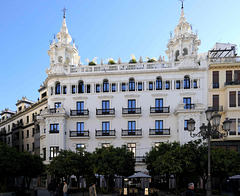
The Plaza de las Tendillas has been known since the 14th century. The current dimensions of the square date from 1923. Most of the current buildings were built in this decade.
The Palacio Colomera was designed in 1928 by the architect Félix Hernández Giménez and erected for the Counts of Colomera. There has been a four-star hotel in the building since 2018.
Jerez de la Frontera - El Gallo Azul
| |
|
|
After the collapse of the Roman Empire, the Vandals and the Visigoths ruled the area until in 711 the Arabs defeated the troops of Visigoth King Roderic in a battle near Jerez.
In 1145 the Almohads conquered the city. In the 12th and 13th centuries, Jerez underwent a period of great development, building its defense system and setting the current street layout of the old town.
In 1231 the Battle of Jerez took place. Christian troops under the command of Álvaro Pérez de Castro, grandson of Alfonso VII, defeated the troops of the Emir Ibn Hud. After a month-long siege in 1261, the city surrendered to Castile, but its Muslim population remained. It rebelled and was finally defeated in 1264.
Today Jerez de la Frontera has well over 200,000 inhabitants.
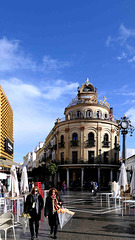
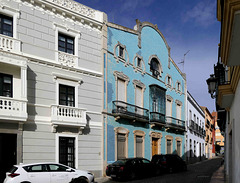
This almost circular building on the busy "Calle Larga" is called "El Gallo Azul". The Domecq family (still in Sherry business) commissioned the architect Aníbal González to erect this building. Work began in 1927 and ended the following year.
Zafra
| |
|
|
In ancient times, Zafra was located on the Via de la Plata, a road fortified by the Romans between Hispalis (Seville) and Asturica Augusta (Astorga). There are ruins of several Roman estates in the area. In the early 8th century the region was taken by the Moors, whose rule under the Umayyads, Almoravids, and Almohads lasted until the 13th century.
During the Reconquista, Zafra was captured twice, first in 1229 by Alfonso IX, and then in 1241 definitively by Ferdinand III. The area was then repopulated ("repoblación") by settlers from the north of the peninsula. In 1394, Henry III handed over the towns of Feria and Zafra to Gómez Suárez de Figueroa, the Grand Master of the Order of Santiago.
Merida - Plaza de España
| |
|
|
In the Roman Empire, the city was known as "Emerita Augusta", the capital of the province of Lusitania. It was founded in 25 BC by Emperor Augustus as a colony for the veteran soldiers ("emeritus") of the Roman legions. The city was very important in Roman Hispania. It was endowed with all the comforts of a large Roman city and served as the capital of the Roman province of Lusitania. For centuries, until the fall of the Roman Empire, Mérida was an important economic, military, and cultural center.
Following invasions from the Visigoths, Mérida remained an important city of the Visigothic Kingdom of Hispania in the 6th century. In 713, the Arabs conquered the city and devastated it. Even under Islamic rule, Mérida remained a bishop's seat until it was moved to Santiago de Compostela in 1119.
In 1230 the Christian troops under Alfonso IX conquered Mérida during the Reconquista.
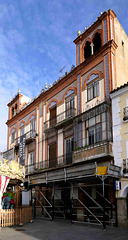
This formerly very prestigious house on the Plaza de España had obviously been scaffolded for a long time. There had been a Chinese store here a long time ago. Some azulejos were still to be found.
Just found out that the building once was called "Palacio de la China"
Cáceres - Art Nouveau
| |
|
|
|
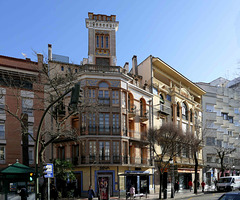
Cáceres goes back to the Roman fortress Castra Caecilia, which was built in 79 BC. A Celtiberian settlement that dates back to around 35 BC. In the 6th century, large parts of the city were destroyed by the invading Visigoths and only later rebuilt by the Moors. The Arabs rebuilt the city, including a wall, palaces, and various towers.
Cáceres was reconquered by the Christians in 1229. During this period the city had an important Jewish quarter. In the 15th century when the total population was 2,000, nearly 140 Jewish families lived in Cáceres. The Jewish population was expelled by Queen Isabella and Ferdinand of Aragon in 1492.
Cáceres flourished during the Discovery of the Americas, as influential Spanish families and nobles built homes and small palaces there, and many members of families from Extremadura participated in the voyages where they made their fortunes.
Today Cáceres is a city with a population of about 100.000.
Badajoz - Casa Álvarez Buiza
| |
|
|
With more than 150,000 inhabitants, Badajoz is the most populous municipality and the largest economic center in Extremadura.
The city was founded around 875 by Ibn Marwan. Under his successors, was the capital of an emirate that encompassed the Spanish Extremadura and, in the 11th century, almost all of Portugal. In 1094 the city was conquered by the Almoravids.It was conquered in 1230 by Alfonso IX. and permanently taken from the Moors by León.
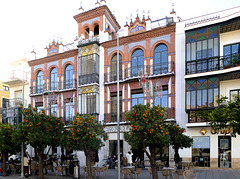
The Casa Álvarez Buiza is an outstanding building within the Andalusian regionalism style of Art Nouveau. It stands out for the profuse use of decorations of tiles, glazes, and exposed brick. Today it hosts a Cervecería and the Colegio de Aparejadores.
Aveiro
| |
|
|
|
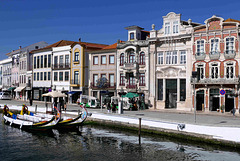
With around 80,000 inhabitants, Aveiro is the second largest city in the Centro region (after Coimbra).
Aveiro was a center of salt production and a trading center in the Middle Ages.
Born in Aveiro in the 16th century, Joao Affonso was one of the first seafarers to visit the rich fishing grounds of Newfoundland, and Aveiro's fishermen soon took an active part in the lucrative fishing industry there. As a result, the population rose to 14,000 inhabitants.
Due to a storm, the harbor entrance silted up in 1575 to such an extent that shipping and fishing were severely impaired. Fertile land became marshy. The population fell to around 3,500 by the end of the 18th century. Aveiro was slow to recover. In 1808, after several unsuccessful attempts, a new port entrance was opened.
Aveiro - Art Nouveau
| |
|
|
With around 80,000 inhabitants, Aveiro is the second largest city in the Centro region (after Coimbra).
Aveiro was a center of salt production and a trading center in the Middle Ages.
Born in Aveiro in the 16th century, Joao Affonso was one of the first seafarers to visit the rich fishing grounds of Newfoundland, and Aveiro's fishermen soon took an active part in the lucrative fishing industry there. As a result, the population rose to 14,000 inhabitants.
Due to a storm, the harbor entrance silted up in 1575 to such an extent that shipping and fishing were severely impaired. Fertile land became marshy. The population fell to around 3,500 by the end of the 18th century. Aveiro was slow to recover. In 1808, after several unsuccessful attempts, a new port entrance was opened.
Jump to top
RSS feed- Latest items - Subscribe to the latest items added to this album
- ipernity © 2007-2026
- Help & Contact
|
Club news
|
About ipernity
|
History |
ipernity Club & Prices |
Guide of good conduct
Donate | Group guidelines | Privacy policy | Terms of use | Statutes | In memoria -
Facebook
X
