

Merida - Templo de Diana
Merida - Templo de Diana
Merida - Alcazaba
Merida - Alcazaba
Merida - Cervecería Baviera
Merida - Calle Santa Beatriz de Silva
Merida - Museo de Arte Visigodo
Merida - Museo de Arte Visigodo
Merida - Museo de Arte Visigodo
Merida - Museo de Arte Visigodo
Merida - Museo de Arte Visigodo
Merida - Basílica de Santa Eulalia
Merida - Basílica de Santa Eulalia
Merida - Basílica de Santa Eulalia
Merida - Basílica de Santa Eulalia
Merida - Funeraria de los Columbarios
Merida - Casa del Mithraeum
Merida - Casa del Mithraeum
Merida - Casa del Mithraeum
Alcuéscar - Nuestra Señora de la Asunción
Arroyo Magasquilla
Trujillo
Trujillo - Francisco Pizarro
Merida - Mercado De Calatrava
Merida - Azulejos
Merida - Azulejos
Merida - Acueducto de los Milagros
Merida - Acueducto de los Milagros
Merida - Puente Romano
Merida - Azulejos
Merida - Azulejos
Merida - Plaza de España
Merida - Teatro romano
Merida - Teatro romano
Merida - Teatro romano
Merida - Anfiteatro
Merida - Plaza de España
Merida - Plaza de Toros
Zafra - Museo Santa Clara
Zafra - Museo Santa Clara
Zafra - Convento de Santa Clara
Zafra - Mercado de Abastos
Zafra - Santa María de la Candelaria
Zafra - Plaza Grande
Zafra - Plaza Grande
Location
Lat, Lng:
You can copy the above to your favourite mapping app.
Address: unknown
You can copy the above to your favourite mapping app.
Address: unknown
See also...
Keywords
Authorizations, license
-
Visible by: Everyone -
All rights reserved
-
117 visits
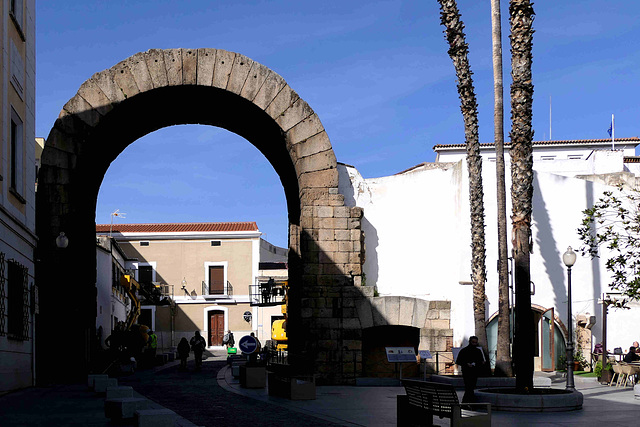
Merida - Arco de Trajano

In the Roman Empire, the city was known as "Emerita Augusta", the capital of the province of Lusitania. It was founded in 25 BC by Emperor Augustus as a colony for the veteran soldiers ("emeritus") of the Roman legions. The city was very important in Roman Hispania. It was endowed with all the comforts of a large Roman city and served as the capital of the Roman province of Lusitania. For centuries, until the fall of the Roman Empire, Mérida was an important economic, military, and cultural center.
Following invasions from the Visigoths, Mérida remained an important city of the Visigothic Kingdom of Hispania in the 6th century. In 713, the Arabs conquered the city and devastated it. Even under Islamic rule, Mérida remained a bishop's seat until it was moved to Santiago de Compostela in 1119.
In 1230 the Christian troops under Alfonso IX conquered Mérida during the Reconquista.
"Trajan's Arch" is a monumental Roman arch that was given this name because it was believed to be a triumphal arch at the time. However, there are no real connections to Trajan.
It is a semicircular arch about fifteen meters high. The span of the arch is almost nine meters.
Following invasions from the Visigoths, Mérida remained an important city of the Visigothic Kingdom of Hispania in the 6th century. In 713, the Arabs conquered the city and devastated it. Even under Islamic rule, Mérida remained a bishop's seat until it was moved to Santiago de Compostela in 1119.
In 1230 the Christian troops under Alfonso IX conquered Mérida during the Reconquista.
"Trajan's Arch" is a monumental Roman arch that was given this name because it was believed to be a triumphal arch at the time. However, there are no real connections to Trajan.
It is a semicircular arch about fifteen meters high. The span of the arch is almost nine meters.
Fred Fouarge, Alexander Prolygin have particularly liked this photo
- Keyboard shortcuts:
Jump to top
RSS feed- Latest comments - Subscribe to the comment feeds of this photo
- ipernity © 2007-2026
- Help & Contact
|
Club news
|
About ipernity
|
History |
ipernity Club & Prices |
Guide of good conduct
Donate | Group guidelines | Privacy policy | Terms of use | Statutes | In memoria -
Facebook
X

Sign-in to write a comment.