

Merida - Teatro romano
Merida - Teatro romano
Merida - Teatro romano
Merida - Plaza de España
Merida - Azulejos
Merida - Azulejos
Merida - Puente Romano
Merida - Acueducto de los Milagros
Merida - Acueducto de los Milagros
Merida - Azulejos
Merida - Azulejos
Merida - Mercado De Calatrava
Merida - Arco de Trajano
Merida - Templo de Diana
Merida - Templo de Diana
Merida - Alcazaba
Merida - Alcazaba
Merida - Cervecería Baviera
Merida - Calle Santa Beatriz de Silva
Merida - Museo de Arte Visigodo
Merida - Museo de Arte Visigodo
Merida - Museo de Arte Visigodo
Merida - Museo de Arte Visigodo
Merida - Plaza de España
Merida - Plaza de Toros
Zafra - Museo Santa Clara
Zafra - Museo Santa Clara
Zafra - Convento de Santa Clara
Zafra - Mercado de Abastos
Zafra - Santa María de la Candelaria
Zafra - Plaza Grande
Zafra - Plaza Grande
Zafra - Farmacia Buzo
Zafra
Zafra - Via de la Plata
Zafra - Palacio de los Duques de Feria
Zafra - Palacio de los Duques de Feria
Sevilla - Catedral de Santa María de la Sede
Sevilla - Catedral de Santa María de la Sede
Sevilla - Catedral de Santa María de la Sede
Sevilla - Catedral de Santa María de la Sede
Sevilla - Catedral de Santa María de la Sede
Sevilla - Catedral de Santa María de la Sede
Sevilla - Catedral de Santa María de la Sede
Sevilla - Catedral de Santa María de la Sede
Location
Lat, Lng:
You can copy the above to your favourite mapping app.
Address: unknown
You can copy the above to your favourite mapping app.
Address: unknown
See also...
Keywords
Authorizations, license
-
Visible by: Everyone -
All rights reserved
-
122 visits
Merida - Anfiteatro
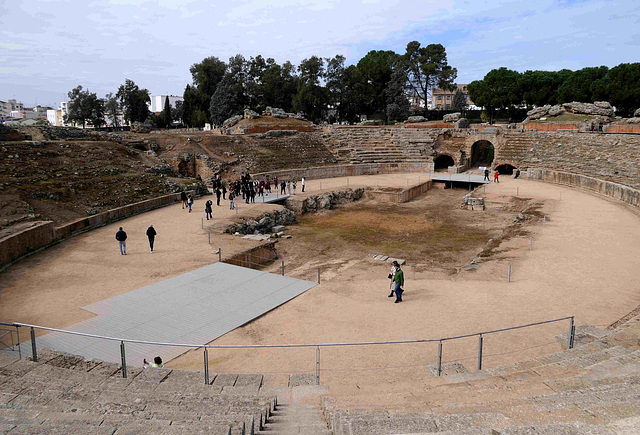

In the Roman Empire, the city was known as "Emerita Augusta", the capital of the province of Lusitania. It was founded in 25 BC by Emperor Augustus as a colony for the veteran soldiers ("emeritus") of the Roman legions. The city was very important in Roman Hispania. It was endowed with all the comforts of a large Roman city and served as the capital of the Roman province of Lusitania. For centuries, until the fall of the Roman Empire, Mérida was an important economic, military, and cultural center.
Following invasions from the Visigoths, Mérida remained an important city of the Visigothic Kingdom of Hispania in the 6th century. In 713, the Arabs conquered the city and devastated it. Even under Islamic rule, Mérida remained a bishop's seat until it was moved to Santiago de Compostela in 1119.
In 1230 the Christian troops under Alfonso IX conquered Mérida during the Reconquista.
The "Anfiteatro de Mérida" is a ruined Roman amphitheater. Emerita Augusta, was founded in 25 BC the amphitheatre itself was completed in 8 BC. The building was intended for gladiatorial fights and combats between beasts or men and beasts. The stands had a capacity of approximately 15,000 spectators.
The amphitheater is part of the Archaeological Ensemble of Mérida, which is one of the most extensive archaeological sites in Spain. It was declared a World Heritage Site by UNESCO in 1993.
Following invasions from the Visigoths, Mérida remained an important city of the Visigothic Kingdom of Hispania in the 6th century. In 713, the Arabs conquered the city and devastated it. Even under Islamic rule, Mérida remained a bishop's seat until it was moved to Santiago de Compostela in 1119.
In 1230 the Christian troops under Alfonso IX conquered Mérida during the Reconquista.
The "Anfiteatro de Mérida" is a ruined Roman amphitheater. Emerita Augusta, was founded in 25 BC the amphitheatre itself was completed in 8 BC. The building was intended for gladiatorial fights and combats between beasts or men and beasts. The stands had a capacity of approximately 15,000 spectators.
The amphitheater is part of the Archaeological Ensemble of Mérida, which is one of the most extensive archaeological sites in Spain. It was declared a World Heritage Site by UNESCO in 1993.
kiiti has particularly liked this photo
- Keyboard shortcuts:
Jump to top
RSS feed- Latest comments - Subscribe to the comment feeds of this photo
- ipernity © 2007-2026
- Help & Contact
|
Club news
|
About ipernity
|
History |
ipernity Club & Prices |
Guide of good conduct
Donate | Group guidelines | Privacy policy | Terms of use | Statutes | In memoria -
Facebook
X

Sign-in to write a comment.