

Korbach - St. Nikolai
Korbach - St. Nikolai
Korbach
Korbach - St. Kilian
Korbach - St. Kilian
Korbach - St. Kilian
Korbach - St. Kilian
Korbach - St. Kilian
Autmn
Hannoversch Münden - Town Hall
Hannoversch Münden - St. Blasius
Hannoversch Münden - St. Blasius
Hannoversch Münden - St. Blasius
Hannoversch Münden - St. Blasius
Bredelar - Kloster
Bredelar - Kloster
Bredelar - Kloster
Bredelar - Kloster
Thülen - St. Dionysius
Thülen - St. Dionysius
Brilon - Rathaus
Brilon
Brilon - Petrusbrunnen
Göttingen
Göttingen - St. Johannis
Göttingen - St. Johannis
Göttingen - Universitäts Apotheke
Göttingen - Junkerschänke
Worbis - St. Antonius
Worbis - St. Antonius
Worbis - St. Antonius
Schulpforte - Zisterzienserabtei Pforte
Schulpforte - Zisterzienserabtei Pforte
Schulpforte - Zisterzienserabtei Pforte
Schulpforte - Zisterzienserabtei Pforte
Schulpforte - Zisterzienserabtei Pforte
Schulpforte - Zisterzienserabtei Pforte
Schulpforte - Zisterzienserabtei Pforte
Schulpforte - Zisterzienserabtei Pforte
Schulpforte - Zisterzienserabtei Pforte
Schulpforte - Zisterzienserabtei Pforte
Schulpforte - Zisterzienserabtei Pforte
Leiha - Gumball Machine
Naumburg - Gumball Machine
Freyburg - Marienkirche
Location
Lat, Lng:
You can copy the above to your favourite mapping app.
Address: unknown
You can copy the above to your favourite mapping app.
Address: unknown
See also...
Keywords
Authorizations, license
-
Visible by: Everyone -
All rights reserved
-
125 visits
Korbach - Rathaus
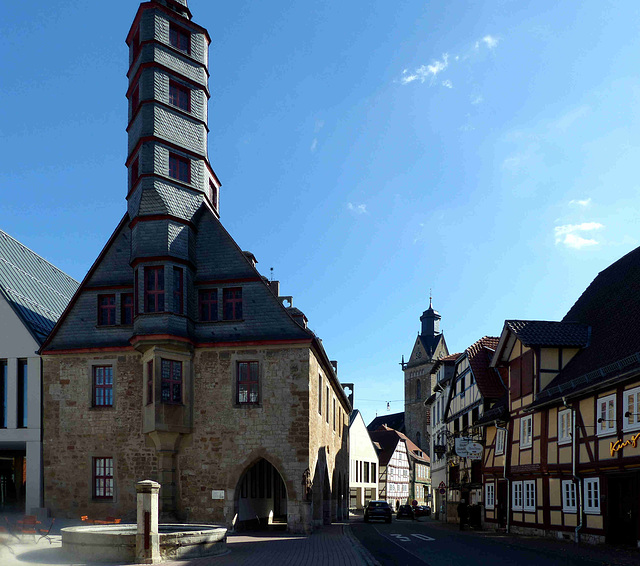

Korbach was granted town rights in 1188 by the Bishop of Paderborn Bernhard II. granted town rights under Soest law. Owing to the location at the crossroads of the Cologne-Leipzig and Frankfurt-Bremen commercial roads, handicrafts and trade quickly developed and Korbach blossomed. In the 14th century, Saint Kilian's Church (Kilianskirche) and St. Nicholas's Church (Nikolaikirche) were built. Korbach joined the Hanse and was first mentioned as a member town of the Hanseatic League in 1469. The Korbach merchants traded in cloth, skins and beer, as well as gold and other metals from the surrounding area. In 1414, a double ring of walls surrounding the whole town was finished.
With the coming of the Reformation, the town, and indeed the whole County of Waldeck, became Protestant.
With the coming of the Reformation, the town, and indeed the whole County of Waldeck, became Protestant.
Marco F. Delminho, appo-fam, Paolo Tanino have particularly liked this photo
- Keyboard shortcuts:
Jump to top
RSS feed- Latest comments - Subscribe to the comment feeds of this photo
- ipernity © 2007-2026
- Help & Contact
|
Club news
|
About ipernity
|
History |
ipernity Club & Prices |
Guide of good conduct
Donate | Group guidelines | Privacy policy | Terms of use | Statutes | In memoria -
Facebook
X

Sign-in to write a comment.