

Super symmetry-0250727 095648(1)
20250731 122900(1)(1)
Saint Annes lace DSC 5040
DSC 5147
white-2-DSC 4954 1(1)
Orange_street_DSC 5213(1)(1)
Saint Suplice Seminary Old Montreal DSC 5220(1)
Orange roadworks_DSC 5229(1)
ROSE-CHAMPLAIN 2
demolition sunset IMG 20230815 200014 (1)
DSC 5534
Darwin's house Kent_DSC5780
The Mermaid in Folkestone_20250908 155023
The Pink House in Folkestone 20250908 151119
Steak and ale pie_20250908 142515
I see you_20250911 072205(1)(1)
Wire-art DSC 5820(1)
GHOSTS
Deptford pink, 20250613 175811(1)(1)
The first red leaves_20250920
The Sandwalk, Down House DSC 5771(1)(1)(1)
DSC 5948(1)(2)
Woodpecker in the shadows DSC 5944(1)
Aquilegia_Columbine_DSC 3052
DSC 3547
redblobDSC 3436
Wild sweet pea IMG 20250706 014008
Conopholis Cancer-root or Bear corn_20250607 11142…
Sunset and pylons 20250630 210123
A sense of direction.
Sunset trees 20250615 205109
Head ROM DSC 1963 (3)
Boat by lake DSC 2944
20250617 142013(1)(1)
Smooth carrionflower Smilax herbacea DSC 2853(1)(1…
Poppy DSC 2888
Water avens G 20250608 205647
DSC 2701
20250511 151920
20250530 141821
In memoriam: H.T. C 1926-2025
Last tulips_2025_05
Virginia bluebells 1000031310
Virginia bluebells 20250518 090839
Wood ducks_20250510 215645
See also...
Keywords
Authorizations, license
-
Visible by: Everyone -
All rights reserved
-
146 visits
pinesapDSC 3275 cropped
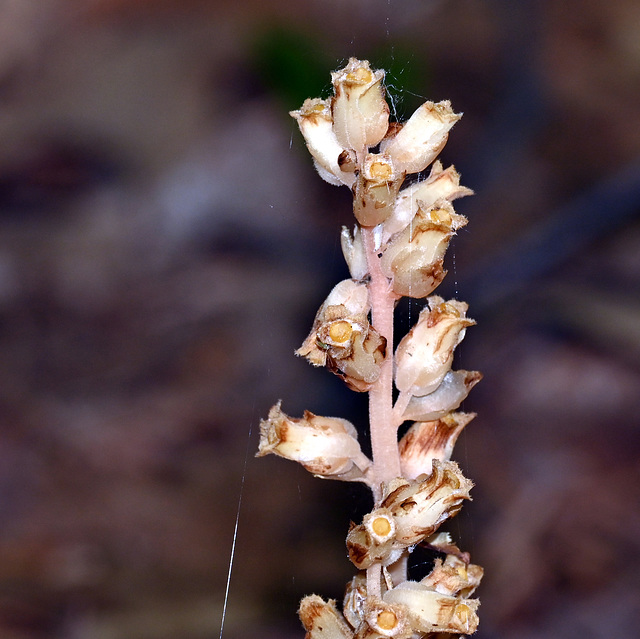

The parasitic plant Pinesap (Monotropha hypopitys) lacks chlorophyll and cannot photosynthesize but gathers all the metabolic carbon it needs from soil fungus. Trees photosynthesize and make sugars; they share some of this with their fungal partners and the fungus reciprocates by providing minerals to the trees. The pinesap steals these nutrients from the fungus. It is all rather devious.
Despite the name pinesaps are found near many trees. Where the photo was taken, there was a lot of birch, some beeches and maples but no pines. The stem here is very light pink, but sometimes it can be bright red (I haven’t seen that in life, only in photos). It occurs throughout the temperate Northern hemisphere and is part of the heath and heather family, Ericaceae which also includes blueberries, and cranberries as well as azaleas and rhododendrons.
Despite the name pinesaps are found near many trees. Where the photo was taken, there was a lot of birch, some beeches and maples but no pines. The stem here is very light pink, but sometimes it can be bright red (I haven’t seen that in life, only in photos). It occurs throughout the temperate Northern hemisphere and is part of the heath and heather family, Ericaceae which also includes blueberries, and cranberries as well as azaleas and rhododendrons.
Günter Klaus, Guydel, William Sutherland, Nouchetdu38 have particularly liked this photo
- Keyboard shortcuts:
Jump to top
RSS feed- Latest comments - Subscribe to the comment feeds of this photo
- ipernity © 2007-2026
- Help & Contact
|
Club news
|
About ipernity
|
History |
ipernity Club & Prices |
Guide of good conduct
Donate | Group guidelines | Privacy policy | Terms of use | Statutes | In memoria -
Facebook
X

Andrew Trundlewagon club has replied to William Sutherland clubWünsche noch ein schönes Wochenende,liebe Grüße Güni :))
Andrew Trundlewagon club has replied to Günter Klaus clubSign-in to write a comment.