

Rangoli
Tender coconuts
Small business, I think
Barbaque Nation
Adigas. Banngalore
The Good, the Bad and the "Idli"
"Toska" / тоска
A street scene @ Bangalore
Workers temporary shelter
Adiga's Interior
Most eligible bachelor in town
Car Street
Krishna Muta tank
A break & a snack in between a game
Warning ~ A Photo I.D -- a must
Ladders
Pots
Basava
Side walk sale
Channa Batura / Puri
TTN Broadband
Residential Area
A street scene
Beyond the chopped tree
At Japanese Tea Garden
Dawn
Hungry
Eke out living
Designed to run
Withered
See also...
Keywords
Authorizations, license
-
Visible by: Everyone -
All rights reserved
- Photo replaced on 28 Aug 2015
-
27 visits
Custard Apple
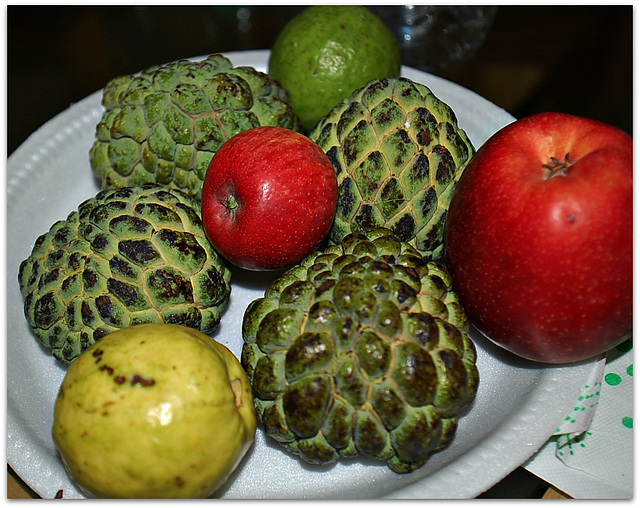

Custard apple evolution began in the West Indies and the tropical regions of the Americas, as they are native to the New World tropics. Human selection and natural processes like cross-pollination have led to the diverse "locally adapted landraces" seen today, a process involving significant genetic changes for traits like flavor, size, and hardiness, as seen in the genetic analysis of A. squamosa. Spanish and Portuguese traders, who carried seeds to Africa, India, and Southeast Asia, facilitated its global spread
- Keyboard shortcuts:
Jump to top
RSS feed- Latest comments - Subscribe to the comment feeds of this photo
- ipernity © 2007-2026
- Help & Contact
|
Club news
|
About ipernity
|
History |
ipernity Club & Prices |
Guide of good conduct
Donate | Group guidelines | Privacy policy | Terms of use | Statutes | In memoria -
Facebook
X

The custard apple (genus Annona) is native to the tropical Americas, with evidence suggesting origins in the West Indies, Central America, and northern South America.
Human Dispersal:
Spanish and Portuguese traders were crucial in spreading the fruit. The Spaniards likely brought it to the Philippines, while the Portuguese are thought to have introduced it to southern India in the 16th century.
Global Distribution:
From these initial introductions, the custard apple spread to tropical Africa and eventually to Southeast Asia and some Pacific islands.
Genetic and Evolutionary Processes
Natural Selection:
Environmental factors, such as temperature and humidity, influence the types of custard apples that thrive in different locations.
Human Selection:
Farmers have selected and propagated desirable varieties over centuries, a process known as artificial selection. This has resulted in the wide variety of locally adapted landraces.
Genetic Studies:
Modern genetic analysis of species like Annona squamosa (sugar apple), provides insights into its evolutionary history, identifying adaptive gene family expansions related to photosynthesis, sugar metabolism, and flavonoid biosynthesis.
Cross-Pollination:
Honey bees act as carriers of cross-pollination, which also contributes to the genetic diversity and adaptation of local cultivars.
Factors Influencing Evolution
Climate and Habitat:
The fruit requires specific conditions, such as cool winters and high humidity during flowering, which drives local adaptation.
Dispersal:
The movement of seeds by humans and animals has been a key factor in the geographical spread and subsequent diversification of the species.
Selective Breeding:
Intentional efforts in breeding programs have created new cultivars, such as the Australian custard apple which developed from a program in Queensland.
Sign-in to write a comment.