


Textiles

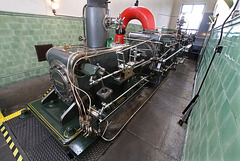
Mill engine
| |
|
|
In the engine house at Queen Street Mill is this 500 hp horizontal tandem engine. It is named "PEACE" and was built by William Roberts & Co of Nelson in 1894.
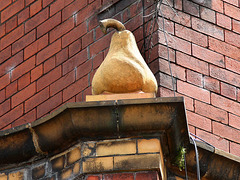
Pear
| |
|
|
Construction of the Pear Mill in Bredbury, Stockport, commenced in 1908 and it was finally completed in 1913 after significant financial difficulties. The mill was designed by Abraham Stott junior and his brother, Philip Sidney, was responsible for the finishing stages, including the office building. It incorporates a lot of terracotta decoration including numerous pear motifs. This is one of a number of pears adorning the enginehouse and chimney.
Transformers
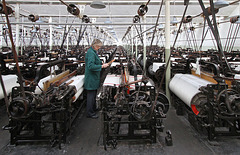
Looms
| |
|
|
Queen Street Mill at Harle Syke, Burnley, was built in 1894 for the Queen Street Manufacturing Company for weaving plain cotton fabric. The business saw little modernisation up to closure in 1982 since when the mill has been run as a museum, still operated by the 500 hp steam engine. The weaving shed once housed nearly 1,000 Lancashire looms and even today there are 300 looms. When running the noise is deafening. Sadly Lancashire County Council have announced closure of the museum and although a reprieve was given for the summer the future is still not looking good for this historic gem.
Dean Clough Mills
| |
|
|
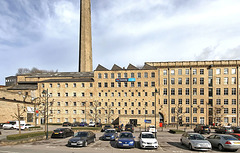
Dean Clough Mills in Halifax are a group of large factory buildings built in the 1840s - 60s for Crossley's Carpets, becoming one of the world's largest carpet factories (half a mile long with 1,250,000 square feet of floorspace). After years of declining production it closed in 1983, when it was bought by a consortium led by Sir Ernest Hall which developed the Grade II listed site for various commercial and cultural uses. It is now seen as a leading example of successful urban regeneration. The converted mills now house about 150 large and small businesses and arts venues.
Marmion clothing factory
| |
|
|
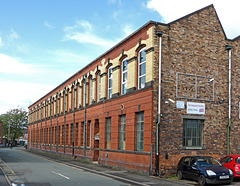
This seven aisled building with north light roof was built by the Crewe Publishing and Printing company 1877 and was then bought by Coop & Co., Ltd after 1887 who began to manufacture clothes in the premises. In 1898 it was remodelled for the firm of W. H. L. Cameron of Manchester extensively and christened the "Marmion Works". Cameron sold the works to the Co-operative Wholesale Society in 1917 and production recommenced in 1918 and juvenile clothing became a speciality. Two extensions were added in 1931 and 1937-8.
Boilerhouse
| |
|
|
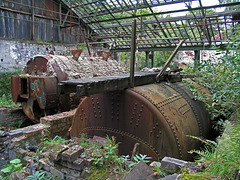
Probably the best surviving features at the Cheadle Bleachworks at the time of this photo were the two boilers. The Lancashire type to the right and the more modern oil or gas fired successor on the left. I strongly suspect that the white insulation that was lying all around was asbestos.
Springfield Mill
| |
|
|
|
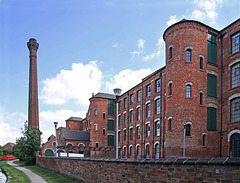
Springfield Mill in Sandiacre was built in 1888 as a lace factory for Terah Hooley, a wealthy local industrialist, by architect John Sheldon of Long Eaton. The total capacity of the factory was originally 160 machines. It has now been converted to apartments and is listed Grade II.
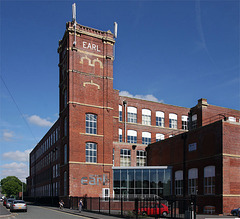
Earl Mill, Hathershaw 05
| |
|
|
This cotton spinning mill at Hathershaw, Oldham, was originally built in 1860 and then rebuilt 1891 to the design of architect PS Stott. Production ceased in 1933 and the mill was used as an army barracks and then a demobilisation centre before becoming a mail order warehouse in 1953. It is now converted to business units.
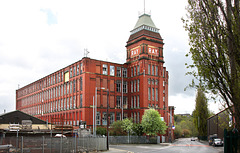
Ray Mill - the end
| |
|
|
On the night of Saturday 17th March Ray Mill at Stalybridge burned down.
It was built for Ray Mills Ltd which was registered in 1907 with a capital of £100,000. Completed in 1908 it was electrically powered from the outset. In 1911 it was joined with the nearby Victor and Premier Mills under the name of Victor Mill Ltd. Ray Mill contained 66,528 ring spindles and over 9,000 doubling spindles when completed. Courtaulds took over the mills in the 1960s and cotton spinning ended in 1982. The mill continued in multiple occupation including warehousing.
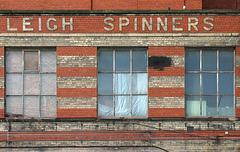
Leigh Spinners
| |
|
|
|
The Park Lane cotton spinning mills of Leigh Spinners date from 1913 and 1923. In latter years they were used for making carpets but are now subject to restoration for business and community use. This includes restoration of the steam engines that remain in situ. The buildings are listed Grade II*.
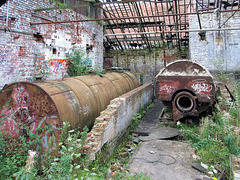
Boilers in retirement
| |
|
|
Derelict boilers amidst the remains of the Cheadle Bleachworks. The site was cleared for housing soon after I took this photo.
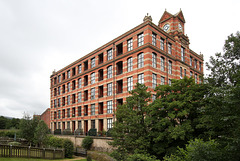
No.3 Twist Mill or Brook Mill
| |
|
|
|
Eagley Mills, Eagley, Bolton were developed from the 18th century. This mill building, constructed in 1871, was burned out in 1886 and was rebuilt in 1887 as the present building, which is Grade II listed. It is built of brick in 5 storeys with stone banding and a slate roof and a rectangular floor plan of 14 by 6 bays. It was mainly used for finishing and winding until 1903, after which it carried out twisting and winding.
In 2003 it was converted to residential accommodation and now has 64 apartments on four floors.
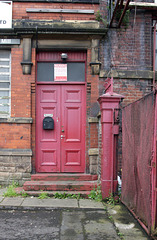
Mill entrance
| |
|
|
Chadderton Mill was designed by P. S. Stott (his first mill) and built in 1885 by the Chadderton Mill Co Ltd. Spinning ended in 1989 and then it reverted to doubling, and finally winding, before being sold by Courtaulds to Shiloh Spinners who continued working here until June 2000.
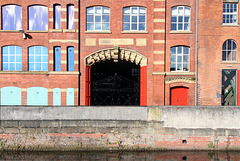
Royal Mill
| |
|
McConnel and Kennedy rebuilt their Old Mill in 1912 as a cotton spinning mill driven by electricity. The construction used Accrington brick with embellishment in gritstone. It was renamed Royal Mill in 1942 after a visit by the King and Queen. The wall in front forms the edge of the Rochdale Canal. It is now mainly used as apartments.
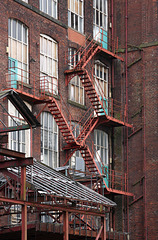
Escape route
| |
|
|
Chadderton Mill was designed by P. S. Stott (his first mill) and built in 1885 by the Chadderton Mill Co Ltd. Spinning ended in 1989 and then it reverted to doubling, and finally winding, before being sold by Courtaulds to Shiloh Spinners who continued working here until June 2000.
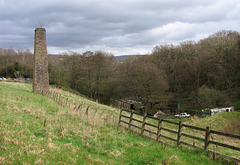
Springwater Mill
| |
|
This chimney is the most substantial of the remains of this interesting industrial location.
The mill had several uses throughout its life, but it appears to have originated as a bone and madder grinding mill, probably being closely linked with Strines Print Works as a supplier of red-madder dye. This substance was extracted from the roots of the madder plant, and the preliminary process would be the grinding of these roots to a powder. Strines Print Works was established about 1790, and the bone and madder grinding mill might be similarly dated. Cotton spinning also took place in this area about that time, as Pigot's Directory, 1824-25 lists a firm called Mosley and Howard as cotton spinners at Strines Hall. The mill building was offered for lett ing in an advertisement of 12 July 1833 in the Stockport Advertiser which reads, 'All that erection or building at Turf Lee lately occupied as a bone and madder mill with steam engine, boiler, shafting, reservoir and a spring of water, and one or two cottages adjoining thereto. The building is 2 storeys high, 14 yards long x 12 yards wide, and the engine is 10 hp. Water from a rock spring, perfectly clean, at 40 gallons per minute. The property is near good roads and within a short distance from the Peak Forest Canal. The premises are well adapted for printing silks or bleaching purposes'.
It seems that the building was taken by a Mr Thomas Bruce Jnr, of Marple, and converted into a calico print works, but the business was short lived and must not have prospered, as a sale notice of 15 April 1836 in the Stockport Advertiser reads:
'To be sold by auction at the print works of Mr Thomas Bruce, Jnr of Marple, known as the Springwater Print Works, all stock in trade, machinery, utensils and materials for the printing of calicos consisting of In Machine Room - a number of copper rollers with the newest patterns, one two-colour machine frame for same. In Boiler House and Stove Room - drying rails and perforated cylinder for steaming pieces. In Dye House - a Fly Dung Vessel with rollers complete, and two dye cisterns, etc. In Wash House - dash wheel, a square wood cistern and winch, a pair of squeezers, fly winch and cistern. In Print Shop - 10 tables with frames, tier and tubs complete, 2 tables and frames not set up.
In Edging Room - rails and pieces for hanging pieces on. In Drug Room - a quantity of drugs of various kinds. In Colour Shop - a large copper pan for decocting, colour pots and mugs copper pan and bath for making colours, one square copper pan and two other copper pans.
The above works are well worthy of the attention of persons engaged in the trade, or desirous of embarking thereon. The works have lately been completed at considerable expense, and are in the best possible repair and working condition.
There is an excellent and unfailing spring of water, and a steam engine of 8 hp'.
Another firm appears to have taken the premises for printing, but their occupation seems to have been brief in the extreme, for an advertisement of 10 September 1836 also in the Stockport Advertiser states, 'Sale by auction of Turf Lee Mill. The mill, buildings, reservoir and water privileges there situated, used as a print works and in the occupation of Messrs Briar and Dutton, together with the steam engine apparatus and a variety of printing utensils now on the premises, in use and in excellent condition. The spring produces 100 gallons of water per minute, and never fails in drought seasons.
It is the purest and best adapted for printing in the district. The premises have been long established'.
Another change of use took place either at this time or later to bleaching, and a further sale notice in the Advertiser dated 26 October 1849 offers, 'Springwater Mill at Turf Lee, now used as a bleach works, fitted with engine, boiler, etc, and now in the occupation of Mr James Cooper as tenant'. Throughout its life the mill has been referred to locally as the 'Bone Mill1, in the 1851 Census records for Marple there are cottages listed under the heading of 'Bone Mill' which must have been situated adjoining the mill. James Cooper, described as a Master Bleacher, and his wife occupied one of them, and two men living in the other two are described as bleachers. There is a further mention of 'The Springwater Bleach Works of Mr Cooper' in an account of a walk round the Marple Boundary in 1855. Finally, an advertisement in the Stockport Advertiser dated 30 September 1904 offered for sale 'The plot of land partly covered with water and used as a reservoir at Turf Lee in Marple,and also all the buildings formerly used as a bleach works and known by the name of Springwater Mill, now in a ruinous condition’.
All that remains apart from the chimney oare the mill dam, with a swampy area which was the mill pond, and various ruined buildings and walls.
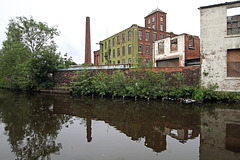
Norwich Street Mills
| |
|
|
|
Former cotton spinning and weaving mill in Rochdale, c1860. The building is listed Grade II. In 1891 it was owned by John Pilling, Norwich Street and Wellfield Mills; 40,000 spindles, 1,500 looms, mexicans, twills, printers, shirtings, &c.
Jump to top
RSS feed- Latest items - Subscribe to the latest items added to this album
- ipernity © 2007-2026
- Help & Contact
|
Club news
|
About ipernity
|
History |
ipernity Club & Prices |
Guide of good conduct
Donate | Group guidelines | Privacy policy | Terms of use | Statutes | In memoria -
Facebook
X
