


Australia


Burra rotunda
| |
|
|
|
If it isn't a bandstand then it ought to be. This cast and corrugated iron structure sits on a roundabout in the centre of Burra, South Australia. A bit of research reveals that it is the King Edward VII Rotunda which was erected by public subscruption in 1911 to commemorate the late king.

Orroroo Station
| |
|
|
The town of Orroroo in South Australia was connected by the Peterborough - Quorn railway line in September 1881, and was served by a Class 1 station and a large Goods Shed. During 1962, concrete grain silos were built in the Yard and these provided the bulk of traffic until the railway was closed in 1987.
Orroroo was the last attended station on the railway; staff were withdrawn and the station operated as "unattended" from August 1981. Passenger services were discontinued during 1969, when the South Australian Railways withdrew the railcar service.
Grain continued to be hauled by rail from Orroroo until 1987, when all rail services were withdrawn by Australian National. Steamtown, a railway preservation group based at Peterborough, operated passenger trains for tourists to Orroroo and Eurelia until 2002. The track was eventually removed in 2008.
The station building is currently (Jan 2022) for sale as a house.
Northern
| |
|
|
|
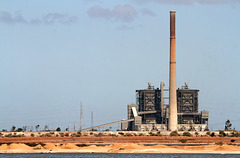
Northern Power Station was located at Port Paterson in the Australian state of South Australia about 6 kilometres south of Port Augusta. It was coal powered with two 260 MW steam turbines that generated a total of 520 MW of electricity. It was operated and maintained by Alinta Energy and was commissioned in 1985. The plant ceased electricity production in May 2016 and was decommissioned and demolished over the following few years. Also closed at that time were the nearby Playford B Power Station, and the Leigh Creek coal mine, 280 km to the north, that supplied them both with fuel.

Not a bandstand
| |
|
|
This cast and corrugated iron structure sits on a roundabout in the centre of Burra, South Australia. A bit of research reveals that it is the King Edward VII Rotunda which was erected by public subscription in 1911 to commemorate the late king.
Morphett's engine houses
| |
|
|
|
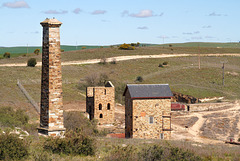
The Burra Burra Copper Mine (The Monster Mine) was established in 1848 mining the copper deposit discovered in 1845. Miners and townspeople migrated to Burra primarily from Cornwall, Wales, Scotland and Germany. The mine first closed in 1877, briefly opened again early in the 20th century and for a last time from 1970-1981. The Burra mines supplied 89% of South Australia's and 5% of the world’s copper for 15 years and the settlement has been credited (along with the mines at Kapunda) with saving the economy of the struggling new colony of South Australia.
The two enginehouses seen here are:
1. (left) Morphett's winding house, built in 1861 to wind rock from Hector shaft, begun in 1858. A 30 inch, 30hp engine with boilers was ordered from Thomas Williams in Devon. Williams actually ordered from Perran Foundry a 30hp rotative beam engine with a cylinder of only 20 inches. The engine house was erected about 300ft from the Hector shaft in order for the boiler house to be shared with Morphett's pumping engine. This had four boilers, to which two more were added for the winding engine. The engine was started in 1861 and was stopped in 1868 when the mine began to convert to opencut operations. It was adapted to drive dressing machinery some 550ft distant via an endless wire rope. A horizontal engine was erected at the dressing plant in 1874 and the winding engine then lay derelict until scrapped in 1916.
2.(right) Morphett's pumping engine house, built in 1858 by Cornish stonemasons Thomas Paynter and Ambrose Harris. It housed an 80 inch Cornish pumping engine purchased new from Perran Foundry which arrived at Burra over a six month period in 1858 with the 15 ton cylinder finally arriving in January of 1859. The engine was started in March 1860 and named after John Morphett, a director of the South Australia Mining Association which owned the mine. Operation of the engine ceased in November 1877 after the shaft had been deepened to the 100 fathom level. It was scrapped in 1916. The engine house was gutted by fire in 1926 but was subject to extensive restoration in 1986 when the upper part of the shaft was also retimbered. It now house an interpretive display relating to the engine and mine.
Face shovel
| |
|
|
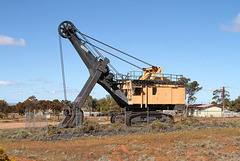
This is one of two electric face shovels seen at Iron Knob and surrounding area. It is a product of the Marion Power Shovel Company, Ohio, and may have worked at the Iron Baron ore mine. Earlier models shovels were first introduced at these mines in 1928 and at one time there were three or four Bucyrus-Erie 120B electric shovels in operation. The other survivor is on top of the spoil tip at Iron Monarch mine.
The information panel for this excavator states: "No. 7 Marion all electric shovel commissioned June 1965, cost $38,000. Taken out of service 14 October 1981 after digging more than 24 million tons. Carried own cable of 3300 V. With bucket of 18 tons cap."
Grain and cement
| |
|
|
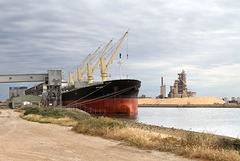
The grain silos at berth 27 of the inner harbour at Port Adelaide can supply wheat and barley to the ship loaders at up to 700 tonnes per hour. Viterra also has a newer deep water terminal in the outer harbour. In the right background is the works of Adelaide Brighton Cement. The ship is the Singapore registered bulk carrier 'Ocean Hiryu'.
Radioactive
| |
|
|
|
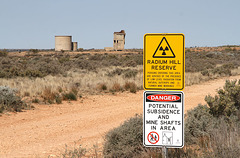
The Uranium Mine at Radium Hill operated from 1954-1961 and on closure the associated town was abandoned and largely demolished. In the background the remains of the ore bins and loading point close to the site of the shafts are probably the best surviving features of the mine itself. The site has now been closed off and visits banned.
Gibb's Garage
Delprat Shaft
| |
|
|
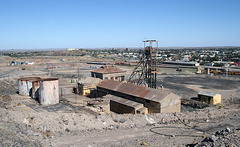
The Delprat shaft, which was commenced in 1900, is named after Broken Hill Proprietary general manager from 1899 to 1921, G D Delprat. The original wooden headframe was replaced in 1952 with the current steel structure. Winding here ceased in 1972 and the shaft has subsequently seen use as a tourist attraction until nearby mining operations caused its closure in 2007.
Long bus
| |
|
|
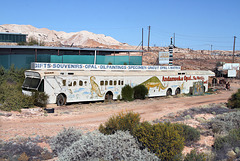
Andamooka is an opal mining town north of Roxby Downs in outback South Australia. There are several little museums and opal showrooms to have a browse through. The Long Bus is certainly eyecatching but was closed when I visited.
Whyalla furnace
| |
|
|
|
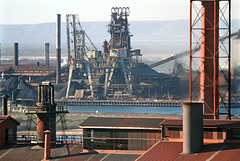
A view of the Whyalla blast furnace in South Australia, looking across the sinter plant.
The Whyalla Steelworks was operated by OneSteel and is a fully integrated steelworks and the only manufacturer of rail in Australia. It processes iron ore from the Middleback Range. Approximately 1.2 million tonnes of raw steel is produced in the steelworks each year, with about 65% of that transferred by rail to OneSteel's Market Mills as billets for further processing. The balance of the steel is then converted to finished products in the Whyalla Rolling Mill.
The works is now owned by the Liberty Steel division of Sanjeev Gupta’s GFG Alliance and appears to be struggling. There is a recent article about the works here:
www.theguardian.com/australia-news/2024/nov/03/its-been-seven-years-since-the-saviour-of-steel-arrived-in-whyalla-but-hopes-for-a-green-transition-are-fading
Silos
| |
|
|
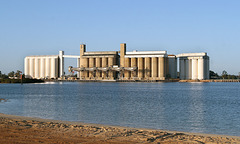
Viterra owned grain silos at Port Pirie on the Spencer Gulf in South Australia. The maximum loading capacity under the spouts was 800 tonnes per hour. The company last used the Port Pirie terminal as a direct export shipping facility in 2005 and grain from here is now sent by rail to the deep water berths at Port Adelaide.
Manoora tank
| |
|
|
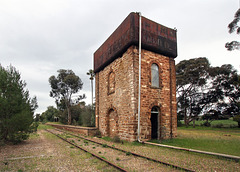
Manoora station is on the now closed line from a junction at Roseworthy to Peterborough, South Australia. This broad standard gauge line reached Manoora on 21 February 1870. Passenger services ended here in January 1984 and grain trains last used this line in 2004. The station remains in increasingly decrepit condition including this water tower constructed of local stone. On the tank can still just be seen the remains of the advertising that was commonly seen on such structures in South Australia.
Adelaide Cement
| |
|
|
|
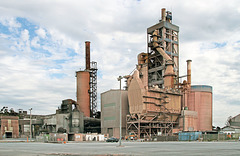
This works, operated by Adbri Cement, formerly known as Adelaide Brighton Cement was founded in 1882. After previous failed attempts going back to 1927, Adelaide Cement Company at Birkenhead and the South Australian Portland Cement Company, with origins at Brighton, merged in 1970 as Adelaide Brighton Cement Ltd. Adbri operates manufacturing and distribution facilities in South Australia, the Northern Territory, and New South Wales. The Birkenhead plant manufactures approximately 1.3 million tonnes per annum of clinker and 1.6 million tonnes per annum of bulk and bagged cement for the South Australian and Victorian markets and is one of South Australia’s biggest manufacturers.
Hughes' Enginehouse
| |
|
|
|
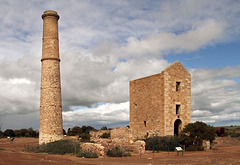
This enginehouse was built by John Beaglehole in 1865. It housed a 60-inch Cornish beam pumping engine which operates until 1923. A balance bob was added in 1866 and flat rods were were connected to a pump in Talor's Shaft in 1868.

Narrow Ghan
| |
|
|
|
Beyer Peacock 4-8-2 W934 climbing from Port Augusta towards Woolshed Flat with a train for Quorn on the Pichi Richi Railway. This line has many accessible spots for the train chaser to get a shot.
North Mine
| |
|
|
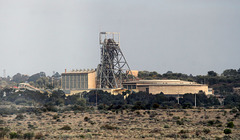
The North Mine at Broken Hill contains 3.7 million tonnes of ore at 11.3 per cent zinc, 13.5 per cent lead and 219 g/t silver making it one of the highest grade deposits in the world. In September 2008 it has placed on care and maintenance but was reopened in 2018.
This is the No. 3 shaft,which was commenced in 1948 and was commissioned in 1962. The depth of this shaft is 1,600 metres. The adjacent concentration mill became operational in 1939.
View from a passing train.
Jump to top
RSS feed- Latest items - Subscribe to the latest items added to this album
- ipernity © 2007-2026
- Help & Contact
|
Club news
|
About ipernity
|
History |
ipernity Club & Prices |
Guide of good conduct
Donate | Group guidelines | Privacy policy | Terms of use | Statutes | In memoria -
Facebook
X
