


Cheshire

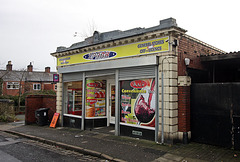
Former Co-op
| |
|
Typical terracotta for a Co-operative branch on this 1928 built shop on John Street, Macclesfield. After closure by the Co-op it became Dale's Oatcake Bakery for many years. I was hoping to find a nice lettered mosaic in the entrance under that mat, but sadly it was plain.
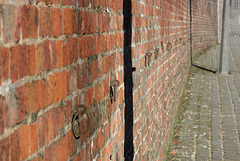
Macclesfield - last remnants of the cattle market
| |
|
A Friday question for the Macclesfield group. Where is this and what were they for?
I have been meaning to photograph this spot for ages, but the light has never been right when I was in the area. Today I seized my chance. Longer term residents should not have too much trouble in identifying this.
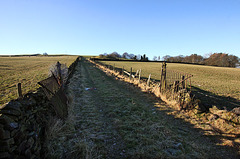
The colliery gates
| |
|
It being another sunny Friday, I set off in search of another of the Macclesfield Collieries although this one is actually just in Rainow. Eddisbury Colliery was operated by Jonathan Hully from the 1860s until at least the mid 1880s but does not appear on the mines list for 1896. In the Geological Memoirs of 1866 it states: 'The Big Mine (Feather-edge Coal) is worked on Eddisbury Hill, it is from four to six feet thick, but only fit for brick-kilns or lime burning' The Eddisbury pit was actually 69 yards deep to this seam which is now known as the Bassy Mine.
These are the gates that guarded access to the mine along the access track off the Buxton Road. The spoil heap is evident ahead.
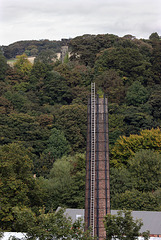
Two chimneys
| |
|
This one has been hanging around in my pending box since the Bollington Flickrmeet in 2008! A look from Chancery Lane over the valley to the brick chimney at Lower Mills and then on to the derelict stone chimney of the Oak Bank Print Works.

Blakelow Colliery 3
| |
|
Coal mining on the southern side of Macclesfield Common was concentrated around Blakelow via a number of shafts to the north-east of the current boundary of Macclesfield Golf Club. The Macclesfield Copper Company leased the Blakelow workings in the later eighteenth century and was extracting the coal from the two Holcombe Brook Seams using pillar and stall workings drained by a sough driven from lower down the hill towards Macclesfield town. The seams were thin and sometimes less than 2ft thick, but the quality was good enough to make it worthwhile extracting them.
The mound just above the frosted grass is the spoil heap and site of the third shaft at the colliery. There are sign of the loading bank in the sunken lane behind. The cart road back to the copper works is seen running steeply uphill at the right side and then turning left to pass Higher Blakelow Farm on its way to Lower Blakelow. It must have been hard work for the horses to surmount this bank, but once past Higher Blakelow it was all downhill. I am told that there is a fourth shaft, but this has now disappeared under the adjacent golf course.
Gas and Electric
| |
|
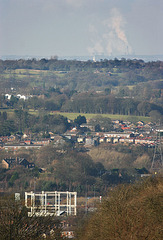
A different view of Macclesfield from the Buxton Road adjacent to Eddisbury Hill whilst I was looking at the remains of the Macclesfield coal industry. Fiddler's Ferry power station was busy that day.
Shaft on Ecton Hill
| |
|
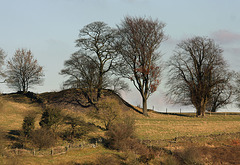
On of the Hulley pits is still evident on the top of the bank above Eddisburygate. The workings that produced this spoil heap were probably active in the late eighteenth or early nineteenth century. The Little Smut and Sweet seams are closest to the surface here.
James Swinnerton, Macclesfield Courier invoice 184…
| |
|
|
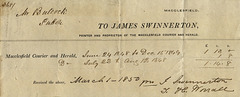
The Macclesfield Express newspaper is celebrating its bicentenary in 2011 and has just published a facsimile of the first edition of the Macclesfield Courier from which it has evolved over the years. In my collection of local ephemera are a number of invoices issued by James Swinnerton who was proprietor of the paper in the 1840s and 50s when it was published as the Macclesfield Courier and Herald. This example was sent to Mr Thomas Bullock of Sutton, a local silk manufacturer, invoicing him for his subscription to the paper. For eighteen months from June 1848 to December 1849 the cost was 33 shillings which is 22 shillings per annum. Today the paper costs 57p which is just slightly more than you would have paid for 6 months of issues in 1848!
The Trading Post
| |
|
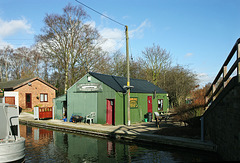
Eddie and Edith Burgess ran Constellation Cruises from the Nelson Arm at Higher Poynton for many years. After Eddie died the buildings slowly became more decrepit and eventually Edith sold the business and retired. The site is now the base of Braidbar boats who fit out narrowboat shells and the only survivor from earlier times is the former chandlery building that has metamorphosed into the ' Trading Post '. Chandlery is still available but you can also have a pump-out, buy diesel, or walkers can buy a cup of tea and something to eat along with a waterway magazine or two.
The Macclesfield Canal runs on the far side of the towpath bridge on the right and the water in view is on the private canal arm constructed for the use of Lord Vernon's Collieries when the canal was built and opened in 1831. It is only a couple of boats long and terminates alongside the modern bungalow seen on the left.
The Nelson Pit was situated somewhere near the birch tree and coal would be brought up the shaft and tipped straight into boats for shipment to the mills of Bollington, Marple and beyond. After winding of coal here ended in 1870 a stationary steam engine was installed to haul coal tubs up a tramroad from the Anson Pit. Loaded tubs destined for the canal were also brought to the Anson Pit on standard gauge railway wagons from the Park Pits some distance away. I believe that he last coal was shipped out from here in the early 1930s.
Being a long-established connection to the main canal means that British Waterways cannot demand an annual connection fee from Braidbar Boats, neither can they insist that any boat in the arm has to have a licence. This is a significant commercial advantage to the business.

Redacre Colliery
| |
|
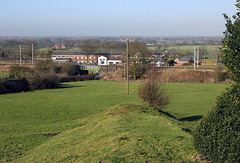
Another of those interesting bumps in the ground that need to be researched and explained. This lies in a narrow isthmus of the Parish of Pott Shrigley which bumps up against the three adjacent parishes of Lyme Handley, Poynton and Adlington and makes for some interesting coal mining development on the different estates.
In the late 1840s the land here was in the ownership of the executors of the late William Turner, textile manufacturer from Blackburn who had purchased a lot of Pott Shrigley from the Downes family in the early nineteenth century and then moved into their ancestral home at Shrigley Hall. The 1848 tithe map shows a trackway from a wharf on the canal to the site of this pit and I suspect that coal was being trammed up to the boats at this time by the lessees Samuel Hunt & Co. By the early 1880s the pit was being operated by the Needham family who had originated in nearby Worth but had for many years operated collieries in Hurdsfield, Macclesfield. George Needham is listed as owner and manager in an 1884 list of collieries, but he had died in 1880 and I suspect that by then the colliery was being run by his son Joseph who was living with his family at Red Acre at the time of the 1881 census. He stated his occupation as Engine Man as he had been since the 1850s at Hurdsfield. By 1888 operations appear to have ceased and the tramway is noted as disused. Joseph went off to Chorlton to become a coal merchant.
The tramroad embankment is seen running in from the right side of the photograph and the spoil tip of the pit is left centre. The extract from the 1882 Ordnance Survey map has the tramroad alignment running up from the bottom and the position from which the photograph was taken marked with a red X. The shaft here was 255ft deep to the Arley seam which is locally known as the Redacre Mine and is about 2ft thick. It is a good quality coal and burned well when I tried the pieces collected from the spoil tip.
Mr Williamson's railway
| |
|
In 1840 Robert Williamson opened the Tower Hill Colliery in Staffordshire, to the east of Mow Cop. To take coal to the markets available along the Macclesfield Canal he constructed a railway of 4ft 8ins gauge connecting Tower Hill and his nearby Trubshaw colliery to a wharf on the canal at Kent Green. Construction was under way quickly and the major work, a tunnel through the hill at Mow Cop, was being driven by February 1842. The line opened on Boxing Day 1842.
On the west side of the tunnel the line descended via two self-acting inclines to Kent Green. This view is from the remains of the embankment of the lower incline, looking down to where the line passed under the North Staffordshire Railway just before the wharf which is behind the long brick building that incorporates a canal warehouse. The white gable end is a building associated with the coal wharf. There is no trace of the underbridge by which the line passed under the main line railway, but it was situated just to the right of the road bridge.
The line closed with the pit in 1887.
39 High Street
| |
|
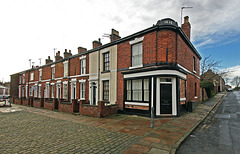
This row of houses on High Street, Macclesfield, are dated 1848. The property on the corner of John Street is No.39 and is shown in the local trade directories as having been in 1878 the premises of John Worthington, beer retailer. By 1910 it was occupied by Arthur Sherwin, Grocer. The surviving shop window and bricked-up remains of the other are certainly indicative of such use.
Percy's Patent - I R D
| |
|
|
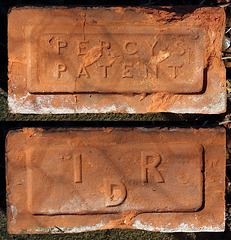
This one is a mystery at the moment. Found in Hyde, which was once in Cheshire but now calls itself Tameside after a series of local government reorganisations. I can find no clue about the initials I R D, which I assume to be those of the manufacturer. As for Percy's Patent, I would love to know what that was. Presumably the patent was something to do with brickmaking machinery.
Latest research (see below) suggests that this may well be a product of the Rowland Brickyard in Birch Lane, Dukinfield.

Quarry Pit
| |
|
Quarry Pit was sunk 94 yards to the 5 Foot seam in the early 19th century at the side of Anson Road in Poynton and was worked as the Bye Pit (the higher of two pits worked together) to the Lower Clough Pit which was some 170 yards away. In 1826 The two pits shared a single winding engine of 12 horsepower which was described in 1826 as:
One Engine to wind coal from two pits in Worth Clough, the cylinder 19 In diameter with air pump and condenser, Iron Engine beam and condensing cistern fixed up in wood framing, wrought iron boiler with brick work, spur gears and flat rope drum fixed up complete.
By 1848 the shaft had been deepened to the Gees seam at 151½ yards and a 35 hp winding engine had been installed whilst the Lower Clough Pit had been abandoned. Just over 100 men were working underground along with 6 horses. The Gees workings were exhausted by 1856 and the next year the pit was closed and the engine removed to the Park Round Pit for winding. Surprisingly that was not the end of the pit as in 1899 it was reopened to work a localised 2ft seam at a depth of about 50 yards. A vertical boiler was placed on the other side of Anson Road and the steam piped across to a small winding engine. This working only employed about ten men underground and was stopped in 1907 with abandonment of the seam and Quarry Pit in 1910 as " temporarily unprofitable ".
The brickwork at the top of the filled-in shaft is still clearly visible and there are some remains of the engine bed too.
Coming off the branch
| |
|
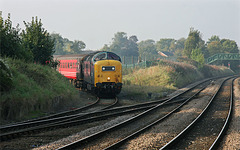
Deltic hauled Ribble Lune Railtour arrives at Northwich off the branch from Sandbach. Reversal at Lostock Works proved to be a shambles due to Network Rail being totally disorganised and the train was delayed for over an hour whilst the staff on the ground made mobile phone calls to control/management.
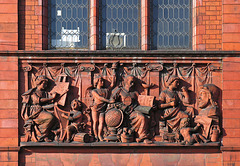
Verdin Technical Schools Northwich - detail
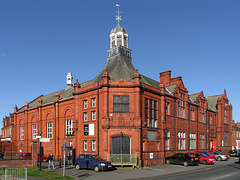
Verdin Technical Schools, Northwich
| |
|
The Verdin Technical School was the gift of Sir Joseph Verdin, Baronet, in 1897, for the the promotion of technical education in his native town.
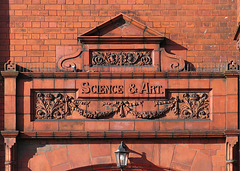
Verdin Technical Schools Northwich - detail
Jump to top
RSS feed- Latest items - Subscribe to the latest items added to this album
- ipernity © 2007-2026
- Help & Contact
|
Club news
|
About ipernity
|
History |
ipernity Club & Prices |
Guide of good conduct
Donate | Group guidelines | Privacy policy | Terms of use | Statutes | In memoria -
Facebook
X
