


Plants of Alberta 6


04 Jul 2010
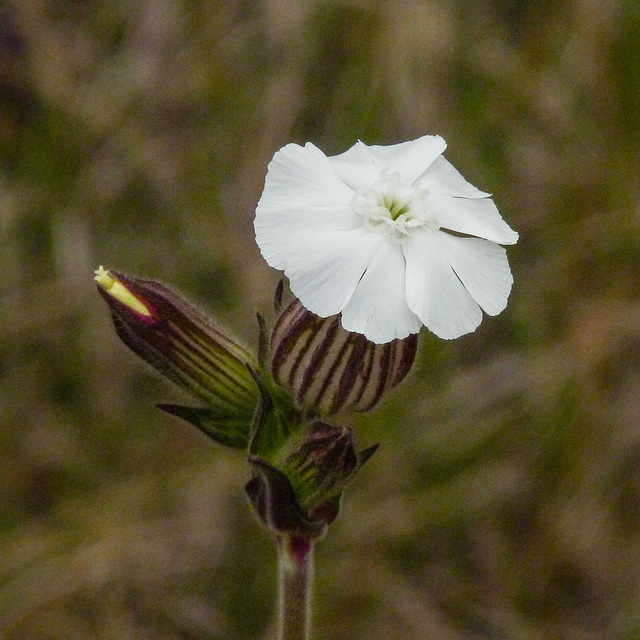
Night-flowering Catchfly / Silene noctiflora
This (poor quality) photo was taken at the Medicine River Wildlife Centre, a long drive NW of Calgary, when we spent the day botanizing the forest and meadows there on 4th July 2010. Posting it as a reminder to check if this flower goes by another name. I can't remember if Night-flowering Catchfly is the same as Campion. No, it is a different Silene species.
www.agriculture.gov.sk.ca/Default.aspx?DN=210c55d8-7f5a-4...
19 Apr 2015
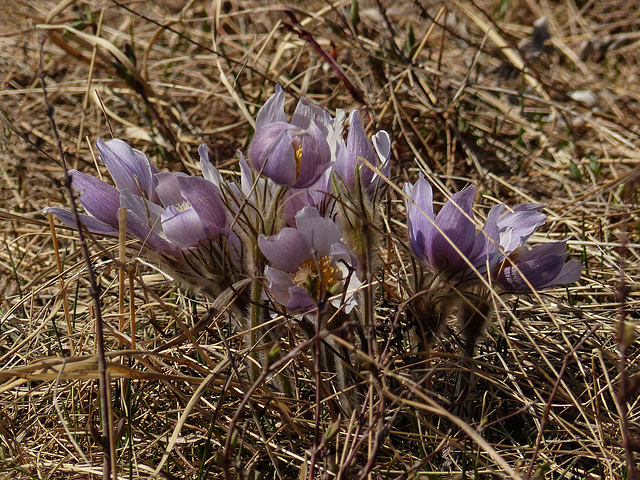
Growing at Pine Coulee Reservoir
Yesterday, 19 April 2015, I went with a group of friends on a birding trip to Pine Coulee Reservoir, which lies SW of Calgary. After a lovely late start, at 9:30 am - wish all our outings started so late! - we very slowly travelled many backroads south of Calgary, eventually arriving at the Pine Coulee Reservoir. I love the whole area down south with its rolling hills. The weather was beautiful, plenty of bird species were seen, and the company was great. As always, I did not see many of the birds, as they were far too far away and I don't have binoculars. Walkie Talkies would be so good to have on any trip where there is more than one car : ) Thanks, Terry, for another great trip! Thanks, Stephen and Dorothy, for driving Shirley and myself the whole day - greatly appreciated!
At one of the stops along the Reservoir, someone mentioned that Prairie Crocuses were in bloom on a slope down from the parking lot. I just had time to dash over and take a couple of very quick shots before we continued our drive.
"The prairie crocus (Anemone patens), is the first plant to bloom on the prairie each year. The true harbinger of spring, its mauve, petal-like sepals dot the still drab prairie landscape, often before the last snow of winter has melted. By blooming so early, the crocus assures itself of the complete attention of available pollinators - small bees and other insects. Its seeds can then ripen by early June and if moisture is available they will germinate right away. If the prairie is too dry the seeds will go dormant, then germinate the following spring.
Tufts of much-divided leaves emerge once flowering is finished and the risk of severe frost is over, but still well before most other prairie plants.
The saucer-shaped construction of many spring flowers like the crocus, is no accident. Neither is the fuzzy centre of the crocus (composed of numerous yellow stamens and a tuft of greyish pistils - that become plumed fruit), nor its highly reflective petals. It all adds up to solar heating . . . Crocus Style!
The sunlight that reaches the crocus' shiny petals is reflected into the flower centre. This energy is bounced around between the stamens and pistils warming these vital reproductive parts of the flower. On a sunny day the temperature inside a crocus flower can be as much as 10 C (18 F) warmer than the temperature of the surrounding air. Not only does the dish shaped flower concentrate the sun's warmth, it tracks the sun across the sky, maximizing the length of time each day that it can stay warmer than the surrounding air." From naturenorth.com.
www.naturenorth.com/spring/flora/crocus/Prairie_Crocus2.html
29 Jun 2010
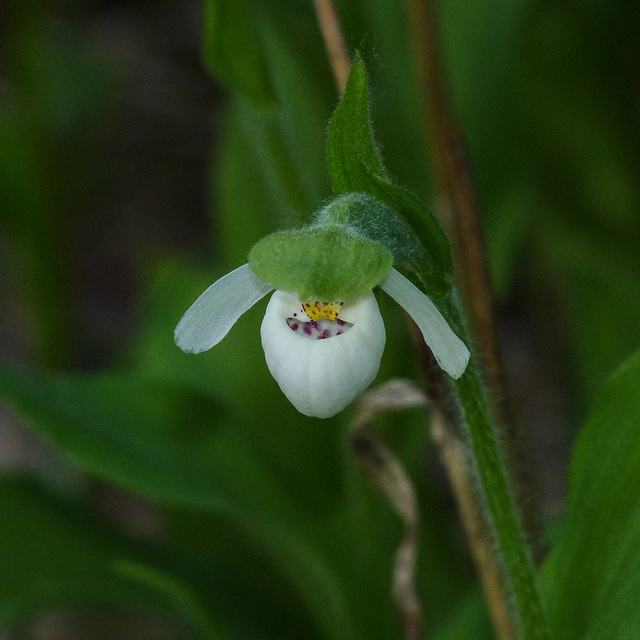
Sparrow's-egg Orchid
These are rarely found in Calgary, but I was one of several people privileged to be shown some of these beautiful, delicate flowers at Lawrey Gardens, Edworthy Park, on 29 June 2010.
"This delicate lady's-slipper is a pleasant find. Often occurring in moist areas along trails, it has 4 or 5 lily-like leaves tightly clasping the stem and slowly spreading outward. The white flower head looks like a white egg bursting out of a green case.
Flower: The flower has a green sepal rising above, almost hiding the white pouch. There are two white lateral wings and a white pouch with purple spots inside. The flower head is approximately 1 cm long." From MountainNature.com.

23 Apr 2015
Balsam or Hybrid Poplar catkins
This is a macro view of colourful hybrid Poplar catkins, taken on 23 April 2015 in Fish Creek Park. When I went for a stroll around the Artisan Gardens at the eastern end of the park yesterday, I found a tree that still had its catkins in reasonable shape. The male and female catkins (flowers or reproductive parts) of hybrid poplars are usually found on separate trees.
A YouTube video showing the Artisan Gardens:
youtu.be/wI3z0_k9mhU
www.bowvalleyranche.com/artisan-gardens.html
02 May 2015
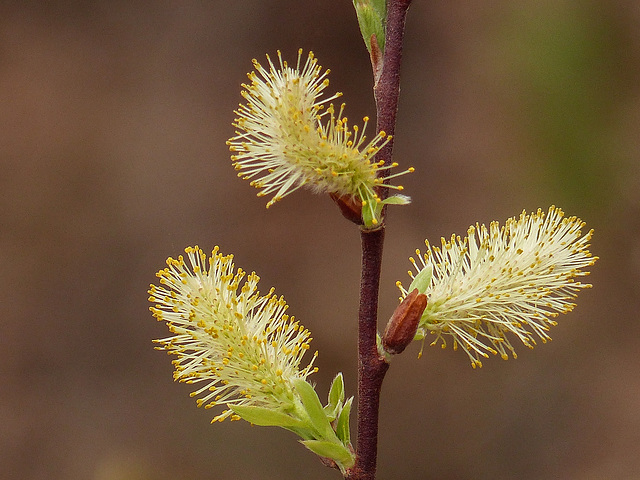
Catkins
Yesterday, 2 May 2015, I was out on a great, full-day birding trip that took us south of the city. This photo was taken when we stopped for a few minutes to see a Great Horned Owl nest, high in a tree and down the road. We could just make out the adult female through the branches and opening leaves.
Will add the report written by the leader of yesterday's birding outing, Terry Korolyk. Thanks so much for another great day out, Terry, and for your detailed account of the day!
"The morning started out cool, overcast, and, windy with the temperature 3 degrees centigrade when I awoke in the morning. Nine participants showed up for the trip at the Glennfield Parking Area in east Fish Creek PP. Our first stop at Sheriff King slough in the southwest corner of the Highways 2A and 22X junction was probably helped by the weather as probably close to 200 BONAPARTE'S GULLS were an amazing sight as they foraged on the water, being forced to stay there overnight. Amongst the other waterfowl here, highlights were 1 male Barrow's Goldeneye and 1 male Greater Scaup.
From there, we travelled through the Pine Creek valley to Highway 2A, moving southward then turning off on Highway 552 and going to the Dewinton area. We stopped at a very convenient Great Horned Owl's nest as we drove east on the road going past the Calgary Gun Club. The nest was in an Aspen almost hanging right above the road! One of the adults, a gray phase bird, was clearly visible, but, we could only barely make out that there were downy young in the nest.
On the southern edge of Dewinton, I observed 3 COMMON GRACKLES, but a more thorough look revealed probably about 15 GRACKLES and almost as many Brewer's Blackbirds. These birds were almost a complete surprise.
From here, there was a bit of a mixup and part of the group got separated. After meeting later, we talked about how we attempted to find each other, but kept missing each other. Amazingly, at the end of the day, we all ended back in Glennfield at the same time!
We all checked sloughs in the Dewinton area. The Field Trip found 2 Least Sandpipers, 15 Lesser Yellowlegs, and 2 Greater Yellowlegs at a slough south of Dewinton, then proceeded westward through the hills enjoying looks at all the returning Spring birds. Cinnamon Teal were very common in the area. We enjoyed a combined flock of 200 of Yellow-headed and Red-winged Blackbirds foraging in a field by a marsh.
Pushing on further westward, a Great Blue Heron flushed from a creek as we drove past on 1119 Drive, then as we stopped at a large slough further westward, we stopped to photograph a pair of Red-necked Grebes building a nest. A small, brown, stubby-tailed bird flushed from the shoreline. I attempted to find it; got a quick look at it, and am almost sure it was a PACIFIC or WINTER WREN!
We turned south on 160 St where at a quiet marsh at the bottom of the road, we saw Horned Grebes and Canvasbacks. A Red-tailed Hawk that burst suddenly from out of the trees appeared somewhat buffy, possibly being a CALURUS subspecies light phase Red-tailed Hawk.
From off Highway 22 south of Turner Valley, we took a road through the foothills past a large marsh which had large numbers of Canada Geese and Ring-necked Ducks. In Aspens beside the marsh, it was lovely to see and hear our first returning male YELLOW-RUMPED WARBLERS of the season. Careful searching uncovered a White-crowned Sparrow and at least 1 CHIPPING SPARROW. Just past the marsh, we found our final highlights of the day, separate lone male EVENING GROSBEAKS at treetops on each side of the road.
Birds found by the lost? group( or, were we the lost group?) included a lone SANDHILL CRANE near the marsh at Highway 799 and 338 Avenue, and more Greater Scaup in this general area. They also found a couple of White-crowned Sparrows near Third Lake 2 kms. south of Highway 552 on 224 Street.
Terry Korolyk"

03 May 2015
Baby Larch cone
These flowers always fascinate me - including the fact that they are growing from tree branches. If you happen to know where there is a Larch tree, take a look at the branches at the right time of the year. When you see these female flowers (they become cones) up close, they really are very attractive. They start off a deep pinky purple and become paler as they open fully.
Yesterday afternoon, 3 May 2015, I met up with a group of birding friends in South Glenmore Park. We walked east towards the "point" and beyond. Not a huge number of birds and most were the far side or in the centre of the Glenmore Reservoir. However, 25 species were seen - will add the list compiled by leaders, Janet and Bernie, posted mainly to help my own memory:
1. Common Loon - 1 heard
2. Horned Grebe - 40+
3. Red-necked Grebe - 40+
4. Western Grebe - 60+
5. Canada Goose - 4
6. Mallard - 12
7. American Wigeon - 10
8. Lesser Scaup - 2
9. Common Goldeneye - 35
10. Bufflehead - 32
11. Swainson's Hawk - 2
12. American Coot - 2
13. Bonaparte's Gull - 3
14. Franklin's Gull - 35+
15. California Gull - 12
16. Northern Flicker - 1
17. Black-billed Magpie - 5
18. American Crow - 15
19. Common Raven - 8 + 2 young in nest
20. Tree Swallow - 2
21. Rough-winged Swallow - 2
22. Black-capped Chickadee - 2
23. American Robin - 6
24. Yellow-rumped Warbler - 1 Myrtle
25. House Sparrow - 2+
Five of us went to the Good Earth cafe after the walk and, as always, coffee and a chat were most enjoyable. Thanks for the good walk, Janet and Bernie!
03 May 2015
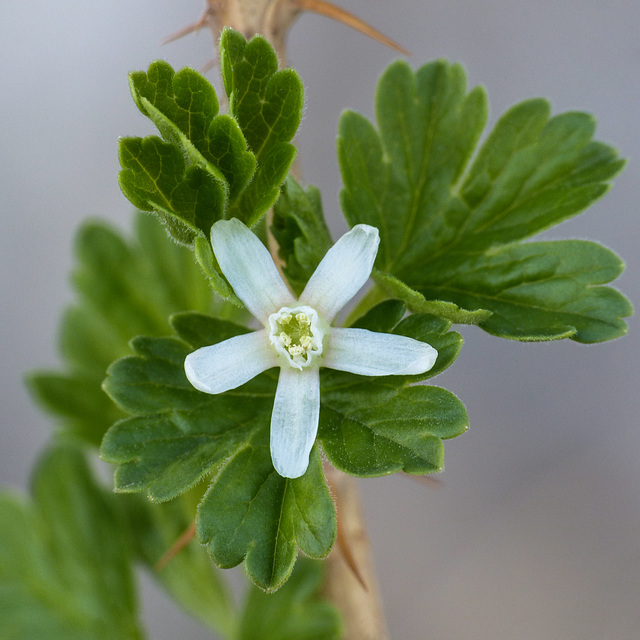
Wild Gooseberry
The day before yesterday, 3 May 2015, I met up with a group of birding friends in South Glenmore Park. We walked east towards the "point" and beyond. In places, the air close to the Reservoir was thick with Midges! Thank goodness they weren't Mosquitoes! These insects are a staple in the diet of fish (Trout) at all stages - also for the Swallows in the area.
Happened to notice this Wild Gooseberry that was blooming along the edge of the path. I'm not sure if it is Canada/Northern Gooseberry, Ribes oxyacanthoides, which I've seen elsewhere in Calgary. I didn't know until a few minutes ago that there was more than one kind of wild Gooseberry. I think it has to be Ribes oxyacanthoides, as the stem was covered with numerous soft prickles, with a few stouter prickles at leaf nodes.
Not a huge number of birds that afternoon and most were the far side or in the centre of the Glenmore Reservoir. However, 25 species were seen - will add the list compiled by leaders, Janet and Bernie, posted mainly to help my own memory:
1. Common Loon - 1 heard
2. Horned Grebe - 40+
3. Red-necked Grebe - 40+
4. Western Grebe - 60+
5. Canada Goose - 4
6. Mallard - 12
7. American Wigeon - 10
8. Lesser Scaup - 2
9. Common Goldeneye - 35
10. Bufflehead - 32
11. Swainson's Hawk - 2
12. American Coot - 2
13. Bonaparte's Gull - 3
14. Franklin's Gull - 35+
15. California Gull - 12
16. Northern Flicker - 1
17. Black-billed Magpie - 5
18. American Crow - 15
19. Common Raven - 8 + 2 young in nest
20. Tree Swallow - 2
21. Rough-winged Swallow - 2
22. Black-capped Chickadee - 2
23. American Robin - 6
24. Yellow-rumped Warbler - 1 Myrtle
25. House Sparrow - 2+
Five of us went to the Good Earth cafe after the walk and, as always, coffee and a chat were most enjoyable. Thanks for the good walk, Janet and Bernie!

06 May 2015
Blossom
OMG, what a mess Flickr is this morning, after all the changes they made!!!I No doubt many of you are experiencing all these new problems, too. What a mess they have made of something that worked just fine!! Great difficulty or impossible to add tags. When something has been done to one of the photos, I can't get back to my photostream - have to close Flickr and open in a new tab, etc., etc.. When I open my photostream in a new tab, the most recent changes have not always been saved. And all those extra tags that Flickr has added to each photo! The tags "pet" and "dog" were added to my photo of a wild Moose suffering from a bad case of tick damage, lol! I always tag all my photos carefully and, with almost 11,000 images on my photostream, there is no way I could ever go through every photo deleting Flickr's inappropriate extra tags!
This photo was taken at the Reader Rock Garden three days ago, on 6 May 2015, when I called in after a volunteer shift. I can't tell one blossom tree from another, so don't know the ID for these white flowers.
03 May 2015
1 favorite
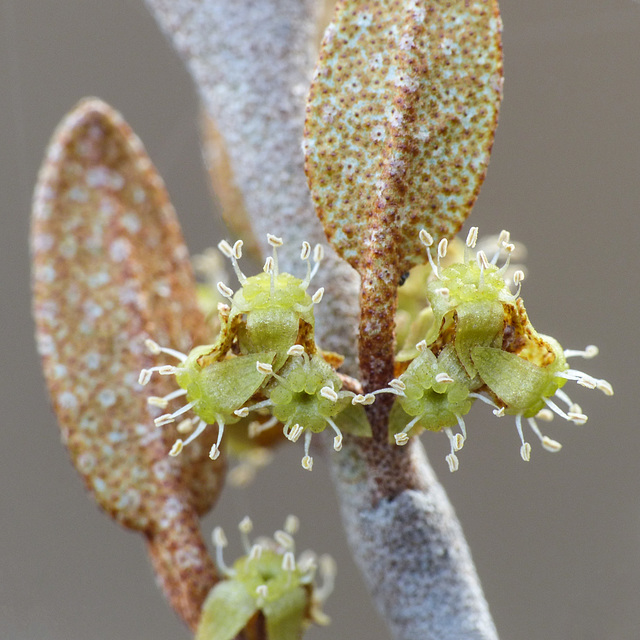
Canada Buffaloberry / Shepherdia canadensis
OMG, what a mess Flickr is this morning, after all the changes they made!!!I No doubt many of you are experiencing all these new problems, too. What a mess they have made of something that worked just fine!! Great difficulty or impossible to add tags. When something has been done to one of the photos, I can't get back to my photostream - have to close Flickr and open in a new tab, etc., etc.. When I open my photostream in a new tab, the most recent changes have not always been saved. And all those extra tags that Flickr has added to each photo! The tags "pet" and "dog" were added to my photo of a wild Moose suffering from a bad case of tick damage, lol! I always tag all my photos carefully and, with almost 11,000 images on my photostream, there is no way I could ever go through every photo deleting Flickr's inappropriate extra tags!
This macro photo was taken during a walk with birding friends at South Glenmore Park, on 3 May 2015.
"Canadian Buffaloberry, also known as Soopalallie (with many variations on this spelling), is one of the most critical Rocky Mountain plants to learn. Look for a woody shrub, up to 1.5 m (5 ft) in height with dark green, oval leaves. The leaves are approximately 2-6 cm (.75-3.5 in) long, and are dark green above and fuzzy below. They are arranged in an opposite manner. Buffaloberry are somewhat unusual in that there are both male and female plants. The flowers are inconspicuous, looking like small yellow growths that emerge below the new leaves. In late-July or early-August, the berries begin to ripen. Only the female plants will bear fruit. They are round, approximately 4-6 mm (.25 in) in diametre, and vary from bright red to orange (occasionally yellow) They are also somewhat translucent. Buffaloberry can be found throughout the Rockies, but tend to be more common along the eastern slopes.
If you learn to identify only one plant in the Canadian Rockies, make it this one. Once the berries ripen, this becomes the most important plant for bears within the northern Rockies. Any trail with an abundance of buffaloberries will also have bears. Try to avoid heavily berried trails in August and September, or at the very least make a lot of noise while hiking in such locales. Remember, an adult grizzly may eat upwards of 200,000 buffaloberries every day during this period. They may also get so engrossed in feeding that they do not hear you approach. Make sure you make lots of noise." From MountainNature.com.
www.mountainnature.com/Plants/PlantsLatinNameResult.asp?I...
"Fruits are extensively collected by some Canadian First Nations peoples such as Nlaka'pamux (Thompson), St'at'imc (Lillooet) and Secwepemc (Shuswap) in the province of British Columbia. The bitter berries are not eaten directly but rather processed as sxusem ("sxushem", also xoosum/"hooshum") or "Indian ice-cream". Branches bearing fruit are hit with a stick and only the very ripe fruits that fall off are collected. A clean mat or tarpaulin is placed below the bush for collection. The berries are later placed into a great bowl that is absolutely free of oil or fat and are mixed with some sweet fruit such as raspberries. The mixture of berries is crushed and vigorously beaten in the manner of whipping cream in order to raise the typical foam of the confection." From Wikipedia.
en.wikipedia.org/wiki/Shepherdia_canadensis
Jump to top
RSS feed- Latest items - Subscribe to the latest items added to this album
- ipernity © 2007-2026
- Help & Contact
|
Club news
|
About ipernity
|
History |
ipernity Club & Prices |
Guide of good conduct
Donate | Group guidelines | Privacy policy | Terms of use | Statutes | In memoria -
Facebook
X
