


Plants of Alberta 6


17 Aug 2014
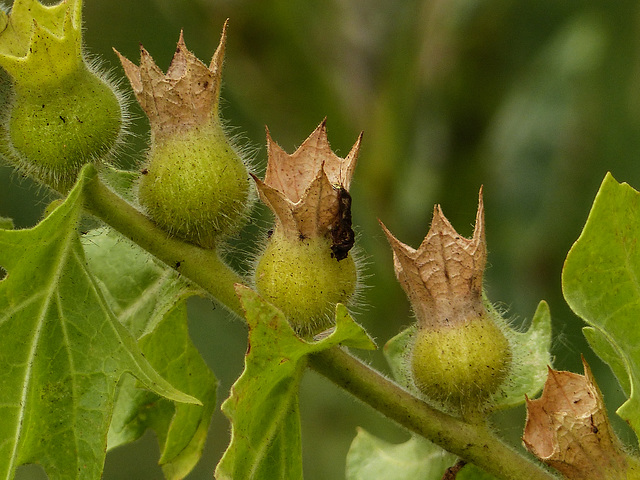
Black Henbane seedpods
I always think that Black Henbane is a strange flower, but with such a beautiful pattern on the petals. Photographed the seedpods of this noxious weed in Carburn Park yesterday, 17 August 2014. I love the seedpods this plant produces!
"An annual or biennial (forming a rosette the first year) plant that reproduces by seed only. Black Henbane was introduced from the Mediterranean and has been used as a medicinal plant since the Middle Ages, and was also used in ancient religious rites because of its hallucinogenic properties. It was even used as a flavoring in beer until the Bavarian Purity Law of 1516. All parts of the plant are poisonous to humans and animals when ingested – tissues contain several toxic alkaloids. Symptoms of poisoning include impaired vision, convulsions, coma, and death from heart or respiratory failure.
It is a member of the nightshade family and also called ‘stinking nightshade’. A single plant can produce as much as half a million seeds in one season, which are viable for about 4 years."
www.invasiveplants.ab.ca/Downloads/FS-BlackHenbane.pdf -
19 Aug 2014
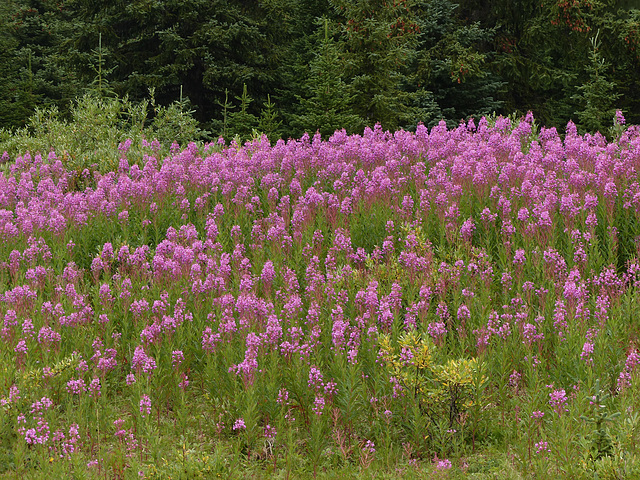
The joy of vibrant Fireweed
Will have to wait till I get home later, after my volunteer shift, to add more information about yesterday's 18-hour trip. For now, I'll just say that the day started and ended on a great note. The little Pika in the previous photo started our day off with such delight, but wait till you hear about the day's ending (no photos taken, though).
This was one of several huge displays of beautiful, vibrant Fireweed that we saw yesterday, on our drive through Kananaskis.
19 Aug 2014
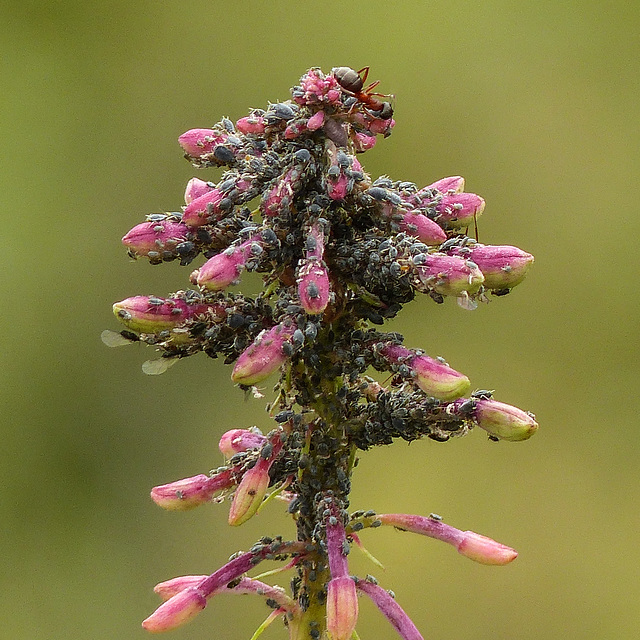
Aphids on Fireweed
"Certain types of aphids live in colonies where they are used as a food source by a neighbouring colony of ants. The ants have been known to bite the wings off the aphids in order to stop them from getting away and depriving the ants of one of their staple foods: the sugar-rich sticky honeydew which is excreted by aphids when they eat plants. (They don't eat the actual Aphids). Chemicals produced in the glands of ants can also sabotage the growth of aphid wings." From ScienceDaily.
www.sciencedaily.com/releases/2007/10/071009212548.htm
en.wikipedia.org/wiki/Aphid
en.wikipedia.org/wiki/Chamerion_angustifolium
17 Aug 2013
1 favorite
1 comment
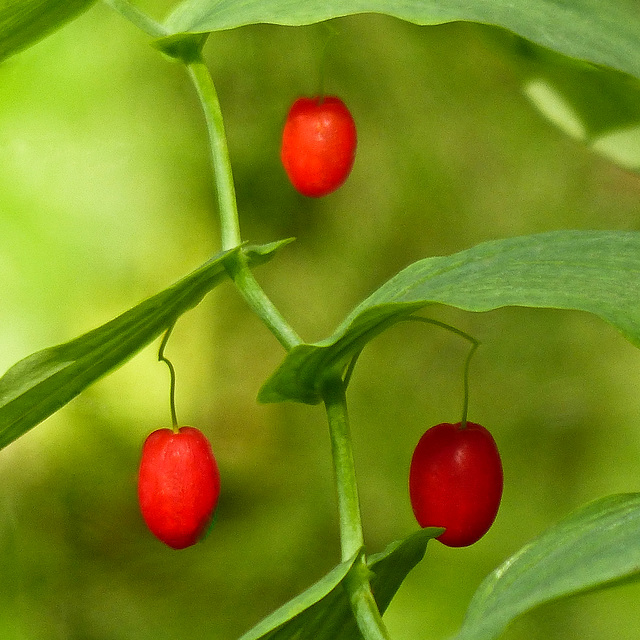
Claspleaf twistedstalk berries
The red berries of the Twisted-stalk plant are always so welcoming when you are on a walk through the forest. The bright splash of colour catches your eye amongst all the green. Taken on 17 August 2013 at Brown-Lowery Provincial Park, SW of Calgary. Also known as twistedstalk, clasping twistedstalk, claspleaf twistedstalk, White Twisted-stalk, or Watermelon berry.
"Twisted Stalk was used as a food plant by Native Americans in Eastern North America and as a medicine. The plant was referred to by early settlers of Eastern and Western North America as "wild cucumber" and as "scoot berries" for the mildly laxative effects of the berries if they are eaten in excessive quantities. The tender young shoots of this plant were eaten by Native Americans as a salad green, but most consider the plant and berries poisonous. The entire plant is sweet with a cucumber-like flavor.[citation needed] The berries are reported to be juicy and sweet, with a cucumber-like flavor.[citation needed] The juice of the berries was used as a soothing treatment for burns by American Indians.
Twisted Stalk has a supercifial resemblance to False Solomon's Seal (Maianthemum racemosum), but Twisted Stalk produces axillary flowers and fruits along the stem, where False Solomon's Seal produces a terminal inflorescence." From Wikipedia.
en.wikipedia.org/wiki/Streptopus_amplexifolius
19 Aug 2014
1 comment
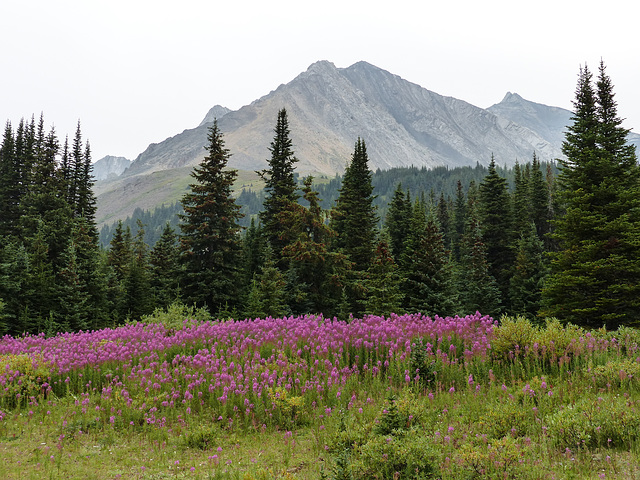
A beautiful display of Fireweed
Fireweed was nicely in bloom when I went with friends, Cathy and Terry, for a great day out in the mountains on 19 August 2014. Our trip was part way along Highway 40 and then along the Smith-Dorrien/Spray Lakes Trail. We passed maybe three or four large, dense patches of Fireweed that were absolutely beautiful. Wish I could say the same about the sky - as you can tell from my photo, it was far from blue. The weather forecast was not good for this day, but we were so lucky that, apart from a few raindrops, the rain stayed away. The sun actually came out at two locations we stopped at for a short while.
12 Aug 2014
Embracing the sun
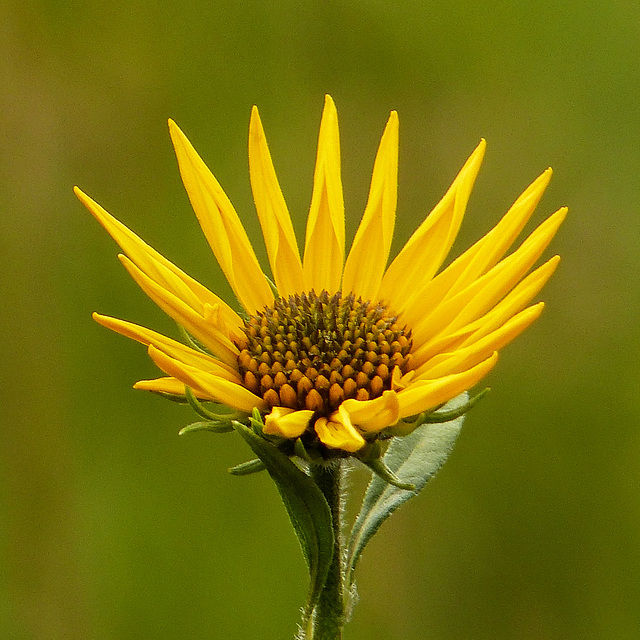
The last few days here have been cold and wet, but today, the sun is finally out (well, I should say "was" out, as the sky has now clouded over). The highest the temperature got yesterday was 12°C, but most of the day it was a few degrees cooler. I don't like the heat, so cooler temperatures suit me better, but - this is summer, lol!
The flower in my photo is a small, native, wild Sunflower, photographed at Griffith Woods. Taken when I was on a botany walk on 12 August 2014. I believe it is Nuttall's Sunflower / Helianthus nuttallii.
19 Aug 2014
Yellow Penstemon
The weather forecast was not good for that day, 19 August 2014, but we were so lucky that, apart from a few raindrops, the rain stayed away. The sun actually came out at two locations we stopped at for a short while. Our 18-hour day (from 6;00 a.m. till midnight!) started off with the thrill of seeing two or three little American Pikas (also called Rock Rabbits) and ended with a brief sighting of a black Wolf (could it be Skoki?) crossing the road ahead of us in the dark. It disappeared into the blackness, but shortly afterwards, we heard three separate Wolves howling (possibly four). We just stood there, in total awe, listening to this amazing sound. The only wild Wolf I had ever seen before was when I was in Yellowstone National Park two years ago. Friends and I saw two Wolves feeding on a Bison carcass across a huge valley - so they were just distant specks, that became larger specks when my camera was in full zoom, ha.
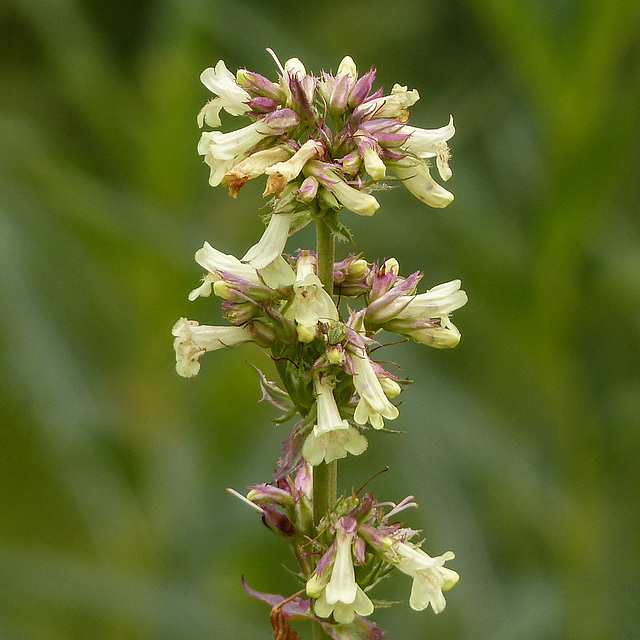
In between these two highlights, we saw several Deer, a small group of Mountain Sheep on the road, a tiny Chipmunk, a few Cedar Waxwings, Columbian Ground Squirrels, a beautiful Red-tailed Hawk that sat on a branch out in the open for a long time, and two tiny Bats that flew very close over our heads when it was getting dark. We also saw a female Spruce Grouse and two young ones. Didn't see too many wildflowers, but was happy to find this Yellow Penstemon (is it Penstemon confertus?) at one of our stopping places. Hadn't seen this plant since a brutal hike a handful of years ago, along the Picklejar Lakes Trail - that nearly killed me!
Then, of course, there is the scenery! Blue sky to go with the splendour of the mountains would have been wonderful, but we've been having cold and gloomy weather recently. Highway 40 and the Smith-Dorrien/Spray Lakes Trail both run through such spectacular scenery, so it was a real treat for me, especially as I won't drive those areas myself. Thanks so much, Cathy & Terry! Thanks, too, Terry, for spending at least an hour (?) removing one of the car wheels and fixing whatever was wrong with it!
10 Aug 2014
Police Car Moth
A couple of weeks ago, on 10 August 2014, I slept right through an hour of very loud music and then woke up nearly five hours later (around 11:30 a.m.)! As a result, I missed a trip with friends to a great place SW of the city, Brown-Lowery Provincial Park - one that I don't like going to on my own. Knowing that there would be other people in the area, I decided to still go, but not go very far into the forest on my own. Hopefully, the others would scare any Bears and Cougars out of the forest and not in my direction! To say that I could kick myself is to put it mildly!
So much for hoping that there would be no bears. When I arrived at the not particularly well-known forest, I signed the "guest book" as I often do. Before I turned the page to sign on a nice fresh page, I happened to read one of the last comments that someone had written - a Black Bear had been seen that day, on the very trail I wanted to go on! I put the can of Bear Spray into my fanny-pack (can't use a backpack because of the rotator cuff inflammation in both my shoulders), but after a few steps, knew my fanny pack felt just too heavy. Put the can back in the car and instead, attached my bear bell to my camera strap and clutched a small air-horn in one hand. I only spent about an hour in the forest, but did not enjoy a single step of it, lol! I was determined to at least go a very tiny way in, having driven all the way there.
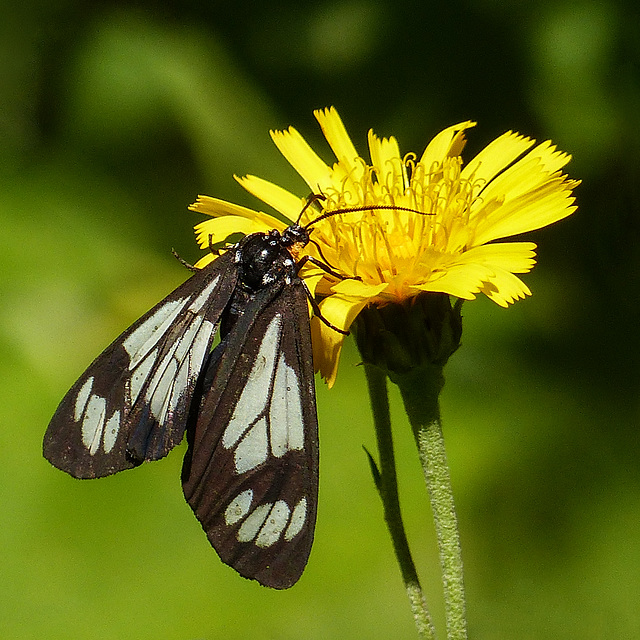
Very thankfully, there was no sign of the bear - but also no sign of any mushrooms other than one tiny cluster of Pholiotas growing at the base of a tree stump. Absolutely nothing, despite recent rain. Maybe it's still too early, especially after such a late spring? August is supposedly the peak of the fungi season here. Found the beautiful Police Car Moth in my photo above, when I walked around the edge of the parking lot after my short walk. Saw very little on the drive home - a couple of Hawks (one on a hay bale), a few Ravens and a few Crows, one Cedar Waxwing, and several very distant ducks. No sign of any Red-winged or Yellow-headed Blackbirds and no Wilson's Snipe.
"The Police Car Moth is a fairly large moth with a wingspan of up to 50 mm. The wings are jet black with large white patches between the black scaled veins. As well, there are two orange patches of hairs on either side of the thorax, right behind the head. It is this colour combination, that of an old style police car, that gives it its name. Larvae are hairy and black with yellow and blue markings. The Police Car Moth is found throughout the province in or near forested areas. Adults fly throughout July and early August." From Royal Alberta Museum.
www.royalalbertamuseum.ca .
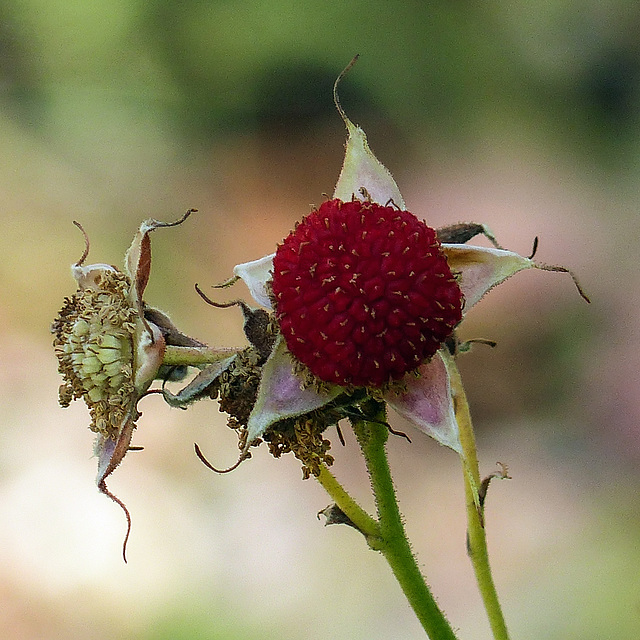
26 Aug 2014
Purple-flowering Raspberry / Rubus odoratus
I'm fairly sure that I have the correct ID for this plant - also known as Thimbleberry. We noticed a lot of these plants during our stay in Waterton Lakes National Park. Apparently, though edible for humans, the berries are tart and rather dry. Provides food for songbirds, game birds, and large and small mammals. There were no flowers left, but I thought the fruit and surrounding bracts were most attractive. I have added a previously posted image of a flower, found in Calgary, in a comment box below.
I spent 26, 27 and 28 August 2014 on a road trip with friends Cathy and Terry, spending the first two days in Waterton Lakes National Park and the third day driving east of Waterton in search of Burrowing Owls and Yellow-bellied Marmots. During our three days away, we saw so many things, I hardly know where to start. This always happens when I go anywhere with Cathy and Terry - every day is a very long, fun-filled day, full of exciting finds.
Perhaps I will simply mention some of the things and then add more detail to each photo as I add them to my photostream. Of course, we couldn't have had a more beautiful area to explore! Waterton Lakes National Park has amazing scenery and wildlife. The weather forecast that I saw before we left Calgary said that we were in for three beautiful days of sunshine - too often, it can be rainy weather. So, luck was on our side, giving us warm, sunny days - until the BIG STORM hit, lol! This storm was approaching very fast, around 5:00 p.m. just before we started our return trip to Calgary. It was like nothing I had ever seen before - a menacing shelf (?) cloud that was travelling fast and furious. Despite trying our best to get away from it, it eventually engulfed our car, surrounding us with more or less zero visibility, pounding hail, thunder and lightning, and very strong winds. There was nothing to do but stop the car and sit tight, hoping that the hail would not break the car windows and that this severe thunderstorm would not develop into a tornado! This storm was very scary, but at the same time, exciting (only because all turned out OK in the end!). Our road trip sure went out with a bang!
A few of the things we saw - fantastic scenery, 4 Black Bears (including one that was swimming in the lake), Bison, Deer, Golden-mantled Ground Squirrels, Chipmunks, various bird species including the Burrowing Owls, a few wildflowers, several Yellow-bellied Marmots (a first for me!), a few different insect species, and a family of some species of Grouse (still not sure what kind). I even got the chance to see three or four new-to-me old, wooden grain elevators.
Cathy and Terry, thanks so much for yet another wonderful trip with you! Can't thank you enough for inviting me along. You always do such a great job of finding so many interesting things for us to see and enjoy. Lots of fun!
Jump to top
RSS feed- Latest items - Subscribe to the latest items added to this album
- ipernity © 2007-2026
- Help & Contact
|
Club news
|
About ipernity
|
History |
ipernity Club & Prices |
Guide of good conduct
Donate | Group guidelines | Privacy policy | Terms of use | Statutes | In memoria -
Facebook
X
