


Carburn Park

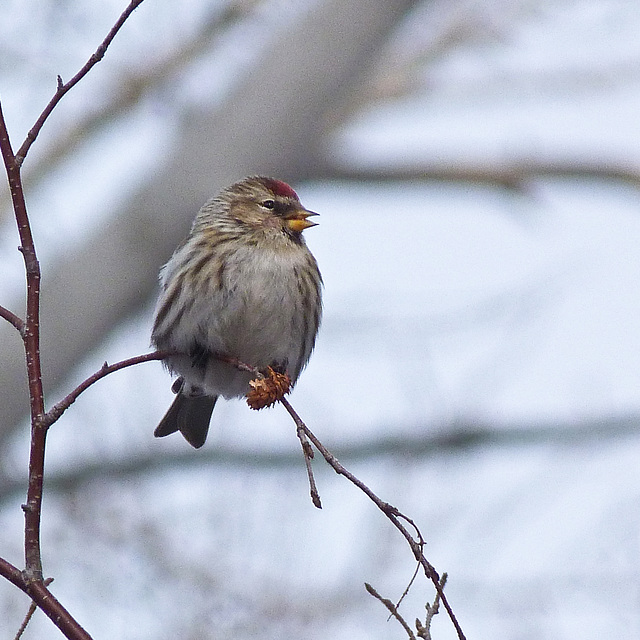

Common Redpoll
This has been a great winter for the dainty little Common Redpolls - lots of them about. They are frequent and often abundant winter visitors across all of Alberta, but some years see a lot more of them than others. Towards spring, redpolls leave for their arctic breeding grounds. Photographed this female at Carburn Park on January 28th. Not the easiest of birds to photograph, as they are either in flight or in constant motion while feeding on the seeds of the Water Birch. Love their little red foreheads.
www.allaboutbirds.org/guide/Common_Redpoll/id/ac
en.wikipedia.org/wiki/Common_Redpoll
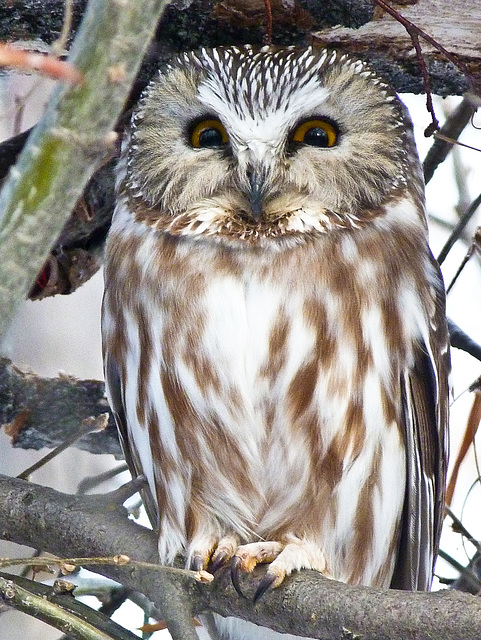
Eyes wide open
This tiny Northern Saw-whet Owl only opened its eyes for a few seconds a couple of times. The rest of the time, it was asleep. Photographed in Carburn Park on January 28th. Winter has returned once more, with a thin layer of snow early this morning.
Adults are 17–22 cm (6.7–8.7 in) long with a 42–56.3 cm (17–22.2 in) wingspan. They can weigh from 54 to 151 g (1.9 to 5.3 oz) with an average of around 80 g (2.8 oz), making them one of the smallest owls in North America. In relative size to other birds they are close to the size of an American Robin.
"A small owl of all types of woodlands, the Northern Saw-whet Owl can be found roosting in winter in small, dense conifer trees, sometimes even in parks and gardens. Its defense upon discovery is to sit still and not fly, leading people to perceive them as "tame." From AllAboutBirds.
After an online "Critter Vote", the Saw-whet Owl became the new star of Telus' mobility campaign in the summer of 2011." Some of you may have seen this very cute TV commercial : )
youtu.be/GaeFUeusM7w
www.allaboutbirds.org/guide/Northern_Saw-whet_Owl/id/ac
en.wikipedia.org/wiki/Northern_Saw-whet_Owl
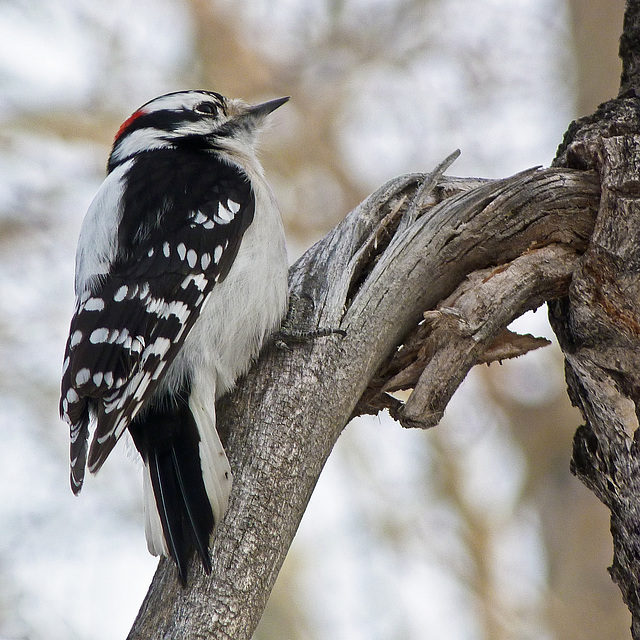
Downy Woodpecker
A little male Downy Woodpecker, seen at Carburn Park on January 28th.
Yesterday, I experienced a step back into my distant past, when I watched two of a set of four DVDs that my amazing, life-long friend in England, Linda, sent me. She had carefully looked at all my father's old movies and set aside any family ones. She then found someone to transfer them to DVD and now I have such a precious reminder of the early days. It is such a feeling to be able to watch my parents in their younger days, camping and cycling and having great fun with various friends. Of course, my father was always the photographer, so there are only a few seconds of him on these movies, which is unfortunate - I guess I did exactly the same when my kids were growing up, so don't have all that many photos of myself (and I hate having my photo taken, anyway!) Also, footage of my brother when young, which was quite sad to watch in some ways. There are also some bits of myself and my oldest child (as a baby) - a treat to see. I've watched three of the DVDs, so there is one left. Can't wait to see what gems it holds : ) Thank you, Linda, for all this painstaking, time-consuming work you've done for us!!
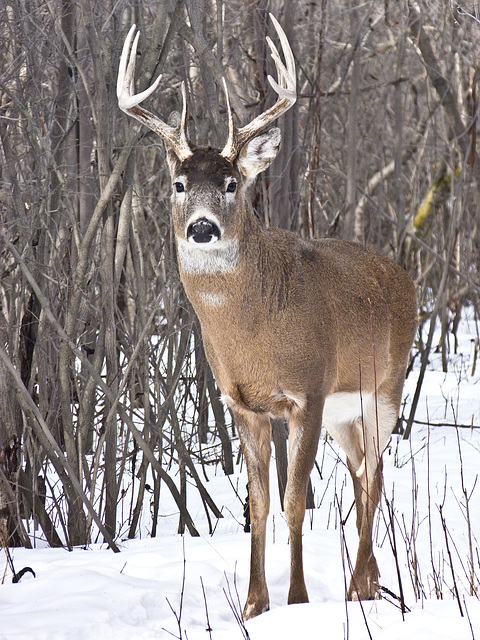
26 Jan 2012
White-tailed Buck, 10-pointer
I posted a head shot of this handsome buck recently, so thought I'd post a photo to show the whole animal. Came across him suddenly when I was on one of the narrow trails at Carburn Park. He was just standing in the middle of a trail leading off the one I was walking along. A breathtaking moment for me - not sure how he felt : ) In other parks and natural areas, I've always found the bucks to be very skittish, which is how it should be, for their own well-being. Taken on January 26th.
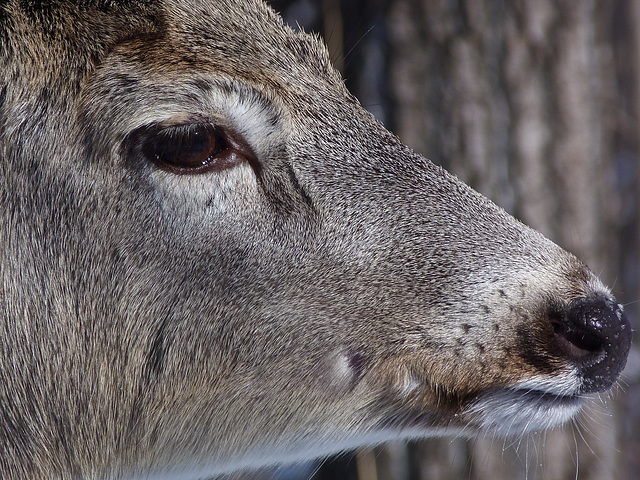
Up really close and personal
A few of us went for a three-hour walk in Carburn Park yesterday morning. The day started off around -20C and ended up around -2C in the afternoon. An absolutely beautiful, sunny day and such a contrast to the previous day that was snowy, miserable, and treacherous for driving. Not many birds around, but we saw at least five beautiful White-tailed Deer. Unfortunately, some people do feed these wild animals, so they are more tolerant of humans than they should be. This one walked towards us and came to within maybe 10 or 12 feet of us and then just stood there and looked at us, no doubt hoping for food (which it didn't get, needless to say). Apparently, the deer have resulted in there being more or less no wildflowers in this park.
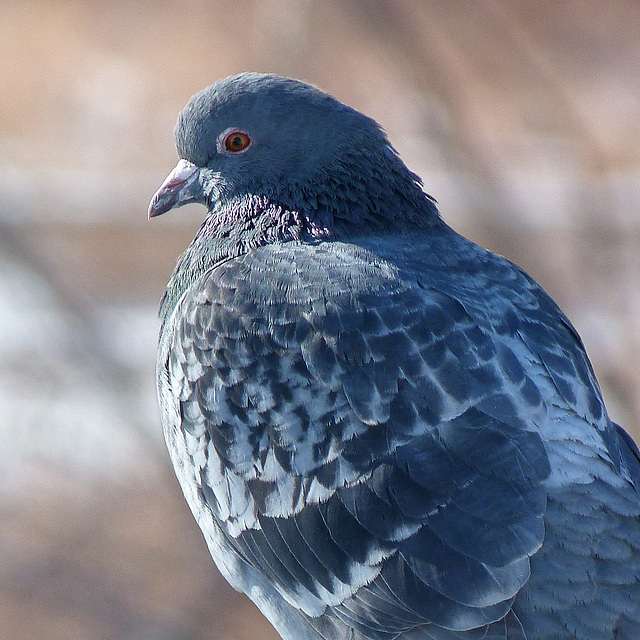
Rock Dove, alias Pigeon
Finally, I got a chance to photograph a couple of Rock Doves when I was on a walk with friends at Carburn Park yesterday. The last few years, I've wanted to get closer, as they are beautiful birds, even if not very popular with many people. So, I was happy that two Pigeons perched on the railing of the bridge over the Bow River and I was able to capture their beauty.
Everyone got a note yesterday, informing us that window-replacement is now starting and that we have to move everything away from all the windows within three feet and remove all blinds/curtains. Yeah, right, I don't think I can even reach them in order to be able to remove them. I noticed that already a couple of new windows are lying against the far, opposite building, so I guess I will be getting a phone call soon to set up which 1-2 days I am available. I think it's eight windows plus my sliding patio door. So, my whole place is going to be in utter chaos (on top of the present mess, ha!). I don't know if the present blinds will fit the new windows and it sounds like they won't put them back, or caulk and paint the new surrounds. To say that I'm not looking forward to all this is the understatement of the year, ha!
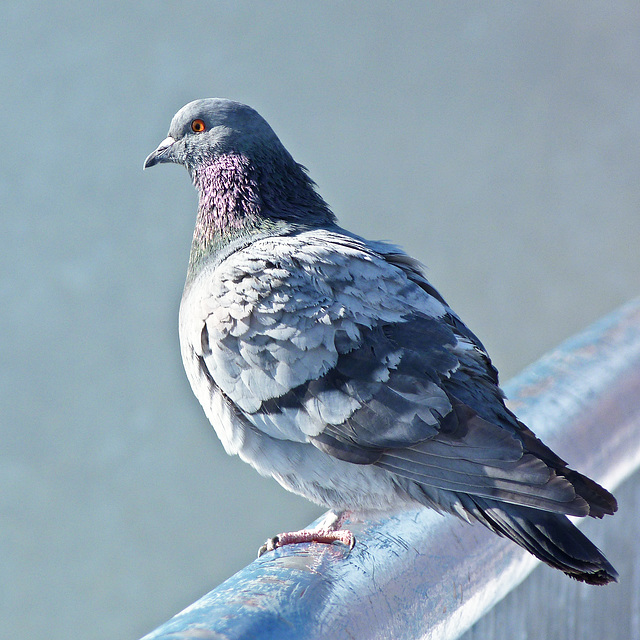
Unpopular beauty
Finally, I got a chance to photograph a couple of Rock Doves (Pigeons) when I was on a walk with friends at Carburn Park on February 27th. The last few years, I've wanted to get closer, as they are beautiful birds, even if not very popular with many people. So, I was happy that two Pigeons perched on the railing of the bridge over the Bow River and I was able to capture their beauty.
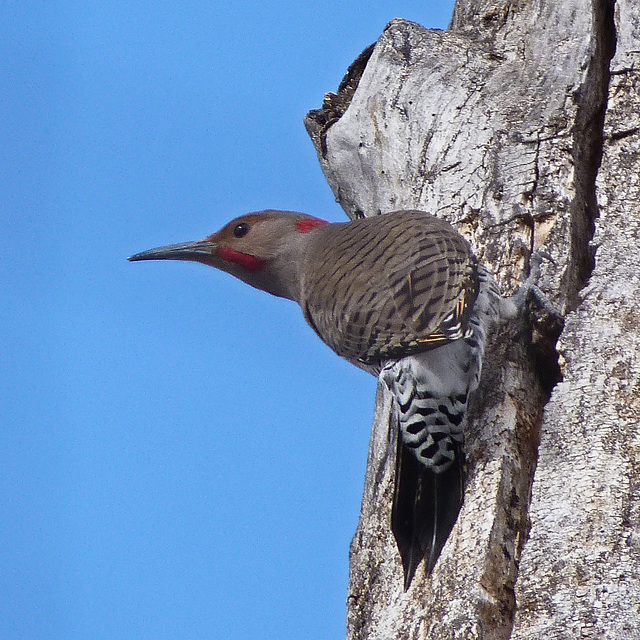
A one-second break
A beautiful Northern Flicker hybrid, stopping long enough to briefly turn its head away from the cavity it was busy making. He's using his tail for balance. Photographed at Carburn Park on March 3rd.
Words from a local naturalist, that were made about a previously-posted Northern Flicker, that explain what a hybrid looks like:
"This photo shows characteristics common to the Northern Flickers in the Calgary area. All of our birds are basically hybrids between the western Red-shafted and the eastern Yellow-shafted forms.
This bird is a male, indicated by the moustache or malar stripe. This is normally red in the western form and black in the eastern form. Both colours occur on this bird.
The yellow shafts of the eastern form are plainly visible in the wing of this birds. Also characteristice of the Yellow-shafted is the red nape patch. Uncharacteristic is the gray throat, typical of the western form. The markings around the eye, while most like the western form, are more exaggerated."
www.allaboutbirds.org/guide/Northern_flicker/id/ac
en.wikipedia.org/wiki/Northern_Flicker
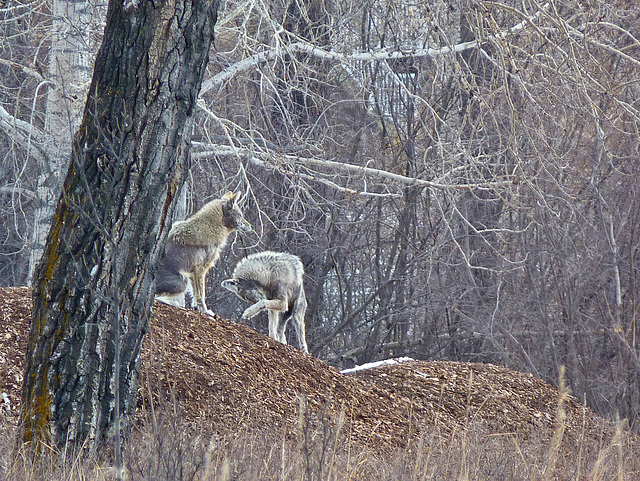
Mangy Coyotes
So sad to see these two Coyotes (far in the distance) who are suffering from Mange. Their bodies are almost completely bare below the shoulders, their tails like rat tails. They itch and itch and writhe constantly. Seen at Carburn Park on March 3rd. My concern is first for the poor animals, that can't stop scratching furiously. I also wondered if these animals might be more likely to turn on a human being when in this frustrated state.
"Mange ( /ˈmeɪnʒ/) is the common name for a class of skin diseases caused by parasitic mites.[1] Since mites also infect plants, birds, and reptiles, the term "mange," suggesting poor condition of the hairy coat due to the infection, is sometimes reserved only for pathological mite-infestation of non-human mammals. Thus, mange is a term used to describe mite-associated skin disease in domestic animals (cats and dogs), in livestock (such as sheep scab), and in wild animals (for example, coyotes, cougars, and bears).[2][3] Since mites belong to the arachnid subclass Acari (also called Acarina), another term used to describe mite infestation is acariasis.
Mammalian parasitic mites that cause mange embed themselves either in skin or hair follicles, depending upon their genus. Sarcoptes spp. burrow into skin, while Demodex spp. live in follicles.
In humans, these two types of mite infections, which would otherwise be known as "mange" in furry mammals, are instead known (respectively) as scabies and demodicosis. However, the mites that cause these diseases in humans are closely related to those that cause the mange in other mammals."
en.wikipedia.org/wiki/Mange
I've just found this 5 minute radio talk about Coyotes and Mange, on CBC with Brian Keating. Quite interesting. It was aired on Monday, November 21, 2011.
www.cbc.ca/video/watch/Radio/ID=2169630619
Jump to top
RSS feed- Latest items - Subscribe to the latest items added to this album
- ipernity © 2007-2026
- Help & Contact
|
Club news
|
About ipernity
|
History |
ipernity Club & Prices |
Guide of good conduct
Donate | Group guidelines | Privacy policy | Terms of use | Statutes | In memoria -
Facebook
X
