


Ducks and Geese


04 May 2016
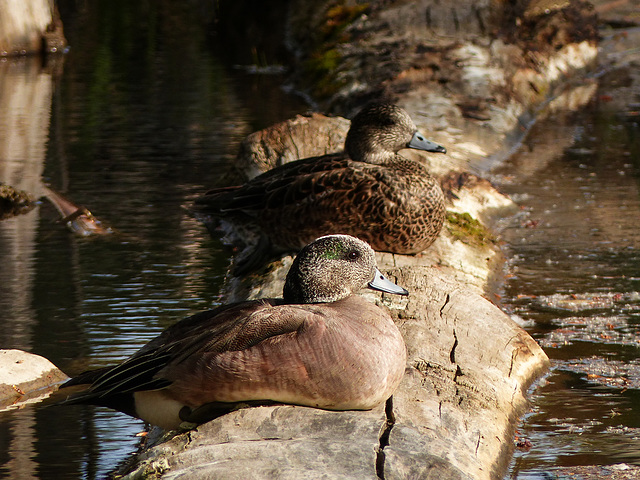
American Wigeon pair
One week ago, on 4 May 2016, I had a volunteer shift and then thought I might call in at the Reader Rock Garden afterwards. Changed my mind when I discovered that new road construction was taking place at the very first corner I was going to take, so I couldn't turn right. Instead, I called in at Fish Creek Park to check on the Great Horned Owls.
I so rarely get photos of American Wigeons, as when I do see one, it is almost always way off in the distance. On this day, however, I was lucky enough to see a pair of them resting on a log, as well as a pair of Wood Ducks that were swimming nearby, all close enough to photograph. You can see just a tiny bit of iridescent green on this male's head, behind the eye.
"A common and increasingly abundant duck, the American Wigeon breeds in northwestern North America and is found throughout the rest of the continent in migration and in winter. Its small bill and the male's white forehead, as well as certain aspects of nesting and feeding behavior, distinguish this species from other dabbling ducks." From AllAboutBirds.
www.allaboutbirds.org/guide/American_Wigeon/id
08 May 2016
Ruddy Duck
Such sad news from the Calgary Zoo just now (16 May 2016):
"We are deeply saddened to share that silverback gorilla, Kakinga, passed away Saturday night at the age of 37. Often called the zoo’s gentle giant, Kakinga was an exceptional silverback; a kind, loving, protective and diligent leader.
Our Veterinary team has determined he died as a result of developing a large tear in his aorta which caused the sac around his heart to become filled with blood and ultimately stopped his heart. This is one of the well-recognized causes of mortality in gorillas, especially males.
Kakinga was born December 1, 1978 at the Jersey Zoo in the United Kingdom and arrived at the Calgary Zoo in 1984. After nine years, he transitioned into the role of silverback, or leader of the troop in 1993, a role he held for the past 23 years.
During his time as silverback, he fathered 13 offspring, eight of which are surviving with the most recent being born just this past March at our zoo. Of those eight, five are males and three are females.
But Kakinga is known for more than just his impressive genetics. His calm and gentle natured endeared him to all zoo staff who cared for him. He was very involved in his role as leader of the troop, acting as a peacekeeper, a protector and in some very tender moments, a father." From the Calgary Zoo.
"Western Lowland Gorillas are part of a Species Survival Program authorized by the Association of Zoos and Aquariums (AZA) and are considered endangered by the World Conservation Union (IUCN). Their last chance for survival may be a few gorilla sanctuaries in Africa, zoos, and other captive environments and breeding programs throughout the world." From the Calgary Zoo.
-----------------------------------------------------------------------------------------------
My plan on 8 May 2016 was to join friends for an afternoon walk at Carburn Park. Closer to the time, I knew I would never make it in time and decided at the last minute that I would instead go for a short drive SE of the city. I knew that I was far more likely to see a few closer birds and get some photo opportunities if I went SE.
I stayed around Frank Lake for most of the time. When I checked the weather forecast before I left, I knew that there was a possibity of rain later on. I totally forgot to check how windy it was going to be, and ended up barely being able to hold my camera steady enough to try and get a few shots. The strong wind was causing mini waves both on the lake itself and also on the very small slough I stopped at, creating a few neat water patterns.
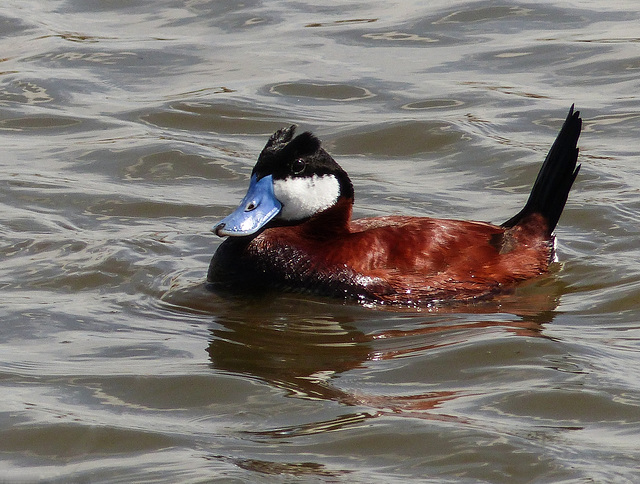
Shorebirds included the always beautiful American Avocet and Black-necked Stilts, a Willet and a couple of different shorebirds. I don't see shorebirds very often and I am not good at IDs for them. A pair of Killdeer were making a lot of noise, as usual. Saw several kinds of ducks, but many of them were too far to get any photos worth keeping. I was happy to see a pair of Canvasbacks and several Ruddy Ducks. The male Ruddy Ducks were busy trying to impress the females - these small guys are so funny to watch, especially during the breeding season, as they seem to have lots of character and a real attitude. The males have quite a stunning, chestnut coloured body and sky-blue bill.
"Ruddy Ducks are compact, thick-necked waterfowl with seemingly oversized tails that they habitually hold upright. Breeding males are almost cartoonishly bold, with a sky-blue bill, shining white cheek patch, and gleaming chestnut body. They court females by beating their bill against their neck hard enough to create a swirl of bubbles in the water. This widespread duck breeds mostly in the prairie pothole region of North America and winters in wetlands throughout the U.S. and Mexico." From AllAboutBirds.
en.wikipedia.org/wiki/Ruddy_Duck
www.allaboutbirds.org/guide/ruddy_duck/id

15 May 2016
Cinnamon Teal
Back later .........
10 Apr 2016
Canada Goose
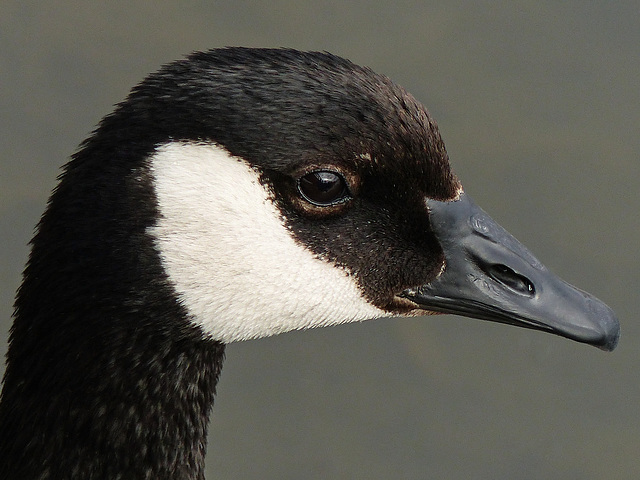
S/he's beautiful, even if s/he is "just" an everyday Canada Goose. This photo was taken at a wetland in SW Calgary on 10 April 2016, when I called in for just a very quick visit. The weather forecast had been for mainly sunny, but the day turned out to be mainly cloudy with a bit of sun. That made me cancel my plans to do a longer drive somewhere, which left me longing to get out with my camera. So, Mr or Mrs. Canada Goose it is : )
"A familiar and widespread goose with a black head and neck, white chinstrap, light tan to cream breast and brown back. Has increased in urban and suburban areas in recent years; just a decade or two after people intentionally introduced or reintroduced “giant” Canada Geese to various areas, they are often considered pests." From AllAboutBirds.
www.allaboutbirds.org/guide/canada_goose/id
10 Apr 2016
Finely iridescent
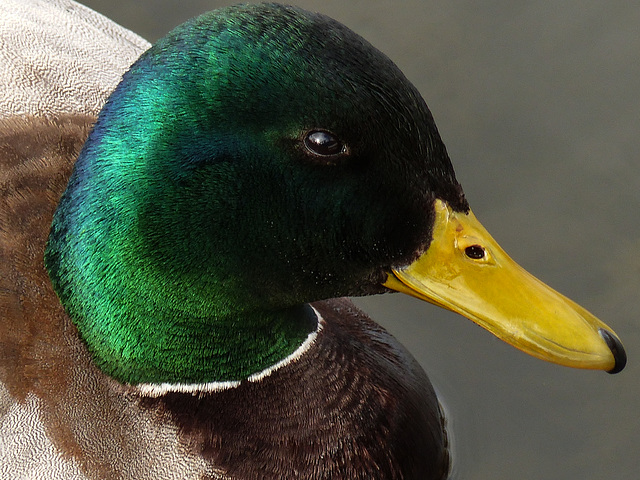
He's beautiful, even if he is "just" an everyday male Mallard. I never get tired of photographing Mallards, or seeing photos taken by other photographers. This photo was taken at a wetland in SW Calgary on 10 April 2016, when I called in for just a very quick visit. The weather forecast had been for mainly sunny, but the day turned out to be mainly cloudy with a bit of sun. That made me cancel my plans to do a longer drive somewhere, which left me longing to get out with my camera. So, Mr. Mallard it is : )
The temperature this morning is 2C, but supposed to soar to 15C this afternoon with a chance of showers. Hopefully, the rain will stay away, though, as it is the May Species Count today and tomorrow.
"If someone at a park is feeding bread to ducks, chances are there are Mallards in the fray. Perhaps the most familiar of all ducks, Mallards occur throughout North America and Eurasia in ponds and parks as well as wilder wetlands and estuaries. The male’s gleaming green head, gray flanks, and black tail-curl arguably make it the most easily identified duck. Mallards have long been hunted for the table, and almost all domestic ducks come from this species." From AllAboutBirds.
Occasionally, Mallards have been known to show up in people’s swimming pools. My good friend, Art (Leapfrog), has had up to around 45 (?) on his pool at any given time. His pool is covered, with water filling the cover. One special pair, Daisy and Donald, have been coming to his backyard pool for 11 or 12 years!
www.allaboutbirds.org/guide/Mallard/id
en.wikipedia.org/wiki/Mallard
11 Jun 2016
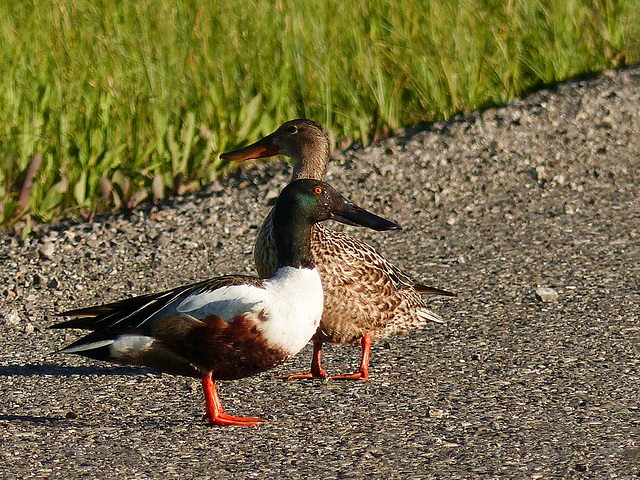
Northern Shoveler pair
I don't often get the chance to photograph a Northern Shoveler, though there are plenty of them around. Definitely don't usually see a pair of them, standing in the road. Saw these when I went for a short drive SW of the city on 11 June 2016.
"Perhaps the most outwardly distinctive of the dabbling ducks, the Northern Shoveler inhabits wetlands across much of North America. Its elongated, spoon-shaped bill has comblike projections along its edges, which filter out food from the water." From AllAboutBirds.
en.wikipedia.org/wiki/Northern_Shoveler
www.allaboutbirds.org/guide/northern_shoveler/id
03 Nov 2016
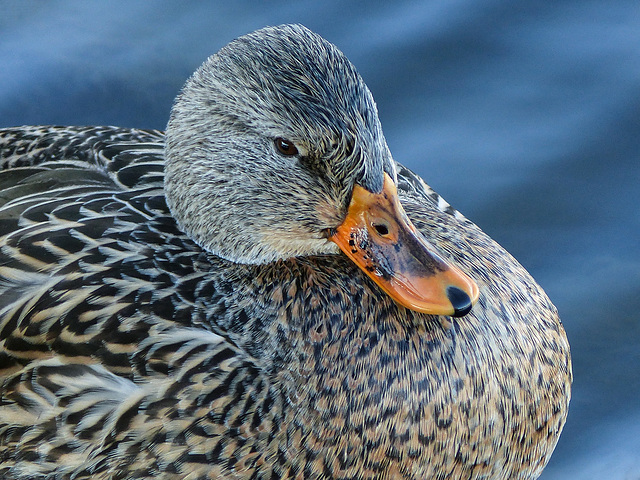
Feather finery of a female Mallard
First of all, has anyone heard anything from, or about, our amazing Flickr friend, Snowinglightly? Today is the 12th day since she suddenly stopped commenting here on Flickr, For years, she has been such a loyal friend, leaving such long, thoughtful and very creative comments on people's photos every single day. To suddenly stop like this, is making me very concerned. The only time I remember her not commenting, for maybe four days in a row, was when she had ended up in hospital. Twelve days would be more than enough time to sort out any computer problems or to have to replace a computer, so I don't think that would be a reason. I have left messages in various places, but so far, still don't know any answer. If you happen to know, could you PLEASE let me know?
-----------------------------------------------------------------------------------------------
She's beautiful, even if she is "just" an everyday female Mallard. I never get tired of photographing Mallards, or seeing photos taken by other photographers. This photo was taken at a wetland in SW Calgary yesterday, 3 November 2016, when I called in for just a very quick visit.
Earlier in the day, I had been on a birding walk at Burnsmead, Fish Creek Park, all morning with friends, seeing various birds that were just distant silhouettes and much too far away for photos. I had been on a similar walk two days earlier, seeing only distant birds.
Yesterday, though, I decided that I needed to see something close enough to photograph, so I went south a little way to look for a Long-tailed Weasel that people had been seeing all last week - but, as usual, not on the day that I went, lol! After 45 minutes of waiting, there was still no sign of the little Weasel yesterday. So, my usual plan of desperation took me to a wetland in the SW of the city, where I can usually see Mallards. Sure enough, there were two pairs hanging out together, and I really appreciated their giving me the chance to take a few photos. They were swimming in and out of sunlight and shadow, giving totally different photos.
I will add the list of species seen at Burnsmead, complied by our leaders, in a comment box below.
01 Nov 2016
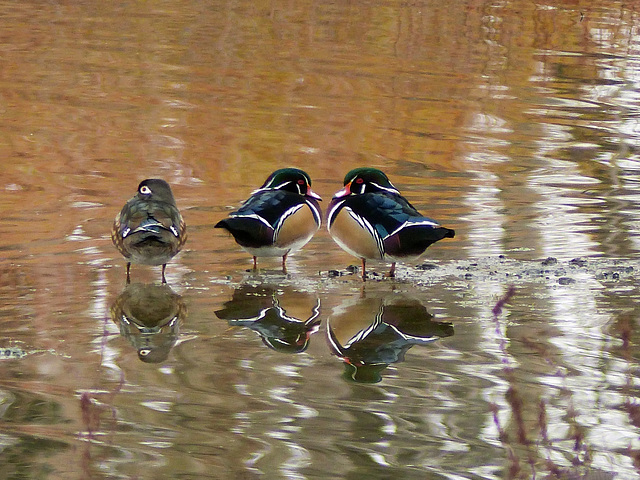
Wood Ducks on a local pond
I don't see Wood Ducks very often and, usually when I do see them, they are far away. The two males and one female in this photo were just within photo range, fully zoomed and cropped. A second female was nearby. They were hanging out at a local storm-water pond at Burnsmead, Fish Creek Park, and were seen on a birding walk with friends on 1 November 2016. By the way, a note to any local birders - the road down to Bankside has been closed for the winter. I don't remember this happening other years. Now you have to park in the Burnsmead parking lot and walk the rest of the way. I will add the list of the 32 bird species seen, in a comment box below.
"The Wood Duck is one of the most stunningly pretty of all waterfowl. Males are iridescent chestnut and green, with ornate patterns on nearly every feather; the elegant females have a distinctive profile and delicate white pattern around the eye. These birds live in wooded swamps, where they nest in holes in trees or in nest boxes put up around lake margins. They are one of the few duck species equipped with strong claws that can grip bark and perch on branches." From AllABoutBirds.
www.allaboutbirds.org/guide/Wood_Duck/id
en.wikipedia.org/wiki/Wood_duck

07 Nov 2016
Rare Long-tailed Duck
GOOD LUCK, AMERICA!! GOOD LUCK, WORLD!!
Today is THE day - voting for the next U.S. President. May the BEST person win.
-----------------------------------------------------------------------------------------------
We had all hoped to have a much closer view of a pair of rare Long-tailed Ducks yesterday, 7 November 2016, but this was the 'best' I could do : ) Better than nothing, though. At least you can see its long tail. They were out in the middle of the Glenmore Reservoir, if not closer to the far side, and I could only see them through someone's scope.
I believe I had only ever seen a Long-tailed Duck on three occasions before. I have photos from each occasion posted on Flickr.
1. 20 October 2009 on the Glenmore Reservoir
2. 12 January 2010, on the Bow River, south of H'way 22X
3. 5 November 2012, saw about 6 of them on Glenmore Reservoir
I have added our leaders' list of species seen yesterday, in a comment box below.
"The Long-tailed Duck, formerly known as the Oldsquaw, breeds across the Alaskan and Canadian Arctic, and spends the winter on the Pacific Ocean. Consequently, it is only a rare transient through Alberta.
A very few Long-tailed Ducks appear in Alberta in late October and early November. Very occasionally, one will overwinter on an open river or lake in the province. They are even scarcer on spring migration from March to May." Written by Andrew Slater for talkaboutwildlife.ca/profile/index.php?s=47 .
"The Long-tailed Duck or Oldsquaw (Clangula hyemalis) is a medium-sized sea duck. It is the only living member of its genus, Clangula .... Adults have white underparts, though the rest of the plumage goes through a complex moulting process. The male has a long pointed tail (10 to 15 cm) and a dark grey bill crossed by a pink band. In winter, the male has a dark cheek patch on a mainly white head and neck, a dark breast and mostly white body. In summer, the male is dark on the head, neck and back with a white cheek patch. The female has a brown back and a relatively short pointed tail. In winter, the female's head and neck are white with a dark crown. In summer, the head is dark. Juveniles resemble adult females in autumn plumage, though with a lighter, less distinct cheek patch."
en.wikipedia.org/wiki/Long-tailed_Duck
Jump to top
RSS feed- Latest items - Subscribe to the latest items added to this album
- ipernity © 2007-2026
- Help & Contact
|
Club news
|
About ipernity
|
History |
ipernity Club & Prices |
Guide of good conduct
Donate | Group guidelines | Privacy policy | Terms of use | Statutes | In memoria -
Facebook
X
