


Ducks and Geese


02 Sep 2014
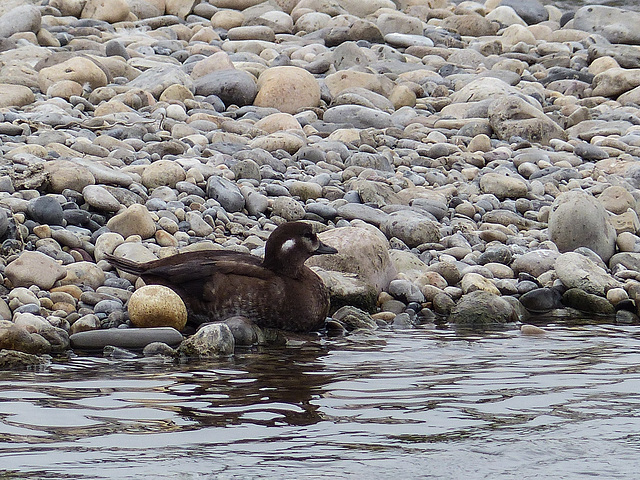
Female Harlequin Duck
Not a very inspiring photo, but a group of us were lucky to see this female Harlequin Duck at Carburn Park on 2 September 2014. She was resting on a small gravel bar out in the middle of the Bow River - hence a fully-zoomed and well-cropped photo. You can see that she has a white spot behind the ear and faded, variable white patches in front of the eye. A pair of these beautiful ducks (the male is spectacular) could often be seen from the Inglewood Bird Sanctuary, but unfortunately, the Sanctuary suffered so much damage from the 2013 Alberta Flood of the Century, that it is still closed more than a year later. They are locally uncommon here from May to September. I think I'm right in saying that there have only been about five of these small ducks in the city, so it's always a treat to see them.
"The harlequin duck (Histrionicus histrionicus) is a small sea duck. It takes its name from Harlequin (French Arlequin, Italian Arlecchino), a colourfully dressed character in Commedia dell'arte. The species name comes from the Latin word "histrio", "actor". In North America it is also known as lords and ladies. Other names include painted duck, totem pole duck, rock duck, glacier duck, mountain duck, white-eyed diver, squeaker and blue streak.
These birds feed by swimming under water or diving. They also dabble. They eat molluscs, crustaceans and insects. Harlequins have smooth, densely packed feathers that trap a lot of air within them. This is vital for insulating such small bodies against the chilly waters they ply. It also makes them exceptionally buoyant, making them bounce like corks after dives." From Wikipedia.
en.wikipedia.org/wiki/Harlequin_duck
www.allaboutbirds.org/guide/harlequin_duck/id
02 Sep 2014
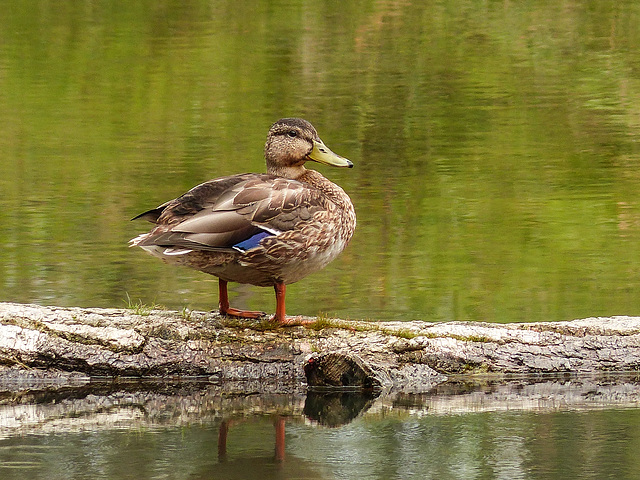
"Just" a Mallard
I thought this female Mallard was posing nicely on this old, fallen log at Carburn Park on 2 September 2014, and showing the white-bordered, blue “speculum” patch in the wing that both sexes have. It feels good to see "green" because we are still in mid-winter - and it's snowing again today. Can't complain, though, as the last few weeks have been incredibly mild for us, except for the last few days. This morning, the temperature here is -13C (windchill -21C). I really feel for all the people, especially in the east and north east of the US, who have received so much snow in the last few days.
"If someone at a park is feeding bread to ducks, chances are there are Mallards in the fray. Perhaps the most familiar of all ducks, Mallards occur throughout North America and Eurasia in ponds and parks as well as wilder wetlands and estuaries. The male’s gleaming green head, gray flanks, and black tail-curl arguably make it the most easily identified duck. Mallards have long been hunted for the table, and almost all domestic ducks come from this species." From AllAboutBirds.
www.allaboutbirds.org/guide/mallard/id
01 Mar 2015
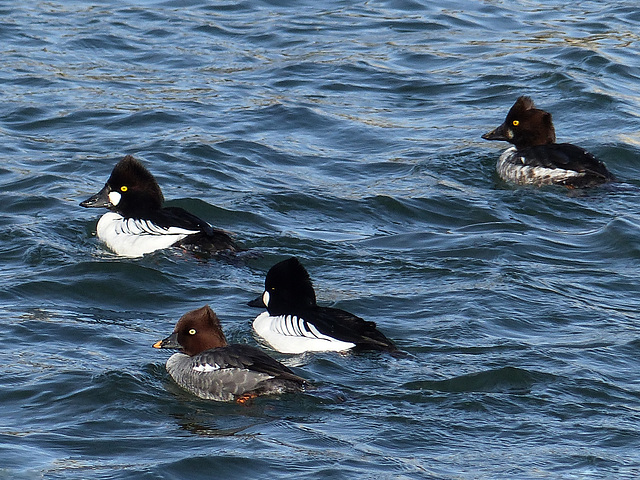
Common Goldeneye
Two days ago, on 1 March 2015, I went on part of a bird walk with friends, at the east end of Fish Creek Park. One of the things we wanted to check on was the pair of Great Horned Owls that have nested there for quite a few years. Sure enough, the male was perched high up in a tree not far from the nesting snag. The female was on the nest, but out of sight because of the deep cavity. All being well, once young ones hatch and grow bigger, she will gradually be forced higher and eventually she will be seen.
I so rarely take photos of waterfowl any more, but took a quick couple of shots of these Common Goldeneye that were swimming in the middle of the river. They just seemed so far away, but I guess it was worth at least trying to get a shot of them. I think I'm right in saying that the bird at top right is an immature male? I can never remember the difference between "immature" and "juvenile" - need to look that up again.
www.allaboutbirds.org/guide/Common_Goldeneye/id
en.wikipedia.org/wiki/Common_goldeneye
The temperature today, 3 March 2015, is -10C (windchill -17C). Tomorrow morning is forecast to be -17C (windchill -23C) and soaring to 1C in the afternoon. After that, it looks like we should have a string of warmer days, unless things change. March is supposedly our snowiest month, but so far there is no sign of it for the next couple of weeks. This winter has been so incredibly mild for much of the time - wonderful!
10 Mar 2015
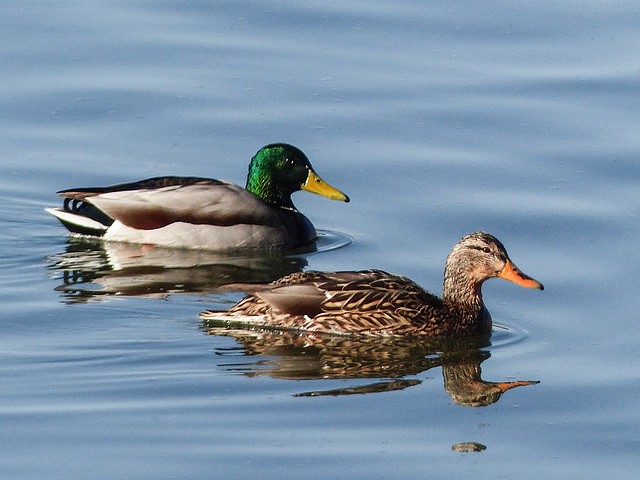
Mallard pair at Mallard Point
This photo was taken yesterday morning, 10 March 2015, when I went on a birding walk with friends at Mallard Point in Fish Creek Park. Sad to see all the damage caused by the last devastating flood. This bridge over the river has been repaired and there was a short stop to check out the river for birds. Every year, I tell myself that I must photograph more of the water fowl, as most of my photos are quite old. Each year, I don't seem to do it. It was sunny and calm during the almost three-hour walk, with a temperature of 2C to 11C.
The list, compiled by leader Gus Yaki, is below - I turned back before the furthest destination, so missed some of the birds, such as the Pheasant and Northern Goshawk:
1. Canada Goose-150
2. AMERICAN WIGEON-6
3. Mallard-100
4. Bufflehead-70
5. Common Goldeneye-80
6. Common Merganser-1 m.
7. Ring-necked Pheasant-1 m.
8. Bald Eagle-2+ (1 ad/1 imm+, - 4 sightings).
9. Northern Goshawk-1 m.
10. RING-BILLED GULL? – 2 Sightings
11. Rock Pigeon-3
12. Belted Kingfisher-1 heard.
13. Downy Woodpecker-6+
14. Hairy Woodpecker-2
15. Northern Flicker-25
16. Blue Jay-4
17. Black-billed Magpie-10
18. American Crow-1
19. Common Raven-10+
20. Black-capped Chickadee-15
21. White-breasted Nuthatch-1
22. AMERICAN ROBIN-4
23. European Starling-30+
24. House Finch-2+
25. House Sparrow-20+
After the walk, I called in to see one of the owls at the east end of Fish Creek Park. Took me a little while, but, just before I was about to give up, I found her on her nest. All you can see is her head or part of it, if that.
10 Mar 2015
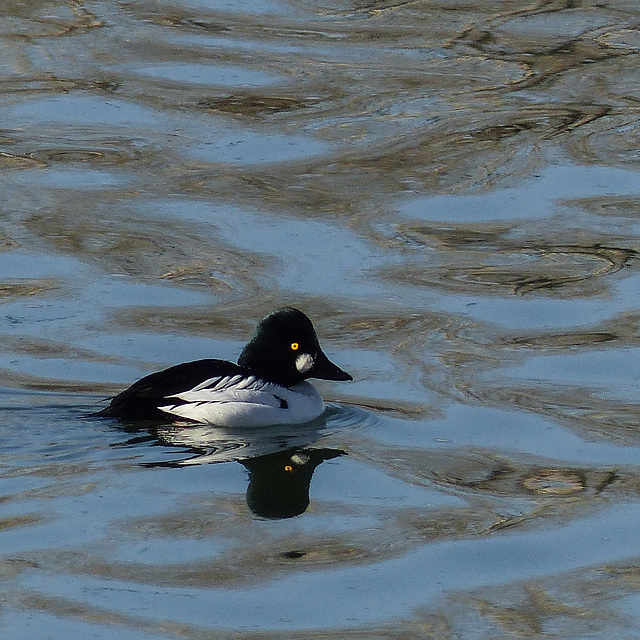
Common Goldeneye
I'm finding it hard to get motivated to go through my archives and somewhat more recent photos at the moment. I've taken very few photos during the past month and few are remotely inspiring. I really need to get out, period, and definitely need some new places to explore. Our weather forecast has a mix of snow and rain or scattered flurries on three days this coming week, but today is supposed to be OK, so I might go for a drive as long as I don't stay on my computer too long.
This photo of a male Common Goldeneye was taken at Mallard Point, Fish Creek Park, on 10 March 2015. You can just see a bit of the green iridescence on the top of its greenish black head, shining in the sunlight.
"The eyes of a Common Goldeneye are gray-brown at hatching. They turn purple-blue, then blue, then green-blue as they age. By five months of age they have become clear pale green-yellow. The eyes will be bright yellow in adult males and pale yellow to white in females." From AllAboutBirds.
www.allaboutbirds.org/guide/Common_Goldeneye/lifehistory
en.wikipedia.org/wiki/Common_goldeneye
05 Apr 2015
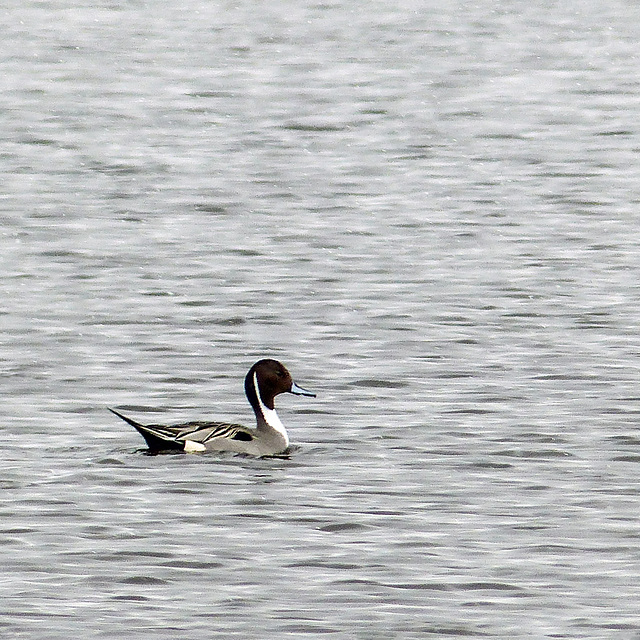
Elegant Pintail
This photo and the previous one (adult Bald Eagle) were both taken yesterday, on a day trip with four other people to Frank Lake, SE of Calgary. Both are really poor photos, but I wanted to add them to my Frank Lake album/set.
Yesterday, 5 April 2015, I woke up to a winter scene, as it had snowed overnight. I wasn't sure if the drive would be cancelled, but fortunately we went ahead as planned. The whole area at and around Frank Lake is one of my favourite places. It was snowing on and off during the day and visibility was not very good. Pretty well all the birds we saw were distant or very distant, as usual when I go on one of these outings. A very enjoyable day as always, though, in an interesting place and with good company. I will add the leader, Tony Timmons' list of our sightings, below, mainly for my own memory. Thanks for the great day, Tony!
"Five participants for the Easter Sunday,Nature Calgary Trip to Frank Lake.
We found 47 species. Best sighting for the group was an adult Golden Eagle perched on the ground close to the road, (along 184st.E and west of the intersection with 594 Ave.E. on route to Basin3)
A Eurasian Wigeon was along the access road to Basin 2,and a pair of Red-breasted Mergansers were spotted in Basin 1.
Canada Goose
Trumpeter Swan 15
Tundra Swan 2
Eurasian Wigeon 1
American Wigeon
Mallard
Northern Shoveler
Northern Pintail
Green-winged Teal
Canvasback
Redhead
Ring-necked Duck
Lesser Scaup
Bufflehead
Common Goldeneye
Barrow's Goldeneye 1m
Common Merganser 5
Hooded Merganser 8
Red-breasted Merganser 2
Ruddy Duck 1
Bald Eagle 1 ad.
Golden Eagle 1 ad.
Northern Harrier 7
Red-tailed Hawk 2
American Kestrel 2
Gray Partridge 8
American Coot
Killdeer 2
American Avocet 2
Franklin"s Gull 8
Ring-billed Gull 10
California Gull 100
Rock Pigeon
Great Horned Owl 3 ad.
Northern Shrike 1
Black-billed Magpie
American Crow
Common Raven
Horned Lark 25
American Robin
European Starling
Dark-eyed Junco 1
Lapland Longspur (small flock overhead 5-6)
Red-winged Blackbird 10
Yellow-headed Blackbird 5
Western Meadowlark 6
House Sparrow
Tony Timmons"
17 Mar 2011
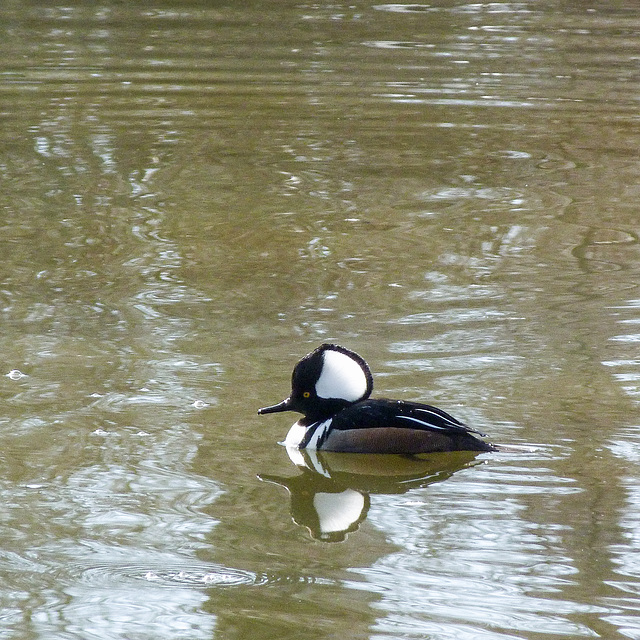
Hooded Merganser male
This is a male Hooded Merganser (uncommon in Alberta) that flew in and landed on a large patch of open water in the lagoon at Inglewood Bird Sanctuary on 17 March 2011. Such beautiful birds with the white crest edged in black. This can be raised, as in this image, or lowered. He looks quite spectacular in his breeding plumage. Not the best photo, but I only have a few photos of this species.
www.allaboutbirds.org/guide/Hooded_Merganser/id
en.wikipedia.org/wiki/Hooded_Merganser
26 Apr 2015
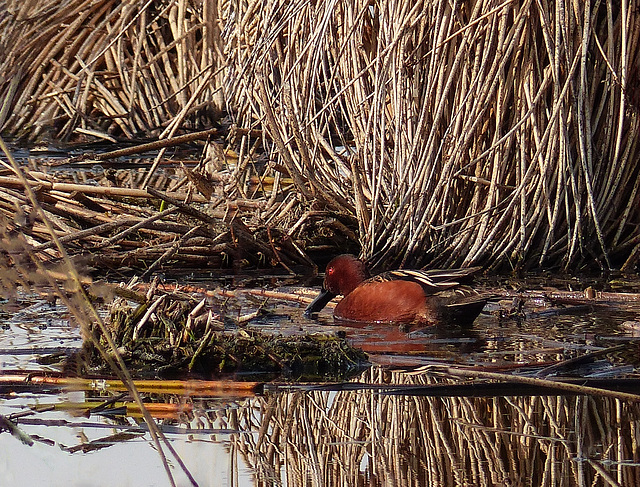
Cinnamon Teal
I only had three photos of Cinnamon Teal on Flickr and all are distant. They are always far away when I very occasionally do happen to see one. This is my closest shot of one and far from good, but will do until I hopefully get a better one. They really are a beautiful duck and their colour is gorgeous when the sun shines on them.
www.allaboutbirds.org/guide/Cinnamon_Teal/id
en.wikipedia.org/wiki/Cinnamon_teal
Three days ago, on 26 April 2015, I spent the day with a fair-sized group of friends, at Frank Lake. The weather was beautiful and, for once, not windy. Frank Lake and the surrounding area is one of my favourite places to spend a day or half a day.
On a trip like this one, there are a lot of the birds that I don't see, as I don't use binoculars. Also, my interest is not to see as many species as possible, but to hopefully come across a few birds close enough to photograph. Fortunately, at the bird blind/hide, a couple of Eared Grebe were within camera range as well as a Coot or two. Every once in a while, they stayed still for a few seconds before continuing their constant swimming and diving.
I will add the final list of the 51 species seen, complied by our Leader, Tony Timmons. Probably not of much interest to most people, but it does help my memory. Many thanks, as always, Tony, for a very successful and most enjoyable day! Really appreciate your giving up a precious weekend day to take us out there.
"The birds put on a spectacular show for the 19 participants on the Frank Lake trip today. We tallied 51 species. (Anne's note: on this trip one year ago, we found 53 species.)
Expected species were present in pretty good numbers; most noteworthy being American Avocet (200+) and White-faced Ibis (120). Thousands of ducks were on the Lake.
Thanks to Dan Parliament and Al Borgardt for scoping birds and sharing sightings with the group.
Before the start of the trip, Rose Painter spotted two Long-billed Curlew near Blackie. Later in the day, we searched for the birds without success.
Eared Grebe 250
Western Grebe 20
Double-crested Cormorant 25
Black-crowned Night Heron 1
White-faced Ibis 120
Canada Goose
Swan sp. 12
Gadwall
American Wigeon
Mallard
Blue-winged Teal
Cinnamon Teal
Green-winged Teal
Northern Shoveler
Northern Pintail
Canvasback
Redhead
Ring-necked Duck
Lesser Scaup
Bufflehead
Common Goldeneye
Hooded Merganser 2 f.
Ruddy Duck
Northern Harrier 3
Swainson's Hawk 3
Gray Partridge 4
American Coot
Killdeer 5
Black-necked Stilt 10
American Avocet 200+
Greater Yellowlegs 5
Lesser Yellowlegs 17
Franklin's Gull 1000
Bonaparte's Gull 10
Ring-billed Gull 5
California Gull 20
Rock Pigeon
Great Horned Owl ( 3 ad. + 3 owlets )
Black-billed Magpie
American Crow
Common Raven
Tree Swallow 60
Bank Swallow 1
Marsh Wren 4
American Robin
European Starling
Red-winged Blackbird
Western Meadowlark 5
Yellow-headed Blackbird
Brewer's Blackbird 1
House Sparrow
Tony Timmons"
01 May 2015
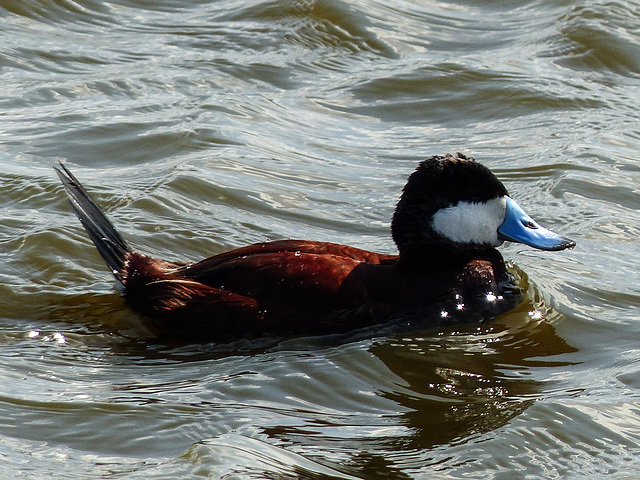
Ruddy Duck in choppy waters
Yesterday afternoon, 1 May 2015, I left home to drive SE of the city, with Frank Lake as my main destination. I was there on 26 April with quite a large group of birders and the lake was so beautifully calm - made for some nice reflections. Yesterday was the opposite, with very strong winds, making it really difficult to stand and especially hold a camera. The wind started a short while after I left home and I did wonder what it was going to be like at Frank Lake. The highway south is through pretty flat, prairie land and so there is little to break the force of the wind. As a result, I had to grip the steering wheel the whole drive, trying to keep my car within the lines of my lane. A few hours of gripping my camera and bracing myself against a wooden corner at the bird blind (hide) didn't help. Last night and today, my shoulders and arms are so painful, having triggered the inflammation in both shoulder rotator cuffs again. Fortunately, today will be a lot more relaxing.
I didn't see many species of bird yesterday afternoon, as my main focus was on the Eared Grebes, that I love seeing and photographing. Far more of them than a few days earlier, probably because they were trying to find a slightly more sheltered bit of water instead of the huge expanse of open lake. Saw a Coot or two, a few Canada Geese, maybe 15 or so White-faced Ibis in flight. Saw a couple of Yellow-headed Blackbirds, one Red-winged Blackbird, this Ruddy Duck, and endless noisy Gulls. Drove past the Great Horned Owl family and all looked well. I went all the way round the lake, but didn't see any birds at all along these gravel roads. I always love the prairie landscape.
The trip was worth it, though (apart from my painful arms!). Now I just have to go through and delete all the dozens of very blurry Grebe shots. Hardly unexpected, though, given the very windy day. I was just amazed that a few photos look like they may be sharp enough to post!
Jump to top
RSS feed- Latest items - Subscribe to the latest items added to this album
- ipernity © 2007-2026
- Help & Contact
|
Club news
|
About ipernity
|
History |
ipernity Club & Prices |
Guide of good conduct
Donate | Group guidelines | Privacy policy | Terms of use | Statutes | In memoria -
Facebook
X
