

Pine Grosbeak male / Pinicola enucleator
Norwegian Fjord Horses
My father, Tom Carden Bassindale
The warmth of orange
Fluffed-up Common Redpoll
'Twas a cold, cold day for us all
Banded Peacock or Fatima / Anartia Fatima
Happy Chinese New Year
The joy of food
Mates for life
Malachite magnificence
A mix of seasons
Icicles near the river's edge
Talk about amazing camouflage
Unusual Canada Goose
Tip of a Tulip stigma
From black silhouette to beauty
Alice Gladwell Bassindale, my paternal Grandmother…
Markhor
Fluffed
Isabella Tiger / Eueides isabella
The only time I look tall and slim, ha
Northern Saw-whet Owl / Aegolius acadicus
Common Eggfly / Hypolimnas bolina
Farm cat
Black-billed Magpie
Lines
Sunburst
Hoya exquisiteness
Surviving the frigid temperatures
Amongst the Lily pads
Wedding Day of my ancestors
One of my favourite old finds
Lichens from Marsden Creek, Kananaskis
Norwegian Fjord Horse
When my thoughts turn to summer
Prairie Falcon
Showy Lady's-slipper
What a treat : )
Beautiful old barn
Orange Jelly Fungus
Stripping the tree
Hericium sp
Red and green = beautiful
I'm the king of the castle ....
Location
Lat, Lng:
You can copy the above to your favourite mapping app.
Address: unknown
You can copy the above to your favourite mapping app.
Address: unknown
Keywords
Authorizations, license
-
Visible by: Everyone -
All rights reserved
-
411 visits
Wolf Willow/Silverberry / Elaeagnus commutata
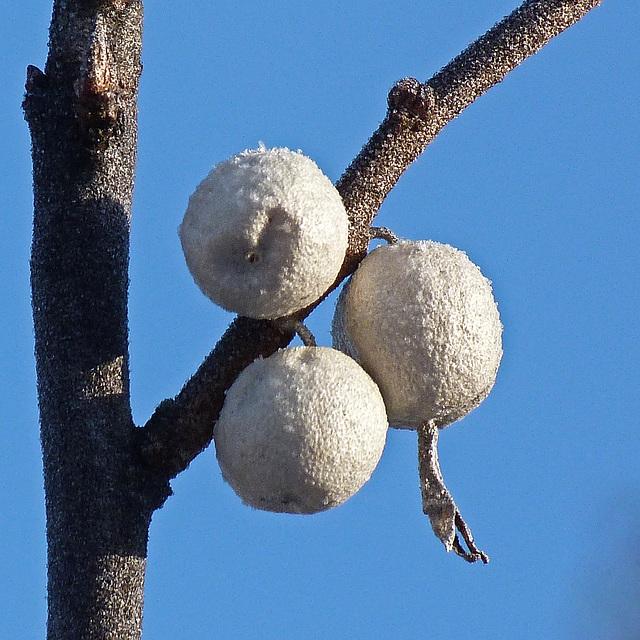

Took this macro photo yesterday morning on a walk in the Weaselhead. The silvery berries of the native Wolf Willow or Silverberry shrub look attractive in winter, especially when seen against a blue sky. This shrub is popular with the Calliope Hummingbird and, in fact, this photo was taken in "The Meadow" in Weaselhead, where one can see these tiny birds. It has a very strong scent - some people love it, others dislike it intensely - I love it : )
"Wolf willow berries were used by Blackfoot Natives to make seed necklaces. The berries were boiled to remove the flesh and the pointed nutlets strung onto necklaces or used to decorate the fringes on clothing. Each seed is dark brown with yellow stripes. When the first settlers arrived, the women quickly learned the art from the natives, and wolf willow seed necklaces became a popular gift to send home.
Wolf willow fruit is mealy and dry, but was still eaten by some First Nations. Blackfoot Indians peeled and ate the berries or mixed them with grease and stored them in a cool place. This was eaten as a confection or added to soups and broths. The berries were sometimes mixed with blood or sugar and cooked for food. Children suffering from frostbite were treated with a strong solution made from the bark. The essential oil is in demand for aromatherapy.
Though commonly called wolf willow, this plant species is not a willow at all. Instead, it belongs to the Elaeagnaceae (Oleaster) family and is related to thorny and Canada buffaloberry (Shepherdia)."
plantwatch.fanweb.ca/plant-information/wolf-willow
- Keyboard shortcuts:
Jump to top
RSS feed- Latest comments - Subscribe to the comment feeds of this photo
- ipernity © 2007-2026
- Help & Contact
|
Club news
|
About ipernity
|
History |
ipernity Club & Prices |
Guide of good conduct
Donate | Group guidelines | Privacy policy | Terms of use | Statutes | In memoria -
Facebook
X

Sign-in to write a comment.