

Scabius
Short-lived beauty
When the weight of the world ...
Hooker's Thistle / Cirsium hookerianum
Sandhill Crane / Grus canadensis
Echinacea
Clover seedhead
Mt. Yamnuska
And away they go ...
Lacewing / Chrysopidae sp.
The twist
A little find in the forest
Lachnum sp.
Earthstar
Reflection
Blue Grama / Bouteloua gracilis
Tropical
Late bloomer
While it lasted
Autumn's palette
Ladybug, ladybug, fly away home ...
.
Highbush Cranberry / Viburnum trilobum
Common Burdock / Arctium minus
Underwing Moth
The power of bokeh
Huddled
Fall colours near the Bow River
Whooping Crane / Grus americana
Bird's-nest Fungi
Sawfly larva / Trichiocampus viminalis
How's this for colour?
Scentless Chamomile / Matricaria perforata
A different Coral Fungus
Tarnished Plant Bug / Lygus lineolaris
Tropical leaves
Touched by the sun
Heliconius sara
Fungus
Butter-and-eggs / Linaria vulgaris
Bird's-nest Fungus
Nodding Thistle/Musk Thistle / Carduus nutans
Soft-leaf Muhly grass / Muhlenbergia richardsonis
Reaching out to the sun
Bird's-nest Fungi by the hundreds
See also...
Keywords
Authorizations, license
-
Visible by: Everyone -
All rights reserved
-
223 visits
Whooping Crane / Grus americana
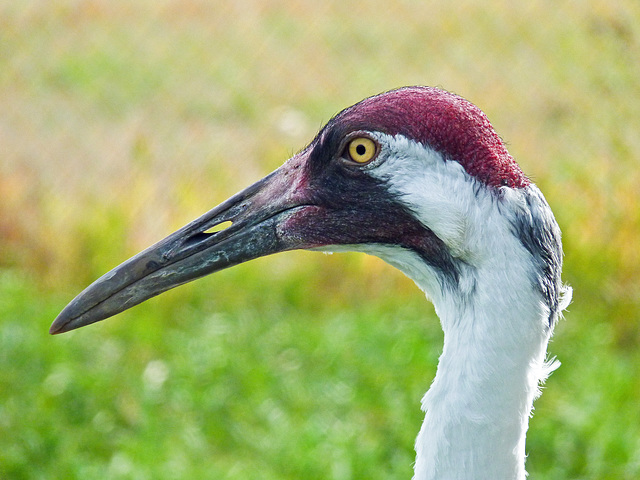

One of the Whooping Cranes at the Calgary Zoo Ranch, south of the city, seen when a group of us had the privilege of visiting four days ago. Tremendous work is being done there to breed several very endangered species, especially the fascinating Whooping Crane. These birds are kept in enclosures and any interaction with the staff is done using white "Crane costumes". The Whooping Crane's lifespan is estimated to be 22 to 24 years in the wild. Many thanks to Crane Keeper, Dwight Knapik, for showing us around for the afternoon and filling us with interesting information. By the way, these birds don't stay still - they are constantly on the move and are a challenge to photograph : )
In 1985, the Devonian Wildlife Conservation Centre (DWCC) opened. Known as the "Zoo Ranch," this land south of Calgary is home to the breeding facilities for the endangered Whooping Cranes, Vancouver Island Marmots, Przwalksi wild horses and Zebra.
"The only remaining flock of wild Whooping Cranes, the wintering population in coastal Texas, reached a low of 15 birds in the winter of 1941-42, and hovered between the low 20s and mid 30s over the next two decades. Efforts to locate the flock's breeding grounds intensified following World War II. Evidence of breeding was first reported in 1954, when several adults and pre-fledged juveniles were observed in Wood Buffalo National Park (WBNP) in Northwest Territories, Canada. Researchers were able to locate the first nests the following year. The inaccessibility of the breeding grounds, protection of the wintering grounds, and extensive public education campaigns have contributed to the population's increase to its current level."
www.npwrc.usgs.gov/resource/birds/cranes/grusamer.htm
www.bringbackthecranes.org/recovery/recv2009.html#Captive
www.whoopingcrane.com/FLOCKSTATUS.HTM
In 1985, the Devonian Wildlife Conservation Centre (DWCC) opened. Known as the "Zoo Ranch," this land south of Calgary is home to the breeding facilities for the endangered Whooping Cranes, Vancouver Island Marmots, Przwalksi wild horses and Zebra.
"The only remaining flock of wild Whooping Cranes, the wintering population in coastal Texas, reached a low of 15 birds in the winter of 1941-42, and hovered between the low 20s and mid 30s over the next two decades. Efforts to locate the flock's breeding grounds intensified following World War II. Evidence of breeding was first reported in 1954, when several adults and pre-fledged juveniles were observed in Wood Buffalo National Park (WBNP) in Northwest Territories, Canada. Researchers were able to locate the first nests the following year. The inaccessibility of the breeding grounds, protection of the wintering grounds, and extensive public education campaigns have contributed to the population's increase to its current level."
www.npwrc.usgs.gov/resource/birds/cranes/grusamer.htm
www.bringbackthecranes.org/recovery/recv2009.html#Captive
www.whoopingcrane.com/FLOCKSTATUS.HTM
- Keyboard shortcuts:
Jump to top
RSS feed- Latest comments - Subscribe to the comment feeds of this photo
- ipernity © 2007-2026
- Help & Contact
|
Club news
|
About ipernity
|
History |
ipernity Club & Prices |
Guide of good conduct
Donate | Group guidelines | Privacy policy | Terms of use | Statutes | In memoria -
Facebook
X

Sign-in to write a comment.