

Lovely Ladybug!
The Tallest Mushroom
Super Fluffy Cooper's Hawk on our Bird Bath!
Paper Wasp Drinking Water
Great Hound's Tongue: The 17th Flower of Spring!
Snail Shell
Droplet-Covered Yellow Daffodil: The 18th Flower o…
Reaching
Dramatic Jonquil Buds: The 19th Flower of Spring!
The 19th Flower of Spring...WAIT A MINUTE!!
March of the Sporophytes
Drippy Daffy
Smallflower Woodland Star: The 20th Flower of Spri…
It's Picture Day, Don't Be Shy!
I R Playing Dead <-- Just Pretending!!
Luscious Leaves
Ceylon Daffodil: The 21st Flower of Spring!
Blondie and the Empty Stomach
Oregon Fawn Lily: The 22nd Flower of Spring!
O Hai! What Animal Am I?!
Flower Fluff
Glowing Mushroom Lamps
A Tiny Rose [EXPLORE #9 TYVM!!]
Henderson's Fawn Lily in Full Bloom
Henderson's Fawn Lily Leaf
Glowing Mushroom Pair
Hall's Desert Parsley: The 15th Flower of Spring!
My Little Buddy, the Jerusalem Cricket
Moist Mushroom Complete with Droplet!
A Chance Meeting: Predator & Prey
Manzanita Buds: The 14th Flower of Spring!
The Merry Jesters
Droplet on Grass with Moss Refraction
Tiny Mushroom Against Rotting Log
The 13th Flower of Spring!
I'm Flying!!!!
Take Me To Your Leader
Star Light, Star Bright: Starry Nights in Fairy La…
The Villagers
Tiny Bubbles
Woodland Star Bud Waving Hello
What a Pretty Pair!
Balancing Act
Cute Little Orange Jelly Fungus
Grass Widows from Behind
Keywords
Authorizations, license
-
Visible by: Everyone -
All rights reserved
-
313 visits
Chickweed Monkeyflower: The 16th Flower of Spring!

[best appreciated at full size against black]
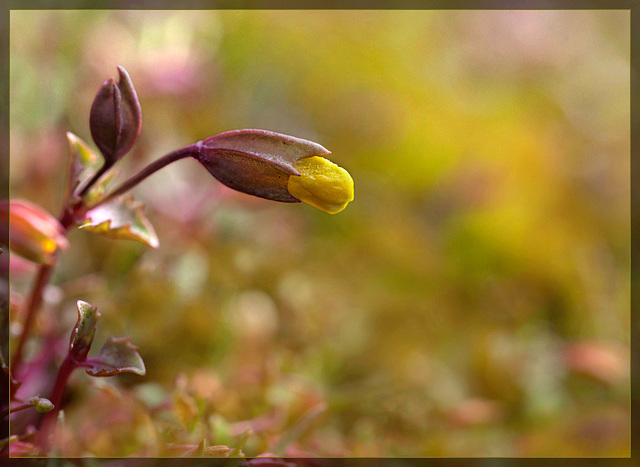
Every year at this time, the moss and grass-covered area around our granite valley begins to take on color. At first, there are the twinkling white Spring Whitlow Grass and Spring Sandwort flowers to ring in the season. Then, as of about a week ago, a flash of yellow can be seen here and there, which will soon erupt into a carpet of tiny yellow flowers that resemble tiny orchids to me! The Chickweed Monkeyflower has begun to bloom!! YAY!! I was very excited to see these tiny jewels begin to appear, and I had a very hard time taking pictures of them last year. This bud represents my first attempt at photographing this tiny flower bud, which measures about 1/3" in length and about 1/8" in diameter unopened.
The Chickweed Monkeyflower is in the genus "Mimulus," includes about 150 species and can be found world-wide. They get their name from the resemblance of some species to a monkey's face. This species is found in places where the ground is very wet, and are only found here on our property. Rain water runs down off of our hillside, through the meadow and down through the valley below, making this area almost bog-like during sprintime. I was interested to find out that monkeyflowers accumulate salt in their leaves and stems, and were used as a salt substitute to flavor wild game by Native Americans and pioneers. It also has medicinal uses; the juice squeezed from the plant's foliage has been used as a soothing poultice for minor burns and skin irritations.
If you would like to know more about monkeyflowers, Wiki has a great source of information here: Wiki: Monkeyflower (Mimulus).
This image was taken in March, 2012.
Every year at this time, the moss and grass-covered area around our granite valley begins to take on color. At first, there are the twinkling white Spring Whitlow Grass and Spring Sandwort flowers to ring in the season. Then, as of about a week ago, a flash of yellow can be seen here and there, which will soon erupt into a carpet of tiny yellow flowers that resemble tiny orchids to me! The Chickweed Monkeyflower has begun to bloom!! YAY!! I was very excited to see these tiny jewels begin to appear, and I had a very hard time taking pictures of them last year. This bud represents my first attempt at photographing this tiny flower bud, which measures about 1/3" in length and about 1/8" in diameter unopened.
The Chickweed Monkeyflower is in the genus "Mimulus," includes about 150 species and can be found world-wide. They get their name from the resemblance of some species to a monkey's face. This species is found in places where the ground is very wet, and are only found here on our property. Rain water runs down off of our hillside, through the meadow and down through the valley below, making this area almost bog-like during sprintime. I was interested to find out that monkeyflowers accumulate salt in their leaves and stems, and were used as a salt substitute to flavor wild game by Native Americans and pioneers. It also has medicinal uses; the juice squeezed from the plant's foliage has been used as a soothing poultice for minor burns and skin irritations.
If you would like to know more about monkeyflowers, Wiki has a great source of information here: Wiki: Monkeyflower (Mimulus).
This image was taken in March, 2012.
- Keyboard shortcuts:
Jump to top
RSS feed- Latest comments - Subscribe to the comment feeds of this photo
- ipernity © 2007-2026
- Help & Contact
|
Club news
|
About ipernity
|
History |
ipernity Club & Prices |
Guide of good conduct
Donate | Group guidelines | Privacy policy | Terms of use | Statutes | In memoria -
Facebook
X

Sign-in to write a comment.