slgwv's photos
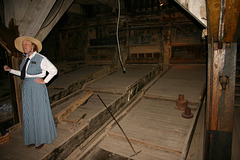
Amalgamating tables, Bodie mill
| |
|
Note the stamp mills at the head of the tables. The crushed ore would spill across these tables, which contained pools of mercury that would trap the large gold fragments. The fines would wash on through to be cyanided in vats beyond. Bodie still used amalgamation as the first processing step, evidently thinking it was cost-effective for the big pieces. They no longer had to worry about overcrushing the ore, too. When amalgamation alone was used, the finest pieces of gold washed on through and were lost, so you didn't want to pulverize the ore _too_ much. However, with cyanide, the finer the pieces, the quicker they dissolved! So the more crushing, the better. (That's not a bug, it's a feature!)
The woman on the left is our guide in her Edwardian-era garb.
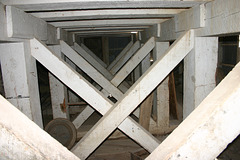
Supports for amalgamating tables
| |
|
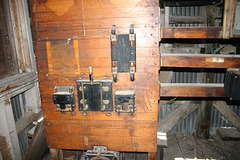
Electric switchboard, Bodie Mill
| |
|
OSHA would have a fit...
Bodie, California, USA. As I mentioned, Bodie was one of the first camps to electrify, in the 1890s. They built a hydropower plant on Green Creek in the Sierra Nevada, about 15 straight-line miles away, and ran a line straight to Bodie. "Straight" literally--the state of electrical knowledge was so primitive they thought they had to keep the powerline as straight as possible, so electricity wouldn't spill off at the corners!
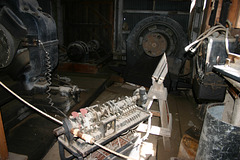
Electrical equipment, Bodie Mill
| |
|
Bodie, California, USA. See adjacent caption for description of Bodie's electrification.
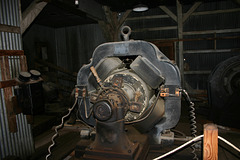
Electric motor, Bodie mill
| |
|
|
Bodie, California, USA. Bodie was the first Western mining camp of any size to electrify, in the early 1890s. They built a dam and hydroelectric generating station on Green Creek, in the Sierras, and ran a powerline to Bodie, a straight-line distance of 15 miles or so. The state of electrical knowledge was so primitive that they thought they had to keep the line as straight as possible, because electricity would spill off the corners!
This was probably the sort of big motor that ran things like the lathe (next pic) with an external belt.
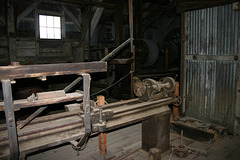
Lathe in Bodie Mill
| |
|
This still has a big pulley (outlined) so that it can be driven by a belt. I expect they were driving the belt with a big electric motor at this point, though, instead of with a steam engine. Small electric motors, the sort we're used to having on each individual machine, didn't come along till much later.
All those flapping belts around in those days also did not enhance workplace safety!
Bodie, California, USA
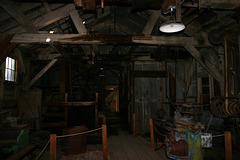
Workshop, Bodie mill
| |
|
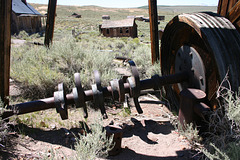
Camshaft for a stamp mill
| |
|
Obviously a 5-stamp unit! Bodie, California, USA.
Bodie was about the first gold-mining camp in the western US to electrify, and to adopt the cyanide process, both in the mid 1890s.
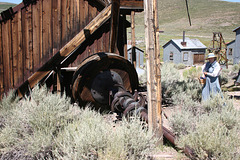
Camshaft for a stamp mill
| |
|
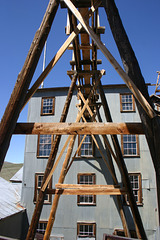
Conveyor track, Bodie mill
| |
|
California, USA. A state park preserving the old mining camp of Bodie.
Bodie was about the first gold-mining camp in the western US to electrify, and to adopt the cyanide process, both in the mid 1890s.
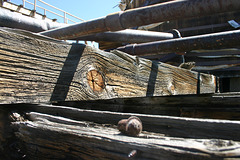
Mill timber closeup, Bodie
| |
|
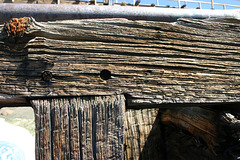
Mill timber closeup, Bodie
| |
|
California, USA.
Bodie was about the first gold-mining camp in the western US to electrify, and to adopt the cyanide process, both in the mid 1890s.
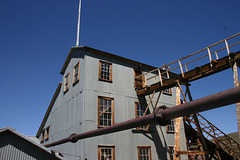
Bodie Mill
| |
|
This area of Bodie is not open to the public except as part of a guided tour. The tour (or at least the one we were on) is conducted by a volunteer who is dressed in period costume and is supposed to stay in character. Our guide was a woman wearing a long Edwardian-era dress who was supposed to be the wife of one of the mine owners, and who was interviewing potential workers.
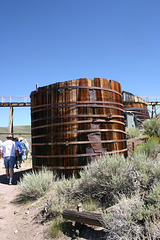
Cyanide vat, Bodie mill
| |
|
|
An old one--they made them out of wood (usually redwood) in the old days. Calfornia, USA.
Bodie was about the first gold-mining camp in the western US to electrify, and to adopt the cyanide process, both in the mid 1890s.

Bodie Mill
| |
|
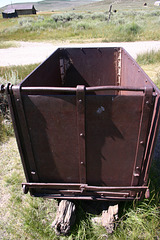
Ore cart
Mill(?) Foundation, Palmetto District