

Alan H's photos
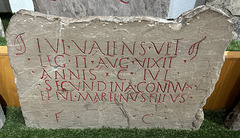
Gravestone of Julius Valens
| |
|
On his retirement from the legion, Julius Valens started a new life close to the fortress, possibly because he had formed an attachment with a local woman. He allegedly survived to the age of 100. His wife died aged 75, and is commemorated on a second stone, set up by their son Gaius Julius Martinus (see previous photo).
D(is) M(anibus)
Iul(ius) Valens vet(eranus)
leg(ionis) II Aug(ustae) vixit
annis C Iul(ia)
Secundina coniunx
et Iul(ius) Martinus filius
f(aciendum) c(uraverunt)
‘To the spirits of the departed; Julius Valens, veteran of the Second Augustan Legion, lived 100 years; Julia Secundina, his wife, and Julius Martinus, his son, had this set up.’
IMG 8566a
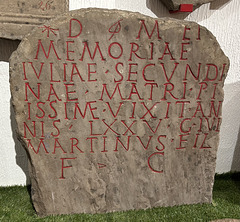
Gravestone of Julia Secundina
| |
|
On his retirement from the legion, Julius Valens started a new life close to the fortress, possibly because he had formed an attachment with a local woman. He allegedly survived to the age of 100 (see next photo). His wife died aged 75, and is commemorated on this stone, set up by their son Gaius Julius Martinus.
D(is) M(anibus) et
memoriae
Iuliae Secundi/nae
matri pi/issime
vixit an/nis
LXXV G(aius) Iul(ius)
Martinus fil(ius)
f(aciendum) c(uravit)
‘To the spirits of the departed and the memory of Julia Secundina, his devoted mother, (who) lived 75 years, Gaius Julius Martinus, her son, had this set up.
IMG 8565a
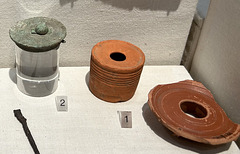
Inkwells
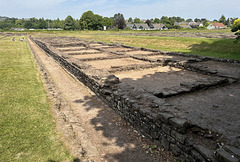
Fortress Barracks
Fortress Ovens
| |
|
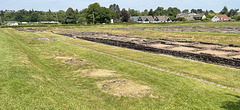
Overview of the fort barracks area with the circular remains of three of the fortress bread ovens to the bottom centre. The ovens were built into the rampart at a distance from the barracks in case of fire.
Caerleon Legionary Fortress.
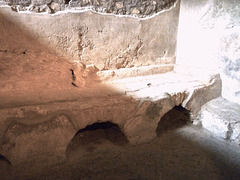
Kitchen
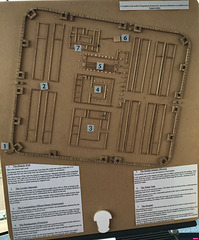
Segedunum - Fort Layout
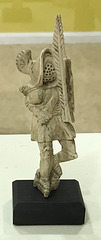
Folding Knife
| |
|
|
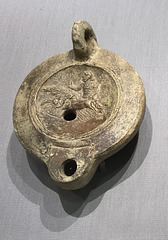
Depicting a Thraex (Thracian) holding a large palm leaf of victory.
"To the Roar of the Crowd' exhibition at Segedunum Roman Fort, Wallsend, UK. Depictions of gladiator fights and chariot racing in ancient Rome.
IMG 8472b
| |
|
|
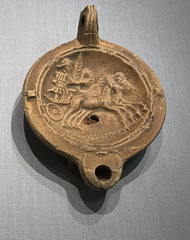
A victorious charioteer in a quadriga (four-horse chariot) with a small wheel, holding a whip in one hand and a palm leaf in the other.
"To the Roar of the Crowd' exhibition at Segedunum Roman Fort, Wallsend, UK. Depictions of gladiator fights and chariot racing in ancient Rome.
Oil Lamp
| |
|
|
A victorious charioteer in a biga (two-horse chariot), carrying both a wreath and a palm leaf.
"To the Roar of the Crowd' exhibition at Segedunum Roman Fort, Wallsend, UK. Depictions of gladiator fights and chariot racing in ancient Rome.
Silver Box
| |
|
|
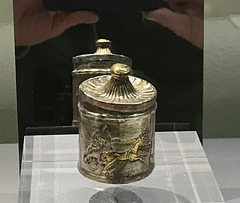
A silver box showing two bigas (two-horse chariots) racing. Between them are the tall conical poles that marked either end of the spina (the barrier running down the centre of the circus).
"To the Roar of the Crowd' exhibition at Segedunum Roman Fort, Wallsend, UK. Depictions of gladiator fights and chariot racing in ancient Rome.
Oil Lamp
| |
|
|
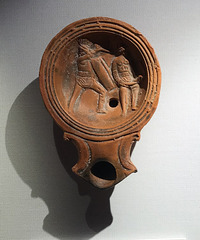
An unusual scene as the murmillo (Fishman) on the left looks away as if asking permission to kill the Thraex (Thracian) on the right, although the Thraex is not on his knees in defeat.
"To the Roar of the Crowd' exhibition at Segedunum Roman Fort, Wallsend, UK. Depictions of gladiator fights and chariot racing in ancient Rome.
Oil Lamp
| |
|
|
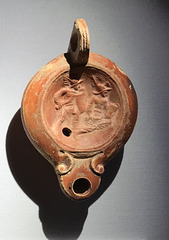
The murmillo (Fishman) to the left is about to execute a defeated Thraex (Thracian) to the right. The murmillo is behind the Thraex, perhaps to make it easier to kill his fellow gladiator, who he knows by name, and has lived and trained in the same troupe for months or even years.
"To the Roar of the Crowd' exhibition at Segedunum Roman Fort, Wallsend, UK. Depictions of gladiator fights and chariot racing in ancient Rome.
Oil Lamp
| |
|
|
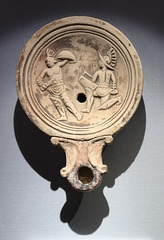
The hoplomachus (Greek warrior) to the left holds up his shield in victory while the Thraex (Thracian) to the right kneels in defeat.
"To the Roar of the Crowd' exhibition at Segedunum Roman Fort, Wallsend, UK. Depictions of gladiator fights and chariot racing in ancient Rome.
Oil Lamp
| |
|
|
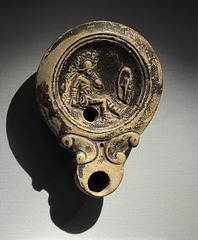
A possible hoplomachus (Greek warrior) sits on the ground in defeat, having thrown aside his round shield. His hand is raised to his face. This gesture was often one of entreaty or of hoping to placate, so perhaps he knows he has not fought as well as the crowd wanted.
"To the Roar of the Crowd' exhibition at Segedunum Roman Fort, Wallsend, UK. Depictions of gladiator fights and chariot racing in ancient Rome.
Oil Lamp
| |
|
|
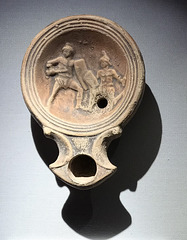
The murmillo (Fishman) to the left gets the better of the Thraex (Thracian) on the right. Although the Thracian’s sword is not very bent he wears the griffin-headed helmet associated with this type of gladiator.
"To the Roar of the Crowd' exhibition at Segedunum Roman Fort, Wallsend, UK. Depictions of gladiator fights and chariot racing in ancient Rome.
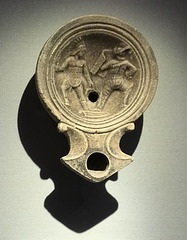
Oil Lamp
| |
|
|
The murmillo (Fishman) on the left has thrown down his shield in defeat, beaten in the fight by the Thraex (Thracian) to the right.
"To the Roar of the Crowd' exhibition at Segedunum Roman Fort, Wallsend, UK. Depictions of gladiator fights and chariot racing in ancient Rome.
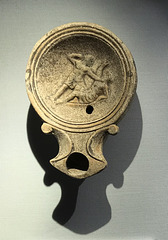
Oil Lamp
| |
|
|
A boxing match. The man on the ground is admitting defeat by raising his hand.
"To the Roar of the Crowd' exhibition at Segedunum Roman Fort, Wallsend, UK. Depictions of gladiator fights and chariot racing in ancient Rome.
