

Alan H's photos
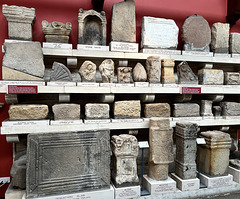
Chesters Museum (IMG 8697)
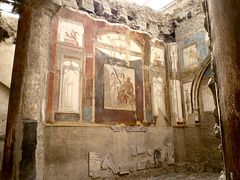
College of the Augustales
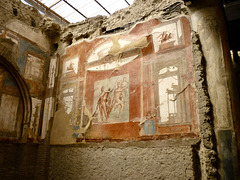
College of the Augustales
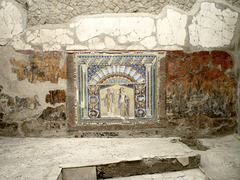
House of the Neptune Mosaic
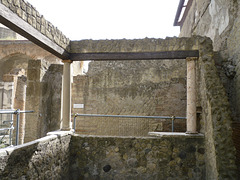
Small Shrine
| |
|
Structure attached to the College of the Augustales, Herculaneum. Outside the main entrance to the College of the Augustales on Decimanus Maximus is an aedicula (small shrine) with marble columns, variously identified as a triclinium connected to the Seat of the Augustales, or as the building for the Guardian Spirits of Herculaneum, mentioned in an inscription which commemorates the reconstruction by Emperor Vespasian following an earthquake reasonably placed in the middle of the 70s of the 1st century AD.
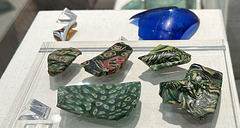
Coloured Roman Glass
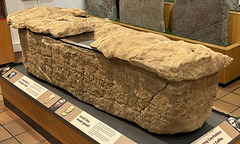
Stone Coffin
| |
|
Looking at the bones of the occupant, the objects placed with him and coffin itself a picture of the person himself has slowly been created.
Studying the bones it is possible to tell that they belonged to a man who died at about 40 years of age. Evidence from his teeth have shown that he grew up in this area and the stone coffin tells us that in life he wanted to be seen as a wealthy man.
IMG 8596a
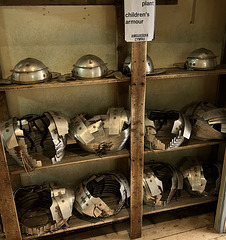
Children's Armour
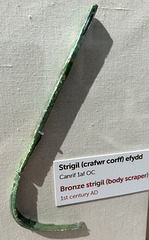
Copper Alloy Strigil
| |
|
Used to scrape the olive oil and sweat from the bather's body in the baths.
1st century.
IMG 8592a
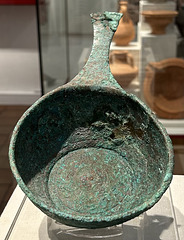
Copper Alloy Cooking Pot
| |
|
Copper alloy cooking pot (trulleus) of Italian or Gaulish manufacture.
Mid 1st century.
IMG 8590a

Scabbard
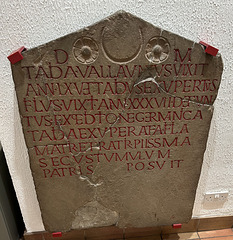
Gravestone of Tadia Vallaunius
| |
|
This stone records a soldier’s family brought up in the shadow of the fortress. Tadius Exuperatus died while serving with a detachment of the legion on an expedition in Germany. His father too had probably been a serving soldier in his time.
Found at Pil-bach, 1km to the west of the fortress, before 1849.
D(is) M(anibus)
Tadia Vallaun[i]us vixit
ann(os) LXV et Tadius Exuper(a)tus
filius vixit ann(os) XXXVII defun(c)/tus
expeditione Germanica
Tadia Exuperata filia
matri et fratri piiss(i)ma
secus tumulum
patris posuit
‘To the spirits of the departed; Tadia Vallaunius lived 65 years and Tadius Exuper(a)tus, her son, lived 37 years, having died on the German expedition; Tadia Exuperata, the devoted daughter, set this up to her mother and brother beside her father’s tomb.’
IMG 8587a
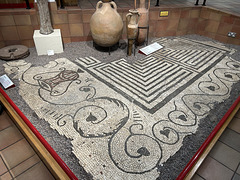
Labyrinth Mosaic
| |
|
From the legate's residence. Probably a dining room floor.
Found in Caerleon churchyard.
1st to 3rd century.
IMG 8584a
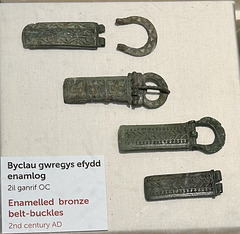
Belt Buckles
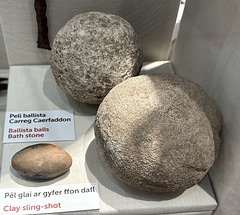
Ballista Balls & Sling Shot
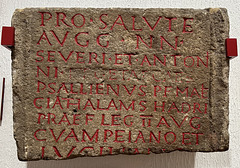
'Geta' Stone
| |
|
This is the 'Geta stone' sketched by Bishop Godwin:
This inscription originally honoured the emperor Septimius Severus and his two sons, Caracalla (officially called Antoninus) and Geta.
After their father's death in York, Caracalla murdered Geta. Geta's name, images and memory were erased across the whole empire. This act of obliteration is called damnatio memoriae . It was considered a crime to mention Geta's name.
In this example from Caerleon, Geta's name and title have been chiselled off, leaving a gap.
Bishop Godwin's Latin note states that 'Geta's name has been erased'.
Caracalla cunningly cemented his position within the army by raising their pay and giving them honours - this was expensive! He also extended Roman citizenship to all free inhabitants of the empire in AD 212. This may have been to enable him to collect more inheritance taxes in order to pay the army.
IMG 8576a
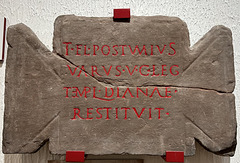
Commander of the Legion
| |
|
This stone is important, it names the commanding officer of the legion. Titus Flavius Postumius Varus was of senatorial status and legate of the Leg II AVG (Second Augustan Legion).
He commanded the legion some time after AD 235, but probably before AD 258. The inscription tells us that Varus restored a temple of Diana at Caerleon. We do not know where this was, but it was probably near the amphitheatre.
We know that Varus had at least one African great-grandfather. He was probably of north-African origin himself.
IMG 8571a
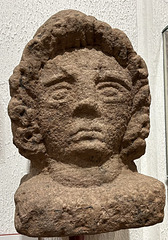
Funerary Head
| |
|
Funerary head of Attis from the cemetery to the west of the fortress. These heads probably adorned tombs, as finials. The god Attis frequently appears in funerary contexts, as a symbol both of death and life to come.
IMG 8569a
