
Amsel (Turdus merula)
The magic of spring! (PIP)
Gestern war der Schnee zurück – und der Buntspecht…
Die Königin ist aufgewacht! (PIP)
Amselweibchen (Turdus merula)
Fieldfare (Turdus pilaris)
Blaumeise frisst Weide / Cyanistes caeruleus, Sal…
House sparrow (Passer domesticus) – a citizen of…
Ich bin verärgert. Lass mich allein in meinem Dorn…
Reh im Wald (Capreolus capreolus)
Mute swan (Cygnus olor) in the morning light.
Schilfrohrsänger (Acrocephalus schoenobaenus) (…
Nature in black and white
Der Haubentaucher wird vom Klimawandel besonders b…
Für entspannte Wanderer :-)
Lachmöwe (Chroicocephalus ridibundus)
Kormoran (Phalacrocorax carbo)
Dunenküken der Sturmmöwe (Larus canus) /PIP/
Common green grasshopper (Omocestus viridulus), f…
Die Rauchschwalbe (Hirundo rustica) /PIP/
Sturmmöwe im Jugendkleid (Larus canus)
Heute ein Platz für eine Bank, gestern ein Platz z…
Baltic Gull (Larus fuscus fuscus) / PIP / B…
The great tit (Parus major) (PIP)
The willow tit
Schnee überall! (PIP)
It has snowed ! :-) HBM!
Buntspecht, Dendrocopos major. (PIP)
When the ice turns blue (3xPIP)
He who saves, has
Serenity - simply being
Winterabend am Fluss Norrtäljeån (3xPIP)
Winter – Anlegesteg II
Winter – Anlegesteg I (+PIP mit Sommerimpression…
2023 – 2024 (PIP)
One motif, three pictures (PIP x2)
See also...
Authorizations, license
-
Visible by: Everyone -
All rights reserved
-
331 visits
Blue tit (Cyanistes caeruleus)
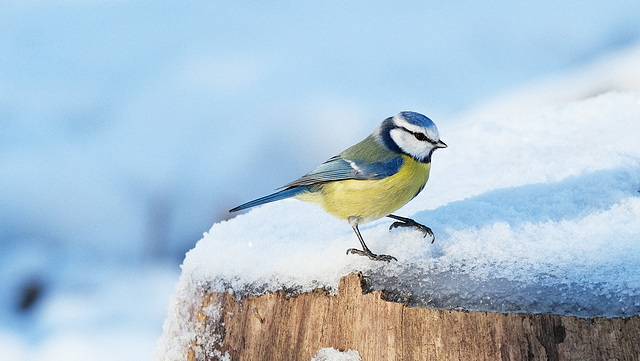

Interestingly, the plumage of the blue tit has a very distinctive colour pattern in the ultraviolet spectrum, which is invisible to the human eye. These colour variations play a role in mate selection.
In Europe the population is considered viable and there are no signs of significant population change. IUCN classifies it as Least Concern (LC) .. :-) .. It occurs also in neighbouring parts of Asia.
In Europe the population is considered viable and there are no signs of significant population change. IUCN classifies it as Least Concern (LC) .. :-) .. It occurs also in neighbouring parts of Asia.
J.Garcia, Bruno Suignard, Stephan Fey, Ch'an and 13 other people have particularly liked this photo
- Keyboard shortcuts:
Jump to top
RSS feed- Latest comments - Subscribe to the comment feeds of this photo
- ipernity © 2007-2026
- Help & Contact
|
Club news
|
About ipernity
|
History |
ipernity Club & Prices |
Guide of good conduct
Donate | Group guidelines | Privacy policy | Terms of use | Statutes | In memoria -
Facebook
X

Admired in: www.ipernity.com/group/tolerance
Sign-in to write a comment.