

John Lawrence's photos

The Wilderness
| |
|
|
|
This is the roof of a luxury underground home sensitively placed next door to the Church of all Saints West Stourmouth Kent, The entrance which is above ground (but out of view) looks like part of the church (it was the mortuary) and steps have been put in to gain access to the house. Yes it is called the Wilderness!! as before the current owner bought the land that is what it was so that's what the owner called the house.
HFF! Everyone!
MY THANKS FOR ALL VISITS AND COMMENTS IT IS APPRECIATED

Blossom
| |
|
|
|
HFF!! everyone The fence is a blue metal one behind the blossom (looks better large)
MY THANKS FOR ALL VISITS AND COMMENTS IT IS APPRECIATED
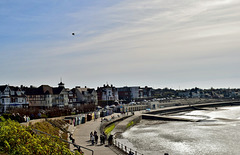
Westgate-on-Sea Kent
| |
|
|
|
Westgate-on-Sea is a seaside town and Civil Parish on the north-east coast of Kent, England. It is within the Thanet local government district and borders the larger seaside resort of Margate Its two sandy beaches have remained a popular tourist attraction since the town's development in the 1860s from a small farming community. The town had a population of 6,996 at the 2011 Census.
The town is notable for once being the location of a Royal Naval Air Service seaplane base at St Mildred's Bay The bay next to this, which defended the Thames Estuary coastal towns during World War 1 The town is the subject of Sir John Betjeman's poem, "Westgate-on-Sea". Residents have included the 19th-century surgeon Sir Erasmus Wilson and former Archbishop of Canterbury William Temple. The artist Sir William Quiller Orchardson painted several of his best-known pictures whilst living in Westgate-on-Sea. The British composer Arnold Cooke attended the town's Streete Preparatory School in the early 20th century,
My father-in-Law ran a nursery in Westgate and was well known for his tomatoes, It is now a block of flats.
The RNAS seaplane base was eventually moved to Manston which became a RAF Station closing in 2014.
HFF Everyone!!
MY THANKS TO ALL WHO VISIT AND COMMENT IT IS APPRECIATED
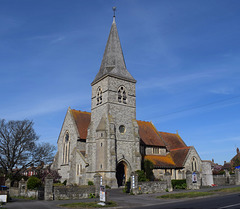
St James’ Church Westgate and Garlinge
| |
|
|
|
St. James' is a suburban seaside Parish on the outskirts of Margate in Kent. The church was founded in 1872 and is blessed with a very attractive building that has an atmosphere of warmth and friendliness. Many visitors comment on the striking East window, which depicts the growth of the church from the day of Pentecost to the present World-wide community of Christians.
The Church was designed by Charles Nightingale Beazley FRIBA, and is built of sandstone which is unusual for this part of Kent, it stands on a (now) very busy Margate to Herne Bay Road. It took 30 minutes of waiting for traffic to clear to get this shot.
MY THANKS TO ALL WHO VISIT AND COMMENT IT IS APPRECIATED.
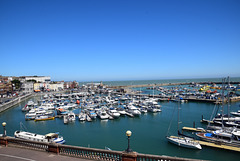
Ramsgate’s Royal Harbour
| |
|
|
|
Ramsgate began as a fishing and farming hamlet. Its earliest reference is in the Kent Hundred Rolls of 1274-5 as ‘Ramisgate’ or ‘Remmesgate’ from Anglo-Saxon”Hræfn’s geat”, or “raven’s cliff gap”, later to be rendered ‘Ramesgate’ from 1357. The legendary mercenaries Hengest and Horsa landed in the 5th century to herald the pagan Anglo-Saxon age in England. The Christian missionary St. Augustine landed in Ramsgate in 597 which re-established the link between England and the Christian church in Rome.
In 1820 King George IV set off from Ramsgate with the Royal Squadron en route to Hanover. He was so impressed by the hospitality he received at the Kent port that he decreed it be declared a ”Royal Harbour” – a status that’s unique in mainland Britain.
Ramsgate largely developed in the form we know today from 1749 onwards. It was intended as a Harbour of Refuge, following a violent storm in 1748. Later, during the Napoleonic wars, British troops were quartered at Ramsgate before embarking for the continent. Climb up Madeira Walk to Ramsgate’s East Cliff to see Wellington Crescent, a reminder of this period.
Ramsgate’s harbour is a defining characteristic of the town. Ramsgate was a member of the Confederation of Cinque Ports, under the ‘Limb’ of Sandwich, Kent. The construction of Ramsgate Harbour began in 1749 and was completed in about 1850. The Harbour has the unique distinction of being the only Royal Harbour in the United Kingdom. Because of its proximity to mainland Europe, Ramsgate was a chief embarkation point both during the Napoleonic Wars and for the Dunkirk evacuation in 1940.
In this picture can be seen in the inner harbour there all kinds of pleasure boats and a few houseboats. the outer harbour is the working space there are various craft for the 3 windfarms (not visible in the haze) and they are Kent Flats, London Array and Thanet Offshore, there are also 2 of the 3 pilot boats which take the pilots to large ships in the Thames estuary and guide them through the English Channel plus various small fishing vessels that operate out of Ramsgate. The fishery protection boat arrived back in harbour 10 mins after I took this picture.
HFF Everyone! An apology I straightened the horizon then uploaded the wrong version and I can't replace it!
MY THANKS TO ALL WHO VISIT AND COMMENT IT IS APPRECIATED
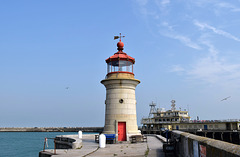
PERFUGIUM MISERIS
| |
|
|
|
PERFUGIUM MISERIS is an overlooked part of Ramsgate’s history. It is the Latin motto which is carved into the beautiful lighthouse, at the end of the western harbour arm. This lighthouse was designed by Georgian master engineer, John Smeaton (1724 – 1792), though built nearly 100 years later, who is widely regarded as the “father of civil engineering”. PERFUGIUM MISERIS translates as “refuge for those in need”.
These two words are a message from the town to the world beyond and stand as a memorial to those who lost their lives beneath the waves, beyond the safety of the harbour walls. Many of those lives were lost in the Great Storm of 1703 which, through tragedy, brought about significant change to Ramsgate. Widely believed to be the only true hurricane to hit British shores at full force, the storm caused the deaths of roughly 1500 sailors from the Royal Navy on the Goodwin Sands alone. That is without the countless lives lost in other vessels out at sea, as the storm raged across the country. The need for a more effective refuge in the area resulted in a new harbour design for Ramsgate, the reconstruction of the harbour commenced from 1749 and took a century to complete with the lighthouse marking the harbour mouth
Facts
Established: 1783, Current Lighthouse Built: 1842, Height: 11 Metres (36.09 Feet), Operator: Ramsgate New Port, Designer: John Smeaton
MY THANKS TO ALL WHO VISIT AND COMMENT IT IS APPRECIATED
Holy Innocents Church Adisham, Kent.
| |
|
|
|
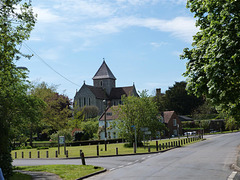
The Manor of Adisham was probably given to Archbishop Justus by King Eadbald of Kent (son of King Ethelbert and Queen Bertha) in about AD 624 following the King’s conversion to Christianity. This tradition was preserved in a charter in about 1080 when Archbishop Lanfranc re-allocated the Manor to the Cathedral Priory. The tradition is supported by it’s rare dedication to Holy Innocents for whom a feast day was designated in the 5th Century. In Roman times the site above the great pond (filled in 1964) had been the centre of an important farming estate.
Nothing remains of the original (presumably wooden) Church. The existing building was erected between 1150 and 1350 and restored in 1869-70.
From the beginning it was probably a Minster or central Church from which a group of priests from the Cathedral served the surrounding area, hence both it’s size and cruciform shape. Adisham Court Farm which is nearby is still the property of the Church.
Between 1542 and 1555 The Vicar of Adisham and Staple was John Bland a firm believer in the protestant faith, who was burned at the stake as a heretic on 12th July 1555, during the reign of the Catholic Queen Mary. He is commemorated on the Martyr’s Memorial in Canterbury’s Martyr’s Field.
There have been some extensive restorations inside the Church. Pews have been removed and the building (which is grade 1 listed) is now more accessible by local community groups and the Village School.
Best viewed full screen HFF everyone!!
My Thanks to all who visit and comment it is appreciated
Bedford House Bridge, Kent
| |
|
|
|
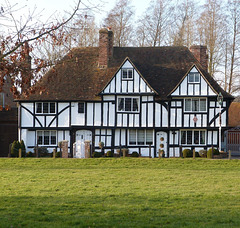
Built in 1420 this timber-framed building was at one time an Inn and later after the Bridge poor law union was established in 1835, it was the Chartham workhouse, it is now a private house.
It is Grade 11 listed
HFF Everyone!
MY THANKS TO ALL WHO VISIT AND COMMENT IT IS APPRECIATED
The Jetty & Viking Bay, Broadstairs
| |
|
|
|
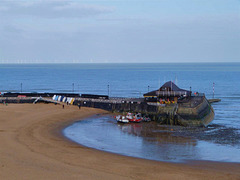
Broadstairs was originally known as Bradstowe which is of Anglo-Saxon origin and means "Broad Place". The name evolved into Broadstairs as a result of the broad "Chapel Stairs" which once led up from the beach to the cliff top.
Originally a small hamlet, the inhabitants made a living from fishing, shipbuilding and during periods of the 18th and 19th centuries ....... from smuggling!
There has been a pier or jetty here since 1490 the last one was destroyed by the great storm of 1897 and rebuilt in 1905.
Viking bay originally known as "The Main Sands", this name was later changed after the arrival, at this bay, of the "Hugin" on July 28th, 1949. The Hugin, a replica Viking Ship, was sailed from Denmark to commemorate the 1500th anniversary of the landing by Hengist in 449 AD.
The Hugin is now on permanent display at Pegwell Bay, Ramsgate - the site of the original landing.
Also on the horizon can be seen the turbines of the Thanet Offshore wind farm
Best Viewed Large or Full Screen
MY THANKS TO ALL WHO VISIT AND COMMENT
St Andrews Chrch, Alfriston, East Sussex
| |
|
|
|
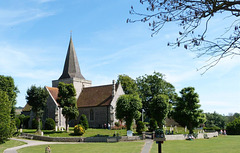
St Andrew's Church is the parish church of Alfriston, East Sussex, England. This Grade I listed building was built in the 1370s and is also known as the 'Cathedral of the Downs' It sits on a small, flint-walled mound, indicating that it was the site of a pre-Christian place of worship, in the middle of 'the Tye' (the local village green), overlooking the River Cuckmere, and is surrounded by the flowered graveyard. It is built in the form of a cross.
No records or monuments indicate who commissioned the church's construction. A consistent architectural style throughout indicates that it was built all at once. Typically, completing such a building before tastes and building techniques have changed is possible only when an individual or family has sponsored the construction, and that person would be buried in the church's graveyard or entombed within. However, St Andrew's does not have any grand tomb or memorial, nor any records indicating who a patron might be. Additionally, there was no Lord of the Manor for Alfriston at the time.
However, on the left-hand side of the south porch there is a Canonical sundial, dating from the 14th century. The stone with the carved sundial was originally on the south wall and was moved to its present location when the porch was built.
Best viewed Large Please
MY THANKS TO ALL WHO VISIT AND COMMENT IT IS APPRECIATED
North Foreland Lighthouse
| |
|
|
|
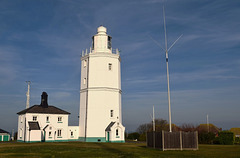
A light was first exhibited at North Foreland in 1499, but the first real lighthouse was built by Sir John Meldrum in 1636, consisting of a two-storey octagonal tower made of timber, lath and plaster with an iron coal-burning grate on top; this tower was destroyed by fire in 1683.
A temporary measure of a single candle in a lantern hoisted on a pole proved—perhaps not surprisingly—ineffective and the present lighthouse was built in 1691; originally the tower was 12 metres tall, constructed of brick, stone and flint. In 1698 the lighthouse is recorded as using 100 tons of coal a year.
North Foreland Lighthouse came into the hands of the Trustees of Greenwich Hospital in 1719; surplus light dues went towards the upkeep of the hospital for the benefit of seamen. They enclosed the fire in a glazed lantern in 1719 but this was removed in 1730 after complaints from shipping. In 1793 a further two storeys were added to the tower and the coal fire was replaced by 18 oil lamps.
Trinity House purchased the lighthouse in 1832. In 1890 a separate room known as the lantern house, was built on to the top of the tower to accommodate the light. An improved light source was installed in 1894, a pair of eight-wick Trinity House-pattern burners for heavy mineral oil, replaced in 1904 by a triple mantle burner, and again replaced in 1923 with a ‘Hood’ 100mm petroleum vapour burner.
North Foreland was the last Trinity House lighthouse to be automated; the occasion was formally marked at a ceremony presided over by HRH The Duke of Edinburgh in 1998 in his capacity at the time as Master of Trinity House.
The lighthouse is now monitored and controlled from Trinity House’s Planning Centre in Harwich, Essex.
My thanks to all who visit and comment it is appreciated
Kentish Flats Offshore Wind Farm (2)
| |
|
|
|
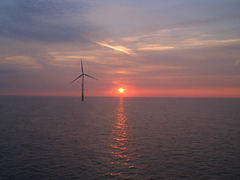
The Kentish Flats Offshore Wind Farm is a Wind Farm located off the coast of Kent, England on a large, flat and shallow plateau just outside the main Thames shipping lanes. The wind farm is operated by Vattenfall.
The distance from the nearest wind turbine to Whitstable is 6.2 miles (10.0 km).
Construction was completed in August 2005, with commissioning and testing of all turbines completed by September 2005. The wind farm consists of 30 Vestas V90 3MW wind turbines with a total nameplate capacity of 90 MW Turbines were installed by the Danish offshore wind farms services provider A2Sea,
This picture was taken by my son when he worked there as a service engineer taken from the crew transfer RIB. The turbines are turned off during servicing.
He has since been reported missing whilst working in the wind industry in Japan.
UPDATE I am pleased to announce he has now been found safe and well and he will be returning to wok in Japan (where he lives) soon. (16/11/22)
Thanks for all visits comments etc it is appreciated
Bekesbourne Oasts
| |
|
|
|
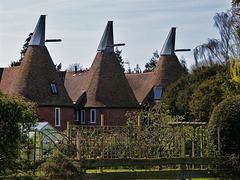
An oast, oast house or hop kiln is a building designed for kilning (drying) hops as part of the brewing process. They can be found in most hop-growing (and former hop-growing) areas and are often good examples of vernacular architecture. Many redundant oasts have been converted into houses, (as these have)
They consist of two or three storeys on which the hops were spread out to be dried by hot air from a wood or charcoal-fired kiln at the bottom. The drying floors were thin and perforated to permit the heat to pass through and escape through a cowl in the roof which turned with the wind. The freshly picked hops from the fields were raked in to dry and then raked out to cool before being bagged up and sent to the brewery. The Kentish dialect word kell was sometimes used for kilns ("The oast has three kells.") and sometimes to mean the oast itself ("Take this lunchbox to your father; he's working in the kell."). The word oast itself also means "kiln".
MY THANKS TO ALL WHO VISIT AND COMMENT IT IS APPRECIATED
The Lodge Ramsgate
| |
|
|
|
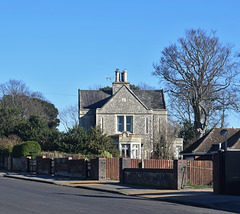
A grade 11 listed building this is a 19 Century (1856) brick/stone built Lodge Just to the side of Bon Secours Nursing home a building (that is still there) but is securely locked as private houses were built on the grounds (so can't get a pic)
The Lodge is called "Gardener's Lodge" and has had 4 owners since it was built in the 1850's.
HFF from a stranger!
MY THANKS TO ALL WHO VISIT IT IS APPRECIATED

St Martins Church Great Mongeham Kent (2)
| |
|
|
|
Please refer to previous picture this is a painting I have of the above Church painted by my late neighbour, He didn't go and look at the Churches just did his artwork from a mono pic in a book, I believe his daughter (quite rightly) has that book
MY THANKS TO ALL WHO TAKE THE TIME TO VISIT IT IS APPRECIATED
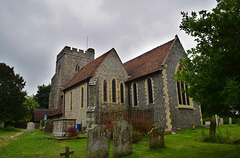
St Martins Church Great Mongeham Kent
| |
|
|
|
t was a grey old day when I took this picture
Great Mongeham is a village and civil parish in east Kent, on the outskirts of Deal. Its name is derived from Mundelingham or village of Mundel. Parts of Great Mongeham's church, St Martin's, dates back to the 13th century. This village church has a complicated history. The original building probably dates from Saxon times but there are claims that it goes back to AD 470. In the sixteenth century the interior was brightly coloured but by 1665 the church was in a state of disrepair. One third of the parishioners belonged to religious sects and did not attend service. The church was restored in 1851 by William Butterfield.
I have a painting on my wall of this Church painted by my neighbour he has removed a few of the tombs and it is a nice clear painting, unfortunately he passed away last year.
MY THANKS TO ALL WHO VISIT AND COMMENT IT IS APPRECIATED
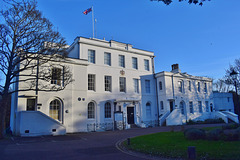
Pierremont Hall Broadstairs
| |
|
|
|
Built in 1785 as a private residence, Pierremont Hall has been home to many and is now open to the community for public and private events.
The building is Grade II Listed, located in the heart of town. This newly renovated building is a beacon of history, showcasing the town’s historical character. The Hall was built in 1785 for Thomas Forsyth and designed by Samuel Pepys Cockerell. The Duchess of Kent and a young Princess Victoria holidayed at Pierremont from 1826 to 1836.
It knew various owners until its sale in 1896 to Leonard Posnett who used it as a school. Most of the original 30 acres of land were developed as housing and the building and remaining park were sold to the Urban District Council in 1927.
The building is still used as Town Council offices today but has recently been updated inside so that more Community events can take place there
The name Pierremont derives from the French for St. Peter's Mount.
MY THANKS TO ALL WHO VISIT AND COMMENT IT IS APPRECIATED
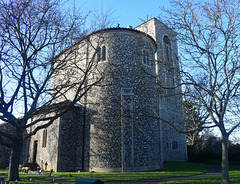
Our Lady Star of the Sea Catholic Church
| |
|
|
|
A remarkable church by Giles Gilbert Scott, designed in 1929 but not completed until 1963. The architectural forms and materials used are traditional but used in an original way, with a low nave and a dramatically tall chancel with an even taller square tower. The general standard of finish is extremely high. I used to walk past this Church on the way to school but could see nothing because of a high hedge and they were still building it!
The first Catholic church in Broadstairs was a corrugated iron church built in 1888 by Dominicans and enlarged in about 1909. The designs for the present church were prepared by Giles Gilbert Scott in 1929. The sanctuary, sacristies and part of the nave were completed in 1931; the church was finished to the original design in 1963, after Sir Giles Gilbert Scott’s death in 1959. His designs for a presbytery were not carried out.
It is a very long Church will post a full length soon.
This is the history of the original Church (no photo due to traffic)
The Shrine of Our Ladye Star of the Sea was an old chapel on the cliffs at Broadstairs (which was formerly known as Bradstowe). Dating back at least to the 1350s, the two towers of the chapel were a major landmark for sailors in the area. Given the veneration in which the shrine was held, the custom developed of ships dipping their top-sails to salute the shrine as they sailed past it.
MY THANKS TO ALL WHO VISIT AND COMMENT IT IS APPRECIATED
For a Guest account such as this, the number of content displayed is limited to a maximum of 100.
