


Historic buildings & Industry

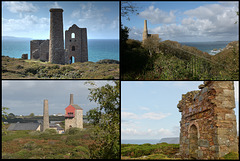
The mines of St Agnes
| |
|
|
|
St Agnes in Cornwall is the home to many old mines and here is a small collection of their engine houses. These mined mostly copper and/or tin often from the early Bronze age up to the beginning of the 20th century when these metals either ran low or were mined much cheaper elsewhere. This is ‘Poldark’ country and it seemed on our brief visit around here that there were mines around every corner. Other minerals were also mined including gold, zinc, silver, lithium and arsenic. Cornwall’s neighbour; Devon, also has many such mines.
Top row from left is the top of Wheal Coates and one of the Polberro Mines. Bottom from left is Wheal Kitty and then Wheal Charlotte which sits just south of St Agnes Head. Only Wheal Kitty now survives of these, as a visitors centre with workshops and a café.
The PiP shows a view of the bottom engine house of Wheal Coates.
Enjoy full screen.

Llanlleiana Old Porcelain Works
| |
|
|
|
Nestled in a valley between Cemaes and Almwich we come across this on our headland walk. I thought at first it had to be an old mine building but no: this old works produced porcelain from deposits of china clay found on Dinas Gynfor and Llanlleiana Head nearby. The works consist of a main building and a remote chimney, this was to direct the noxious fumes away from the working areas. Llanlleiana means “church of the nuns” and the works were built on the site of a convent. They closed the works in 1920 after it was badly damaged by fire.
In the fields behind the ruins are the remains of St Ana’s Church and on the headland above the works are the remains of the Dinas Gynfor Iron Age settlement.
The curved walls to our left spills onto a shingle bay with a picnic table. No guesses then where we had our picnic. PiP
Enjoy full screen.
HWW, have a great day.
Wheal Coates from high
| |
|
|
|
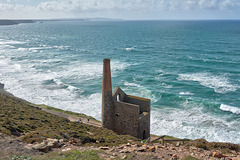
Another chance to see this iconic Cornish tin mine. We are on our way down the twisty coastal path to the lower part you can see here where we will walk further along the ‘South West Coastal Path’ towards Chapel Porth. Its windy and the waves are quite choppy as can be seen. See PiP for one of my earlier photos and descriptions of this mine.
Best viewed full screen
HFF – Birnbeck Island and Pier, Weston Super Mare
| |
|
|
|
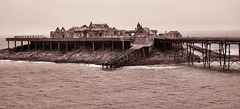
It’s a cold wet September day and I am above Birnbeck Island at Weston Super Mare, with a view of this sadly dilapidated Birnbeck Pier. The retro sepia look, I believe, is quite in keeping in what we have here today. See PiP for alternative view.
The pier, designed by Eugenius Birch first opened in 1867. Steam-ship trips were once taken from here. We see clearly the Weston Lifeboat Station that was housed here from the late 1880s.
“Over the years there have been many plans to restore this iconic and once beautiful pier but they have come to nothing. However, there are now plans afoot to save the pier and eventually rehouse the lifeboat station here.”
Enjoy full screen
Sad Fence Friday
| |
|
|
|
Tanks encircle Kyiv as democracy and people die in Ukraine. The world stands and watches.
ON THE CANAL SIDE
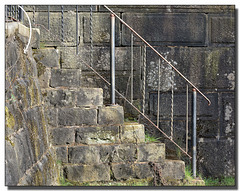
Built by the Victorians to stand the test of time these steps helped the barge-men gain the height to the top of the canal lock here on the Rochdale Canal in Lancashire. There was also a ramp nearby where the dray horse could get to the top too and have a little rest before carrying on its hard pull along the next stretch of water.
The fence here built with care and made to last in the days when such things were normal. Even the rocks making this wall are shaped to add beauty to a very practical structure.
Enjoy the weekend. Herb
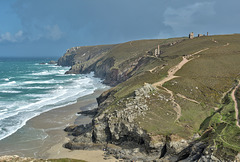
A vision of Cornwall
| |
|
|
|
St Agnes Head and Wheal Coates from Chapel Porth. The tiny cove of Chapel Porth with its sandy beach is just below us here (see PiP). All the buildings are in fact part of the Wheal Coates mine complex and you can see here part of the 630 mile long South West Coastal Path which was our constant companion. See PiP for another view of this small cove, from behind the little cafe.
Enjoy full size and contrast the freedom of this sight compared with what our friends in Ukraine have today.
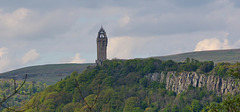
The National Wallace Monument, Stirling
| |
|
|
|
We have almost finished this extraordinary fortnight in Scotland covering two very different scenic areas. Many photos taken and this is our last evening. A late stroll along Stirling’s great river Forth gives us a glimpse up to this very Scottish monument.
The National Wallace Monument is a 67 metre tower on the shoulder of the Abbey Craig, a hilltop overlooking Stirling in Scotland. It commemorates Sir William Wallace. Wallace was a Scottish knight who became one of the main leaders during the First War of Scottish Independence. He was born c. 1270, probably near Paisley, Renfrew, Scotland—died August 23, 1305, London, England and is one of Scotland’s greatest national heroes and the chief inspiration for Scottish resistance to the English king Edward I. He served as guardian of the kingdom of Scotland during the first years of the long and ultimately successful struggle to free his country from English rule. Along with Andrew Moray, Wallace defeated an English army at the Battle of Stirling Bridge in September 1297.
The 1995 epic American drama, Braveheart, with Mel Gibson was based on Wallace leading the Scots against England.
This taken from some distance away alongside the river. The inside is open to visitors and from the top of the very spacious tower one has fantastic panoramic views (not that we got there ~ ) ).
Enjoy full screen.
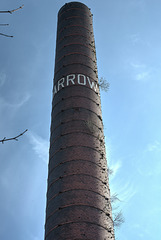
Arrow
| |
|
|
|
The Arrow mill in Castleton, Rochdale is a massive old cotton mill. Fortunately, it is one of the few mills that have not been demolished over the last 50 years and is indeed Grade II listed. It is situated on the banks of the Rochdale Canal from where I took this shot of its most impressive chimney. Of course I was taken by the trees sprouting out at this very high part of the structure.
The mill no longer spins cotton helped along by its big steam engines with its 22ft diameter flywheel, as it did when it opened in 1908 but is now a storage depot, renting out space.
More info: www.simplestorage.co/history
Worth looking at full screen.
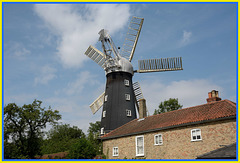
The Alford five sailed windmill
| |
|
|
|
We are in the village of Alford in Lincolnshire and looking at this most unusual mill. It was built in 1837 to grind local corn. It actually worked till 1955 then was idle for some years before being restored to full working order and is now only one of four working mills in Lincolnshire. Today it is a tourist attraction and is again undergoing renovations. PiP
Enjoy the day in peace. Herb
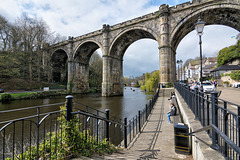
Down on the Nidd
| |
|
|
|
A quick blast of sunshine lights up this wonderful railway viaduct scene on the River Nidd at Knaresborough.
Carrying the ‘Harrogate Line’ connecting Leeds to York, operated by ‘Northern’. The viaduct was supposed to have opened in 1848, but the first construction collapsed into the river very near to completion, which necessitated a new viaduct and delayed the opening of the line through Knaresborough by three years.
Notice the flying Ukraine flag (PiPs)
Enjoy the weekend.
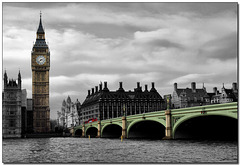
London: Big Ben view.
| |
|
|
|
As Britain celebrates our Queens Platinum Jubilee this weekend, I share memories of my visit to London in 2010. A familiar if not interesting view of our famous Westminster Bridge landmark.
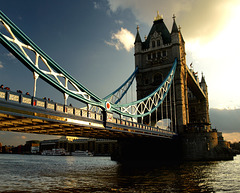
London: Tower Bridge
| |
|
|
|
As Britain celebrates our Queens Platinum Jubilee this weekend, I share memories of my visit to London in 2010. Here we have the famous Tower Bridge taken in the golden hour.
Tower Bridge is a Grade I listed combined bascule and suspension bridge, built between 1886 and 1894, designed by Horace Jones and engineered by John Wolfe Barry with the help of Henry Marc Brunel.
See PiP and last photo for arched view.
Enjoy.
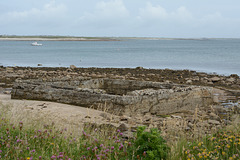
Blacksod Whaling past
| |
|
|
Lying just about 50 metres away from the harbour we see this. We were informed that this was used in the whaling operations that was quite intensive here almost 100 years ago. As to its real use in that operation, one can only guess. Apart from an old winch nearby, there seems little else but long forgotten memories about all this.
See next photo for more info and harbour scene.
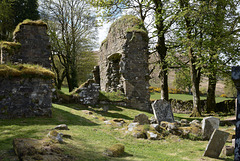
Saddel Abbey
| |
|
|
|
Standing amongst a graveyard is this ancient Abbey. Building of the abbey began in 1148 and it is thought that the end came in 1493.
We see here the remains of the north transept and choir of the abbey church. Nothing is left of the much larger nave and the south transept of the church. And almost nothing remains of the square of buildings surrounding a cloister that once stood to the south of the abbey church.
more info: www.undiscoveredscotland.co.uk/carradale/saddellabbey/index.html
Enjoy full screen and have a great week.
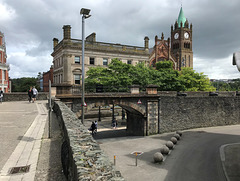
Northern Ireland: A Derry city wall view.
| |
|
|
|
Welcome on this wall that encircles the old city centre. We see here the wonderful gem of the Guild Hall with its Tap House being the rectangular building on the left. Both buildings used by the merchants of Derry/Londonderry since its predecessor in 1689. See the cannons ready to defend the city.
Pips shows street view and another canon from walls.
Nice full size.
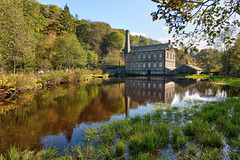
Gibson Mill revisited
| |
|
|
|
This autumn I have had another rare chance to revisit a favourite place: Hardcastle Crags near Hebden Bridge. In its heart sits this mill and pond. The mill, now a small café and museum, it even has seats where I am here to picnic whilst admiring this wonderful view. I
This fine old mill now owned by The National Trust lies in a very picturesque valley. The Gibson Mill was built around 1800. It was one of the first generation mills of the Industrial Revolution. The Mill was driven by a water wheel inside and produced cotton cloth up until 1890. In 1833, 21 workers were employed in the building, each working an average 72 hours per week
Enjoy full size.
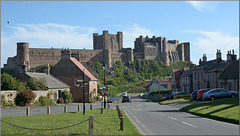
Bamburgh and its castle
| |
|
|
|
Almost looking like it could have been built just a few years go, this is the village view of its high walls and towers. It is still intact and inhabited today and is a very popular tourist destination. Just at the base of the walls near the white van is the village cricket field. Not many chances of broken windows by the cricket ball in that side of the castle.
Nice full screen. - Contrast this view with the sand-side PiP view.
Have a great day.
HBM from the Beadnell Lime Kilns
| |
|
|
|
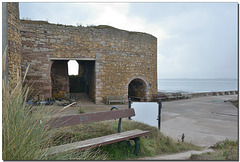
Another capture from out trip to Northumbria last year. These old kilns stand at the head of the harbour and now just give storage and shelter to the local fishing boat gear. On a good day the view over the sands and sea is astounding but on this one, we were not so lucky.
By lighting fires with coal in the kilns and adding crushed limestone, lime was produced and used as fertilizer in the nearby fields. The kilns were built by Richard Pringle in 1798 for the landowner John Wood. John Wood from whose estate the coal and limestone were extracted, completed the rest of the harbour there and maintained it in good repair. The first kiln was built in 1798, and the lime sold so well, that another 2 kilns were built soon afterwards. The kilns are around 8 metres tall and at the time, produced at least 1,000 carts of lime each year. The lime from the kilns was mainly exported to Scotland. (https://fabulousnorth.com/beadnell-lime-kilns/)
The PiP’s reveal two more views.
Enjoy the day.
Jump to top
RSS feed- Latest items - Subscribe to the latest items added to this album
- ipernity © 2007-2026
- Help & Contact
|
Club news
|
About ipernity
|
History |
ipernity Club & Prices |
Guide of good conduct
Donate | Group guidelines | Privacy policy | Terms of use | Statutes | In memoria -
Facebook
X
