


Architecture-Churches-Houses

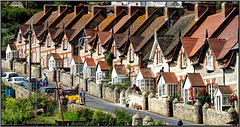
Beer, Devon
| |
|
|
|
We've been to Devon a few times during our lives and so when I came across this the other day I thought it might be worth an airing again. It was originally in my Panoramio account.
Beer, Devon Aug 2013
'Once a fishing village, Beer later made its name as the source of Beer Stone, which provided the material for many of Britain's most famous buildings. The village was mentioned in the Domesday Book, and the manor of Beer was once owned by Catherine Parr, last wife of Henry VIII. It later became infamous as a haven for smugglers. - The first thing to clear up is the origin of the name; it has nothing to do with an alcoholic drink, but comes from the Saxon word 'bearu' for 'grove', a reference to the woodland once grew thick around this area of the coast.
Beer grew up around a sheltered bay which made fishing easier than at other places along the Jurassic Coast. But fishermen were not the only ones to make use of Beer; smugglers also appreciated the relatively easy anchorage and used caves in the cliffs to store contraband goods. There is no natural harbour at Beer so boats had to be winched up onto the shingle. This used to be done manually with a capstan on the shore which required 20 men to operate. Now electrically driven winches make light work of the task!' (www.britainexpress.com)
Enjoy, full screen.
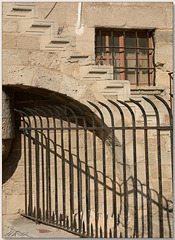
A Rhodes fence
| |
|
|
|
Autumn 2019 and we are walking the old town of Rhodes. Every turning reveals another glimpse of history and interest. Here at the edge of the harbour is a closed small room, built into the wall. Do the step outlines show an old stairway or some kind of geometric pattern? A fence stops us from exploring further but it only raises more questions.
HFF, enjoy your weekend
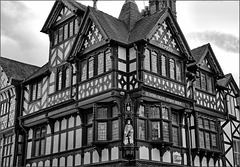
A corner of Chester
| |
|
|
|
Chester, UK, the old Roman fortified town has many charms. Here is just one of them.
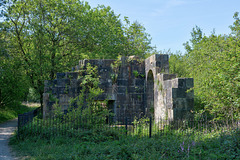
Visions of Park Bridge: Ye olde pump house.
| |
|
|
|
This little corner was part of the coal colliery that was sited here. It will have certainly have housed a steam engine as running from here and still present is a small water-way that leads to the weir. Later in its life it was also used in conjunction with the nearby iron works. To me, it has always been a ruin, that should not be a surprise as the cessation of coal mining here was in 1887.
Nice full screen.
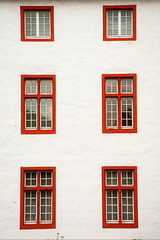
SPC Winner: Six Red Windows
| |
|
|
|
My SPC entry for this months SPC 'Windows' competition. Taken in Germany: Koblenz, Deutsches Eck.
Enjoy
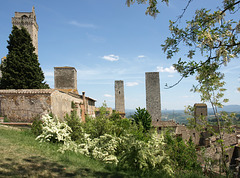
Memories of Tuscany: San Gimignano and its towers
| |
|
|
|
Memories of Tuscany: San Gimignano and its towers
Our first full day trip out here in Tuscany was to San Gimignano and Volterra. San Gimignano is famed for its high narrow towers, some show here. This is a beautiful hilltop town but unfortunately I never got the chance to capture it from low down nor far away, showing the classic view.
Enjoy full screen
"San Gimignano, a small walled village about halfway between Florence and Siena, is famous for its fascinating medieval architecture and towers that rise above of all the other buildings offering an impressive view of the city from the surrounding valley.
At the height of its glory, San Gimignano's patrician families had built around 72 tower-houses as symbols of their wealth and power. Although only 14 have survived, San Gimignano still retains its feudal atmosphere and appearance. Recognized as a UNESCO World Heritage Site since 1990, San Gimignano offers visitors the chance to step back in time" - www.discovertuscany.com/san-gimignano
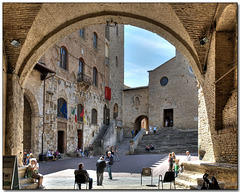
Memories of Tuscany: Piazza Duomo Archways
| |
|
|
|
You have to be in San Gimignano to really appreciate the medieval beauty and history of this place. Here we are in perhaps the very heart of this walled town, at the 11th c Piazza Duomo. The steps belong to the Bassilica S.Maria Assunta and the building on the left is the Town Hall (Comune San Gimignano) and I am under the archway of a big towered building called Torre Rognosa.
It is warm and bright here; hence many of the visitors seek these squares for a quiet place to relax in the shade. The town has many stoned archways; here we can see four alone.
Enjoy full screen
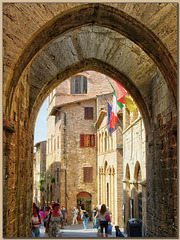
Memories of Tuscany: Archways of San Gimignano
| |
|
|
|
As people go about their normal day and tourist look for the next souvenir shop, I run around with my camera to my eye and just shoot and shoot. Here a double arched thoroughfare lets me capture part of this medieval town in all its splendor.
Enjoy full screen
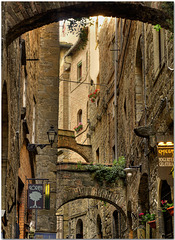
Memories of Tuscany: Volterra Street detail
| |
|
|
|
Volterra is another town of tight narrow streets and alleyways as can be seen here. I believe it was common practice to build arches joining high buildings that were close together to counter earthquake damage in such areas. Of course the streets are narrow so that the buildings can give cool shade, and the heights were driven by the needs of a high population in a very restrictive footprint on this hilltop plateau.
Enjoy full screen
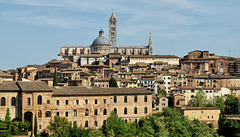
Memories of Tuscany: Siena
| |
|
|
|
The next town on our Tuscany list is Siena. Here we see a view looking towards the highest part of this charming city, showing its cathedral, ‘Duomo di Siena’. Its construction started in 1196 and it is built with medieval bricks.
The Pip shows the main forward view of this magnificent building.
Enjoy.
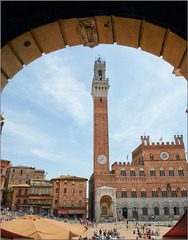
Memories of Tuscany: Siena - Piazza del Campo,
| |
|
|
|
Our walk continues to the centre of this lovely city as we come to this large square. Looming 102 meters over the Piazza del Campo, the elegant, sleek tower to the Palazzo Pubblico is the third tallest in all of Italy. Built from red brick, as a symbol of its affinity to the “commoner” the tower is 87 meters tall of brick and the remaining is a white travertine, most probably to make it visually more prominent. Siena was determined to give the church and the civic authority the same “power” and reverence, so when building the tower which would eventually become the Tower of Mangia and the cathedral bell tower, there were to be of the same height as the cathedral to show that they are equal powers. In reality the bell tower of the Duomo of Siena is only 77 meters, the position of the bell tower is 10 meters higher on the hill - so when gazing upon the skyline of Siena as you are walking the via Francigena, it actually looks the same.
Enjoy full screen
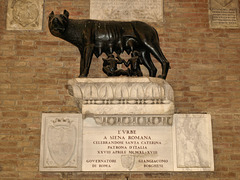
Memories of Tuscany: The Capitoline Wolf
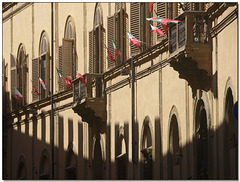
Memories of Tuscany: The Siena light
| |
|
|
|
Siena, has beautiful light! It all works so perfectly well with the coffee coloured walls of its many buildings. Here we have a view of one of the many streets with high walls and shuttered windows. Of course the shadows from the opposite buildings gave me this unique bridge-like effect here. The green, white and red national flags help too (il Tricolore) :)
Enjoy full screen
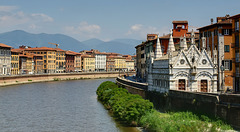
Memories of Tuscany: The Church Santa Maria Della…
| |
|
|
|
Pisa, as we continue our stroll towards the city centre and the fabled leaning tower we spy this wonderful church here on the River Arno.
"Santa Maria della Spina is a small church in the Italian city of Pisa. The church, erected around 1230 in the Pisan Gothic style, and enlarged after 1325, was originally known as Santa Maria di Pontenovo for the newer bridge that existed nearby, collapsed in the 15th century, and was never rebuilt." Wiki
Enjoy full size
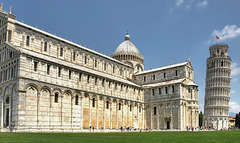
Memories of Tuscany: Pisa - Piazza dei Miracoli
| |
|
|
|
A walk through the center of the old city eventually brings us here to the Piazza dei Miracoli, formally the ‘Piazza del Duomo’ – Cathedral Square. Centre of attraction in this photo is the cathedral itself, the Cattedrale di Pisa which was started in 1063. The left side of this picture is actually the front main Entrance (pip). To the left of that (facing the entrance) is another impressive round building: The San Giovanni Baptistery (Battistero di San Giovanni) . Of course to its right is the famous leaning tower.
Pisa Cathedral is a medieval Roman Catholic cathedral dedicated to the Assumption of the Virgin Mary, in the Piazza dei Miracoli in Pisa, Italy. It is a notable example of Romanesque architecture, in particular the style known as Pisan Romanesque. It is the seat of the Archbishop of Pisa. Wikipedia
“San Giovanni Baptistery (Battistero di San Giovanni): The Baptistery of San Giovanni was founded on 15 August 1152. It is here that the Sacrament of Baptism is administered and the Christian embarks upon the path of Faith. The reason that such a fascinating and enigmatic building was constructed was certainly the wish to endow the cathedral with a worthy adjunct: a Baptistery that, in terms of position, size, materials and style, would be in harmony with the majestic building that already stood opposite.”
Enjoy full screen.
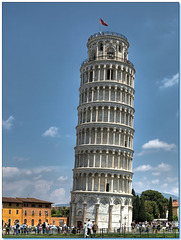
Memories of Tuscany: The Leaning Tower of Pisa
| |
|
|
|
The climax of any visit to this city has to be its famous leaning tower. I must admit, that I was even more impressed with the cathedral and its Baptistery all in the same square. One could get to the top if you were prepared to pay the price and wait for a few hours. We did not have the luxury of time and so had to forgo that experience. Must admit too, that I never took a single shot of my wife pushing the tower back straight, or having it in her hand, as countless other tourist seem to be doing. Ah well, it was still a most enjoyable lifetime experience witnessing all this.
“The Leaning Tower of Pisa (Italian: Torre pendente di Pisa) is the campanile, or freestanding bell tower, of the cathedral, known worldwide for its nearly four-degree lean, the result of an unstable foundation. The tower is the third-oldest structure in the Square, The height of the tower is 55.86 metres (183.27 feet) from the ground on the low side and 56.67 metres (185.93 feet) on the high side. The width of the walls at the base is 2.44 m (8 ft 0.06 in). The tower has 296 steps but two less on the short side of the building.
The tower began to lean during construction in the 12th century, due to soft ground which could not properly support the structure's weight, and it worsened through the completion of construction in the 14th century. By 1990 the tilt had reached 5.5 degrees. The structure was stabilized by remedial work between 1993 and 2001, which reduced the tilt to 3.97 degrees.”
As usual, best visual results in full screen.
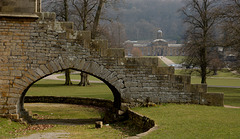
A Chatsworth view
| |
|
|
Chatsworth House in Derbyshire is the setting for this view. The great house lies just right out of picture but these arches are easily as interesting.
More info: www.chatsworth.org
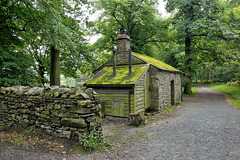
The Bothy
| |
|
|
|
On the banks of Loweswater stands this bothy. An impressive old building for sure and as it is only feet away from a favourite fishing spot (see previous photo), normally very handy indeed. However it is at this moment truly locked-down.
"A bothy is a basic shelter, usually left unlocked and available for anyone to use free of charge. It was also a term for basic accommodation, usually for gardeners or other workers on an estate. Bothies are found in remote mountainous areas of Scotland, Northern England, Northern Ireland, Wales and the Isle of Man." Wiki
Jump to top
RSS feed- Latest items - Subscribe to the latest items added to this album
- ipernity © 2007-2026
- Help & Contact
|
Club news
|
About ipernity
|
History |
ipernity Club & Prices |
Guide of good conduct
Donate | Group guidelines | Privacy policy | Terms of use | Statutes | In memoria -
Facebook
X
