

Wolfgang's photos with the keyword: Hồ Chí Minh City
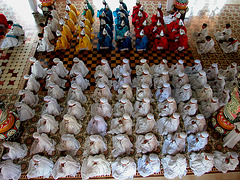
Praying in the Cao Đài Holy See (church) in Tây Ni…
| 31 Oct 2007 |
|
|
|
Monthly rituals are held at the Cao Đài Temples on the 1st and 15th days of each lunar month.
Monthly and annual rituals (in Vietnam) are normally held at 12:00 midnight (Thời Tý) or 12:00 noon (Thời Ngọ).
Twice a month, on the first and the fifteenth day of the lunar calendar, believers must meet at the Thánh-Thất / Temple of their local area and attend the ceremony and listen to the teachings.
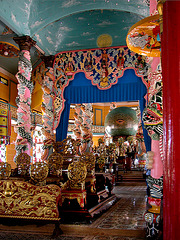
Inside the Cao Dai Church in Tây Ninh
| 31 Oct 2007 |
|
|
Dao Cao Đài (Caodaism in English) is the third largest religion in Viet Nam (after Buddhism and Roman Catholicism). "Cao" means "high"; "Đài" means "palace". Cao Đài refers to the supreme palace where God reigns. The word is also used as God's symbolic name.
Caodaism is a syncretistic religion which combines elements from many of the world's main religions, including Buddhism, Confucianism, Christianity, Hinduism, Islam, Judaism, Taoism, as well as Geniism, an indigenous religion of Viet Nam.
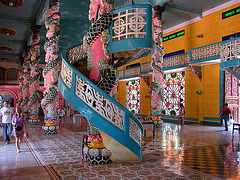
Cao Đài Holy See hall
| 03 Nov 2008 |
|
|
Caodaiists credit God as the religion's founder. They believe the teachings, symbolism and organization were communicated directly from God. Even the construction of the Tây Ninh Holy See is claimed to have had divine guidance. Cao Đài's first disciples, Ngô Văn Chiêu, Cao Quỳnh Cư, Phạm Công Tắc and Cao Hoài Sang, claimed to have received direct communications from God, who gave them explicit instructions for establishing a new religion that would commence the Third Era of Religious Amnesty.
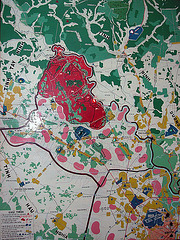
Map of the tunnel network
| 03 Nov 2008 |
|
The tunnels of Củ Chi are an immense network of connecting underground tunnels located in the Cu Chi district of Ho Chi Minh City (Saigon), Vietnam, and are part of a much larger network of tunnels that underlie much of the country. The Củ Chi tunnels were the location of several military campaigns during the Vietnam War, and were the National Front for the Liberation of South Vietnam's base of operations for the Tết Offensive in 1968.
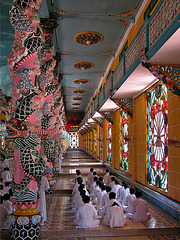
Caodaiists pray in the side strake
| 03 Nov 2008 |
|
|
Adherents engage in ethical practices such as prayer, veneration of ancestors, nonviolence, and vegetarianism with the minimum goal of rejoining God the Father in Heaven and the ultimate goal of freedom from the cycle of birth and death.
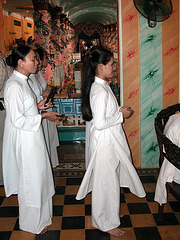
Caodaiist women pray
| 03 Nov 2008 |
|
Caodaiism stresses equality among men and women in society. However, in the spiritual domain, ordained women may not attain the two highest positions: Legislative Cardinal and Pope. The church claims this is ordered by God, who declared that because Yang represents male and Yin corresponds to female, Yin cannot dominate Yang spiritually or else chaos would occur.
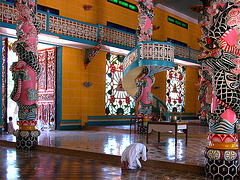
A lonely prayer in the Holy See hall
| 03 Nov 2008 |
|
Caodaiism has also faced schisms like other religions. Some of the Cao Dai sects that have broken away from the Tây Ninh Holy See are Chiếu Minh, Bến Tre and Đà Nẵng. Ngô Văn Chiêu founded Chiếu Minh when he left the original church structure, refusing his appointment as Caodaiism's first Pope. He was neither involved in the religion's official establishment in 1926 nor the Tay Ninh Holy See; he accepted another entity as Đức Cao Đài and the Chiếu Minh sect of Caodaiism was formed.
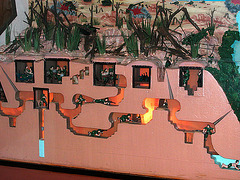
A cross section from the tunnel system
| 03 Nov 2008 |
|
This area was also the termination of the Ho Chi Minh Trail. Because of this, the Củ Chi and the nearby Ben Cat districts had immense strategic value for the NLF (National Front for the Liberation of South Vietnam). Mai Chi Tho, a political commissar stationed in Củ Chi describes the region as a “springboard for attacking Saigon.” He goes on to say: “We used the area for infiltrating Saigon-intelligence agents, part cadres, sabotage teams. The Tết Offensive of 1968 was preparedthe necessary troops and supplies assembled in the Củ Chi tunnels.”
In the beginning, there was never a direct order to build the tunnels; instead, they developed in response to a number of different circumstances, most importantly the military tactics of the French and U.S. The tunnels began in 1948 so that the Viet Minh could hide from French air and ground sweeps. Each hamlet built their own underground communications route through the hard clay, and over the years, the separate tunnels were slowly and meticulously connected and fortified. By 1965, there were over 200 kilometers of connected tunnel. As the tunnel system grew, so did its complexity. Sleeping chambers, kitchens and wells were built to house and feed the growing number of residents and rudimentary hospitals created to treat the wounded. Most of the supplies used to build and maintain the tunnels were stolen or scavenged from U.S. bases or troops.
The medical system serves as a good example of Vietnamese ingenuity in overcoming a lack of basic resources. Stolen motorcycle engines created light and electricity and scrap metal from downed aircraft were fashioned into surgical tools. Doctors devised new methods to perform sophisticated surgery. Faced with large numbers of casualties and a considerable lack of available blood, Dr. Vo Hoang Le Ly came up with a resourceful solution. "We managed to do blood transfusion," Vo said, "by returning his own blood to the patient. If a comrade had a belly wound and was bleeding, but his intestines were not punctured, we collected his blood, filtered it, put it in a bottle and returned it to his veins.”
By the early 1960’s, the NLF had created a relatively self-sufficient community that was able to house hundreds of people and for the most part, go undetected by American troops based, literally on top of the tunnels.
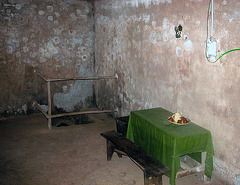
Livingroom in the underground
| 03 Nov 2008 |
|
For the NLF, life in the tunnels was difficult. Air, food and water were scarce and the tunnels were infested with ants, poisonous centipedes, spiders and mosquitoes. Most of the time, guerrillas would spend the day in the tunnels working or resting and come out only at night to scavenge supplies, tend their crops or engage the enemy in battle. Sometimes, during periods of heavy bombing or American troop movement, they would be forced to remain underground for many days at a time. Sickness was rampant among the people living in the tunnels; especially malaria, which accounted for the second largest cause of death next to battle wounds. A captured NLF report suggests that at any given time half of a PLAF unit had malaria and that “one-hundred percent had intestinal parasites of significance.” In spite of these hardships, the NLF managed to wage campaigns against a conscripted army that was technologically far superior.
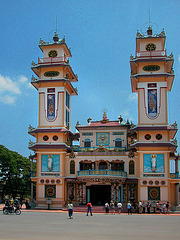
Cao Đài Holy See (church) in Tây Ninh
| 03 Nov 2008 |
|
Tây Ninh is the centre of the Cao Đài sect. Their beliefs are an eclectic mix of Buddhism, Taoism and Confucianism. The temple architecture is as extraordinary as the sect, whose patron saints include Joan of Arc, Victor Hugo and Winston Churchill. Caodaism was founded by Ngo Minh Chieu in 1926. The religion grew quickly and by the 1950’s one of every eight southern Vietnamese was a Cao Đài. Caodaism is strongest in Tây Ninh and the surrounding areas but temples are located throughout southern and central Vietnam.
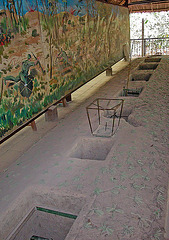
Different kind of traps exhibited
| 03 Nov 2008 |
|
The Củ Chi tunnels of Vietnam are one of those horrible remnants of a horrible war that most folks would probably rather forget. So, of course, they've become a tourist attraction. Many different kind of traps made it nearly impossible for enemies to get on their way.
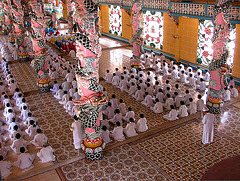
Cao Đài Holy Mass is every day
| 03 Nov 2008 |
|
|
The eye represents the heart.
Source of twin pure light beams.
Light and Spirit are ONE.
god is the Spirits gleam.
CaoDai is a universal faith with the principle that all religions have one same divine origin, which is God, or Allah, or the Tao, or the Nothingness, one same ethic based on LOVE and JUSTICE, and are just different manifestations of one same TRUTH.
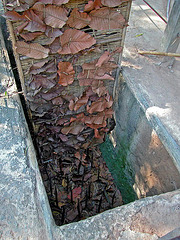
A booby trap with bamboo spikes.
| 03 Nov 2008 |
|
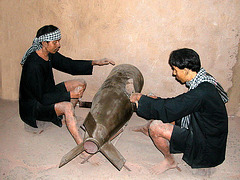
Using the content of duds
| 03 Nov 2008 |
|
The Vietcong were using a lot of Uxo's (unexploded ordnance devices) to create their new bombs and grenades.
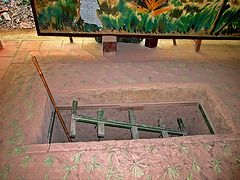
An other trap model
| 03 Nov 2008 |
|
There were hidden trap doors every where and gruesomely effective bamboo-stake booby traps.
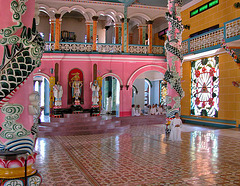
Inside the Holy See hall
| 03 Nov 2008 |
|
There are a number of important figures in the Cao Đài pantheon. The major saints are Chinese revolutionary leader Sun Yat-sen, the 19c French writer Victor Hugo and the 16c Vietnamese poet Nguyen Binh Khiem. Lesser dignitaries who have manifested themselves in seances include notables such as Joan of Arc, Descartes, V. I. Lenin, William Shakespeare, and Winston Churchill. The organizational structure roughly follows that of the Roman Catholic Church with a pope, cardinals, bishops and priests. There are several million practicioners in (mostly southern) Vietnam and perhaps over a thousand Holy Sees, mostly in the Mekong delta. There are also practicioners in the west, though these are primarily in the expatriate Vietnamese communities.
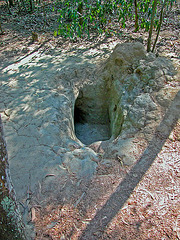
A tunnel entrance
| 03 Nov 2008 |
|
The tunnels were used by NLF guerrillas as hiding spots during combat, as well as serving as communication and supply routes, hospitals, food and weapon caches and living quarters for numerous guerrilla fighters. The role of the tunnel systems should not be underestimated in its importance to the NLF in resisting American operations and protracting the war, eventually persuading the weary Americans into withdrawal.
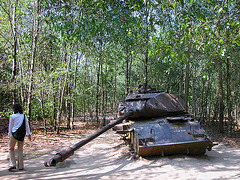
The remain a cruel and nonessential war
Jump to top
RSS feed- Wolfgang's latest photos with "Hồ Chí Minh City" - Photos
- ipernity © 2007-2026
- Help & Contact
|
Club news
|
About ipernity
|
History |
ipernity Club & Prices |
Guide of good conduct
Donate | Group guidelines | Privacy policy | Terms of use | Statutes | In memoria -
Facebook
X
