
Kathleen Thorpe's photos with the keyword: Pompeii
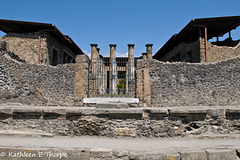
Pompeii - villa - 052014 -0010
| 02 Sep 2015 |
|
|
|
Thank you all for visiting and for your gracious and appreciated comments! I wish I could thank each of you personally.
Have a great creative day!
Please do not use my photograph without my express consent. All rights reserved.
Kathleen
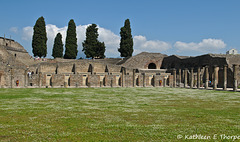
Pompeii - Gladiatorial Arena - 052014 -009
| 26 Aug 2015 |
|
|
|
Thank you all for visiting and for your gracious and appreciated comments! I wish I could thank each of you personally.
Have a great creative day!
Please do not use my photograph without my express consent. All rights reserved.
Kathleen
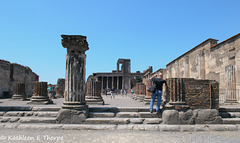
Pompeii - 052014-023
| 25 Aug 2015 |
|
|
|
Thank you all for visiting and for your gracious and appreciated comments! I wish I could thank each of you personally.
Have a great creative day!
Please do not use my photograph without my express consent. All rights reserved.
Kathleen
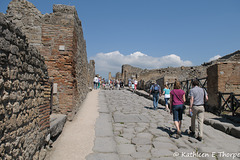
Pompeii Street SOOC 052014-004
| 12 Jan 2015 |
|
|
|
Pompeii, Italy - ancient streets
Thank you all for visiting and for your gracious and appreciated comments! I wish I could thank each of you personally.
Have a great creative day!
Please do not use my photograph without my express consent. All rights reserved.
Kathleen
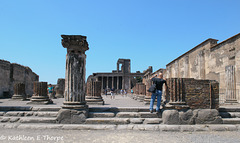
Pompeii - 052014-023
| 08 Nov 2014 |
|
|
|
Pompeii, Italy
Thank you all for visiting and for your gracious and appreciated comments! I wish I could thank each of you personally.
Have a great creative day!
Please do not use my photograph without my express consent. All rights reserved.
Kathleen
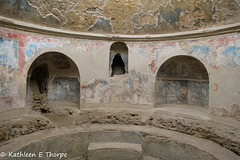
Pompeii Bathhouse SOOC 052014-005
| 03 Oct 2014 |
|
|
|
Pompeii, Italy
The Suburban Baths are located in Pompeii, Italy. Pompeii (located in the Italian region of Campania) was destroyed on August 24, 79 AD when Mount Vesuvius erupted, burying the entire city (along with Herculaneum) and consequently preserving them.
The Suburban Baths were built around the end of the 1st century BC against the city walls north of the Marina Gate. They served as a public bath house to the residents of Pompeii. They were originally discovered in 1958 and have since been excavated and restored. Excavation of the Suburban Baths have given historians a glimpse into an aspect of the social and cultural workings of Roman life in Pompeii. The entrance to the Baths is through a long corridor that leads into the dressing room. Upon excavation of the Baths only one set of dressing rooms was revealed and has led to speculation by archaeologists that both men and women shared this facility. One such dressing room (known as apodyterium) is where archaeologists discovered erotic wall paintings in the 1980s. The dressing room then led to the tepidarium (lukewarm room), followed by the calidarium (hot room). The erotic wall paintings in the Suburban Baths are the only set of such art found in a public Roman bath house. Explicit sex scenes (such as group sex and oral sex) are depicted in these paintings that can not be easily found in collections of erotic Roman art. The paintings are located in the apodyterium and each scene is located above a numbered box. These boxes are thought to function as lockers in which bathers put their clothes. It is speculated that the paintings possibly served as way for the bathers to remember the location of their box (in lieu with the numerical numbering). The presence of these paintings in a public bath house shared by men and women gives some insight into Roman culture and suggests that people would not have found this offensive.
Thank you all for visiting and for your gracious and appreciated comments! I wish I could thank each of you personally.
Have a great creative day!
Please do not use my photograph without my express consent. All rights reserved.
Kathleen
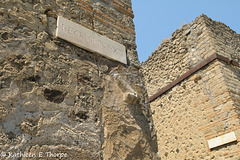
Pompeii Courtesan House SOOC 052014-006
| 18 Sep 2014 |
|
|
|
Pompeii, Italy - Courtesan House - Ancient residents would "advertise" their business with an attachment placed on the outer wall of their residence.
Thank you all for visiting and for your gracious and appreciated comments! I wish I could thank each of you personally.
Have a great creative day!
Please do not use my photograph without my express consent. All rights reserved.
Kathleen
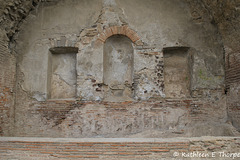
Pompeii - (Lararium) shrine for the villa gods - 0…
| 28 Aug 2014 |
|
|
|
Houses in Pompeii were made of various types of local stone, covered with plaster, and lavishly decorated when finances allowed. Houses were built very close together, and right up against the street. The streets were recessed, leaving raised sidewalks. There were stepping stones available for crossing the street, so as to avoid the muck that might be found there. Some buildings had second stories, but it seems to have been uncommon. The floors were made of concrete, and windows were usually closed by wooden shutters (though some glass panes have been found). There is a Roman architects guide, which gives general guidelines for the way houses should have been built. One thing it states is that the floor plan must vary according to a persons profession. Large reception areas were needed for politicians, and merchants needed to have shops along the front of their houses, facing the street.
There were some common elements among most houses. Upon entry there would be a short corridor, which opened into the atrium. The atrium was a large, central room, which was surrounded by small rooms. The main feature of the atrium would be an impluvium, or small pool to catch rainwater, which would fall through a corresponding opening in the roof. The atrium often would open to a tablinum, or reception area. This would open onto the peristyle, a large outdoor garden. Houses without a peristyle would often have a smaller outdoor garden at the back of the house. There were no "backyards" in Pompeii, and this would have been their personal outdoor space (for city dwellers). The atrium and peristyle were surrounded by other, smaller rooms used as bedrooms, dining rooms, kitchens, storerooms, sometimes a bath, whatever would suit the needs of the owners. There were often shops along the front of the houses, that would have large counters open to the street. Sometimes the shops, or the rooms over them, were rented out, as evidenced by "for rent" signs painted on the walls. Bright colors were used for painting, and beautiful murals were found on the walls of many houses. They painted directly on the walls of their houses instead of hanging pictures, as many of us do.
Lararium:
This was a shrine to the household gods. There would often be an altar or a niche in the wall. Pictures of the gods would be painted here, along with those of family ancestors. A common feature of the pictures was a pair of serpents. Sacrifices would be left for the gods here (usually food and/or drink).
Thank you all for visiting and for your gracious and appreciated comments! I wish I could thank each of you personally.
Have a great creative day!
Please do not use my photograph without my express consent. All rights reserved.
Kathleen
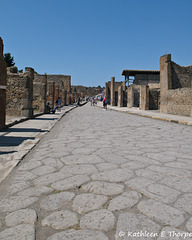
Pompeii - via - 052014 -0011
| 17 Aug 2014 |
|
|
|
Pompeii, Italy
Thank you all for visiting and for your gracious and appreciated comments! I wish I could thank each of you personally.
Have a great creative day!
Please do not use my photograph without my express consent. All rights reserved.
Kathleen
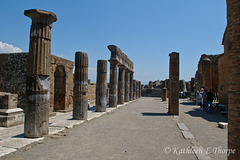
Pompeii Ruins 052014-001-1
| 12 Jul 2014 |
|
|
|
Thank you all for visiting and for your gracious and appreciated comments! I wish I could thank each of you personally.
Have a great creative day!
Please do not use my photograph without my express consent. All rights reserved.
Kathleen
Jump to top
RSS feed- Kathleen Thorpe's latest photos with "Pompeii" - Photos
- ipernity © 2007-2026
- Help & Contact
|
Club news
|
About ipernity
|
History |
ipernity Club & Prices |
Guide of good conduct
Donate | Group guidelines | Privacy policy | Terms of use | Statutes | In memoria -
Facebook
X
