

Joe, Son of the Rock's photos with the keyword: Seabird

Lesser Black-Backed Gull
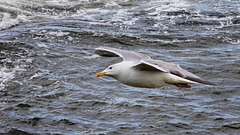
Fulmar in Flight
| 20 Apr 2024 |
|
|
|
St Andrews
Fulmars may look superficially like gulls, but they are not closely related. They are in fact part of a group of birds known as ‘tubenoses’, or ‘petrels’, which includes both giant albatrosses and tiny storm petrels. They are almost gull-like, grey and white seabirds that are related to the albatrosses. They fly low over the sea on stiff wings, with shallow wingbeats. So, while they share some characteristics with gulls, they are a distinct group of birds.
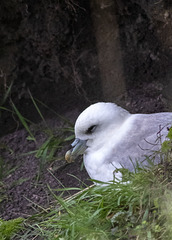
Fulmar
| 28 Apr 2024 |
|
|
|
St Andrews
Related to the massive albatross, the fulmar is a gull-like bird that nests on rocky cliff edges
Quoted from the Wildlife Trusts website
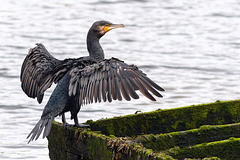
Cormorant
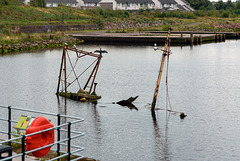
Cormorant

Cormorant
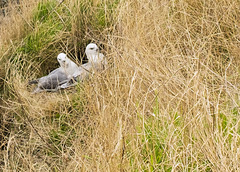
St Andrews, Fulmars, The East Scores
| 20 Sep 2020 |
|
|
|
The fulmars are tubenosed seabirds of the family Procellariidae.... Fulmars superficially resemble gulls, but are readily distinguished by their flight on stiff wings, and their tube noses. They breed on cliffs, laying one or rarely two eggs on a ledge of bare rock or on a grassy cliff. Quoted from Wikipedia
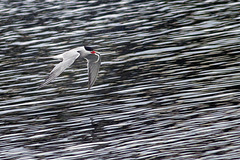
Arctic Tern with a Fish
| 12 Jun 2019 |
|
|
|
The Arctic tern (Sterna paradisaea) is a tern in the family Laridae. This bird has a circumpolar breeding distribution covering the Arctic and sub-Arctic regions of Europe, Asia, and North America (as far south as Brittany and Massachusetts). The species is strongly migratory, seeing two summers each year as it migrates along a convoluted route from its northern breeding grounds to the Antarctic coast for the southern summer and back again about six months later. Recent studies have shown average annual roundtrip lengths of about 70,900 km (44,100 mi) for birds nesting in Iceland and Greenland and about 90,000 km (56,000 mi) for birds nesting in the Netherlands. These are by far the longest migrations known in the animal kingdom. The Arctic tern flies as well as glides through the air. It nests once every one to three years (depending on its mating cycle); once it has finished nesting it takes to the sky for another long southern migration. Quoted from Wikipedia .
Jump to top
RSS feed- Joe, Son of the Rock's latest photos with "Seabird" - Photos
- ipernity © 2007-2026
- Help & Contact
|
Club news
|
About ipernity
|
History |
ipernity Club & Prices |
Guide of good conduct
Donate | Group guidelines | Privacy policy | Terms of use | Statutes | In memoria -
Facebook
X
