

LaurieAnnie's photos with the keyword: Nubia

Architectural Element from a Temple in the Metropo…
| 07 Feb 2026 |
|
On loan to The Met
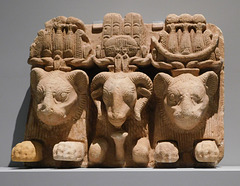
Title: Architectural element from a temple depicting two lion deities and Amun as a ram
Period: Meroitic Period
Date: late third century BCE
Medium: Stone - Sandstone
Dimensions: 65 × 85 cm, ~110 kg (25 9/16 × 33 7/16 in., ~242.5 lb.)
Credit Line: Sudanarchäologische Sammlung und Archiv, Humboldt-Universität, Berlin (II C/24)
Object No.: DE.095
This architectural element is from the great Meroitic temple of the powerful lion-headed war god Apedemak. Shown on either side, he wears an Egyptian hemhem crown. The ram depicts Amun, whose central position indicates his significance. When Kushite rulers conquered Egypt around 733 BCE, they spread myths that placed the origin of the god Amun in Nubia, despite the (even then) ancient history of Amun’s Egyptian roots. Nubians already worshipped a water god in the form of a ram with thick horns that curled downward, perhaps easing the fusion of Egyptian and Nubian beliefs and iconography.
Text from: www.metmuseum.org/exhibitions/divine-egypt/exhibition-objects

Architectural Element from a Temple in the Metropo…
| 07 Feb 2026 |
|
On loan to The Met
Title: Architectural element from a temple depicting two lion deities and Amun as a ram
Period: Meroitic Period
Date: late third century BCE
Medium: Stone - Sandstone
Dimensions: 65 × 85 cm, ~110 kg (25 9/16 × 33 7/16 in., ~242.5 lb.)
Credit Line: Sudanarchäologische Sammlung und Archiv, Humboldt-Universität, Berlin (II C/24)
Object No.: DE.095
This architectural element is from the great Meroitic temple of the powerful lion-headed war god Apedemak. Shown on either side, he wears an Egyptian hemhem crown. The ram depicts Amun, whose central position indicates his significance. When Kushite rulers conquered Egypt around 733 BCE, they spread myths that placed the origin of the god Amun in Nubia, despite the (even then) ancient history of Amun’s Egyptian roots. Nubians already worshipped a water god in the form of a ram with thick horns that curled downward, perhaps easing the fusion of Egyptian and Nubian beliefs and iconography.
Text from: www.metmuseum.org/exhibitions/divine-egypt/exhibition-objects
Architectural Element from a Temple in the Metropo…
| 07 Feb 2026 |
|
On loan to The Met
Title: Architectural element from a temple depicting two lion deities and Amun as a ram
Period: Meroitic Period
Date: late third century BCE
Medium: Stone - Sandstone
Dimensions: 65 × 85 cm, ~110 kg (25 9/16 × 33 7/16 in., ~242.5 lb.)
Credit Line: Sudanarchäologische Sammlung und Archiv, Humboldt-Universität, Berlin (II C/24)
Object No.: DE.095
This architectural element is from the great Meroitic temple of the powerful lion-headed war god Apedemak. Shown on either side, he wears an Egyptian hemhem crown. The ram depicts Amun, whose central position indicates his significance. When Kushite rulers conquered Egypt around 733 BCE, they spread myths that placed the origin of the god Amun in Nubia, despite the (even then) ancient history of Amun’s Egyptian roots. Nubians already worshipped a water god in the form of a ram with thick horns that curled downward, perhaps easing the fusion of Egyptian and Nubian beliefs and iconography.
Text from: www.metmuseum.org/exhibitions/divine-egypt/exhibition-objects
Amulet of Isis or Hathor Nursing a Nubian Queen in…
| 07 Feb 2026 |
|
On loan to The Met
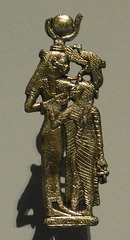
Title: Amulet of Isis or Hathor nursing a queen
Period: Napatan Period
Date: ca. 747–710 BCE
Medium: Metal - Silver
Dimensions: H. 5.7 × W. 1.9 cm (2 1/4 × 3/4 in.)
Credit Line: Boston, Museum of Fine Arts; Harvard University–Boston Museum of Fine Arts
Expedition (24.928)
Object No.: DE.022
Similar in iconography but varying in detail, the sculptures depict Isis with an infant on her lap. Although the children do not nurse, Isis offers mother’s milk, which ancient Egyptians regarded as a magical substance capable of healing and transferring power between generations. Found throughout Egypt in a variety of materials and sizes, such images could be amulets or donations to temples. In the silver amulet a goddess, possibly Isis or Hathor, nurses Queen Nefrukekashta to give her nutrition and power.
See also: Statuette of Isis with the infant Horus
The Metropolitan Museum of Art, New York, Purchase, Joseph Pulitzer Bequest Fund, 1955 (55.121.5)
Statuette of Isis with the infant Horus, dedicated by Ankhhor
The Metropolitan Museum of Art, New York, Rogers Fund, 1945 (45.2.10)
Text from: www.metmuseum.org/exhibitions/divine-egypt/exhibition-objects
Amulet of Isis or Hathor Nursing a Nubian Queen in…
| 07 Feb 2026 |
|
On loan to The Met
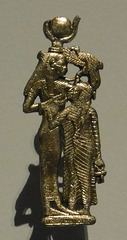
Title: Amulet of Isis or Hathor nursing a queen
Period: Napatan Period
Date: ca. 747–710 BCE
Medium: Metal - Silver
Dimensions: H. 5.7 × W. 1.9 cm (2 1/4 × 3/4 in.)
Credit Line: Boston, Museum of Fine Arts; Harvard University–Boston Museum of Fine Arts
Expedition (24.928)
Object No.: DE.022
Similar in iconography but varying in detail, the sculptures depict Isis with an infant on her lap. Although the children do not nurse, Isis offers mother’s milk, which ancient Egyptians regarded as a magical substance capable of healing and transferring power between generations. Found throughout Egypt in a variety of materials and sizes, such images could be amulets or donations to temples. In the silver amulet a goddess, possibly Isis or Hathor, nurses Queen Nefrukekashta to give her nutrition and power.
See also: Statuette of Isis with the infant Horus
The Metropolitan Museum of Art, New York, Purchase, Joseph Pulitzer Bequest Fund, 1955 (55.121.5)
Statuette of Isis with the infant Horus, dedicated by Ankhhor
The Metropolitan Museum of Art, New York, Rogers Fund, 1945 (45.2.10)
Text from: www.metmuseum.org/exhibitions/divine-egypt/exhibition-objects
Jump to top
RSS feed- LaurieAnnie's latest photos with "Nubia" - Photos
- ipernity © 2007-2026
- Help & Contact
|
Club news
|
About ipernity
|
History |
ipernity Club & Prices |
Guide of good conduct
Donate | Group guidelines | Privacy policy | Terms of use | Statutes | In memoria -
Facebook
X
