

LaurieAnnie's photos with the keyword: WashingtonHeights
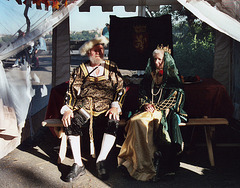
King and Queen of the Festival at the Fort Tryon P…
| 20 Nov 2006 |
|
What Is The Medieval Festival?
The Medieval Festival brings to life the customs and spirit of the Middle Ages. Manhattan's Fort Tryon Park is transformed into a medieval market town decorated with bright banners and processional flags. Performers, guests and festival goers dress in medieval costume. Visitors are greeted by authentic medieval music, dance, magic, and minstrels, as well as jugglers and jesters. The afternoon is concluded with a thrilling joust between four knights on horseback. Costumed vendors will be on hand to demonstrate and sell a wide variety of medieval crafts as well as food and drink.
The festival is free -- there are no charges for admission or entertainment. Donations at our wishing wells are welcome, however!
Text from: www.whidc.org/home.html
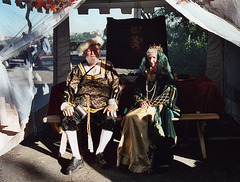
King and Queen of the Festival at the Fort Tryon P…
| 20 Nov 2006 |
|
What Is The Medieval Festival?
The Medieval Festival brings to life the customs and spirit of the Middle Ages. Manhattan's Fort Tryon Park is transformed into a medieval market town decorated with bright banners and processional flags. Performers, guests and festival goers dress in medieval costume. Visitors are greeted by authentic medieval music, dance, magic, and minstrels, as well as jugglers and jesters. The afternoon is concluded with a thrilling joust between four knights on horseback. Costumed vendors will be on hand to demonstrate and sell a wide variety of medieval crafts as well as food and drink.
The festival is free -- there are no charges for admission or entertainment. Donations at our wishing wells are welcome, however!
Text from: www.whidc.org/home.html
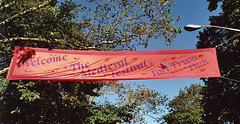
Fort Tryon Park Medieval Festival Banner, Oct. 200…
| 19 Nov 2006 |
|
What Is The Medieval Festival?
The Medieval Festival brings to life the customs and spirit of the Middle Ages. Manhattan's Fort Tryon Park is transformed into a medieval market town decorated with bright banners and processional flags. Performers, guests and festival goers dress in medieval costume. Visitors are greeted by authentic medieval music, dance, magic, and minstrels, as well as jugglers and jesters. The afternoon is concluded with a thrilling joust between four knights on horseback. Costumed vendors will be on hand to demonstrate and sell a wide variety of medieval crafts as well as food and drink.
The festival is free -- there are no charges for admission or entertainment. Donations at our wishing wells are welcome, however!
Text from: www.whidc.org/home.html
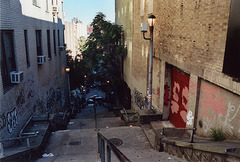
Stairs Going Down From Fort Washington Avenue Near…
| 20 Nov 2006 |
|
187th Street becomes a staircase between Fort Washington Ave and Overlook Terrace. Here is a look east, down the staircase. In the foreground, graffiti on the building walls is appearing again.
Text from: www.brorson.com/M4Bus/HH.html
View of Washington Heights from Fort Tryon Park ,…
| 20 Nov 2006 |
|
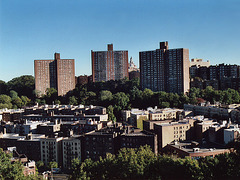
Fort Tryon Park is a public park located in the Washington Heights neighborhood of the New York City borough of Manhattan, USA, 40°51.7′N 73°56′W. It is situated on a 67-acre (270,000 m²) ridge in Upper Manhattan, with a commanding view of the Hudson River, the George Washington Bridge, the New Jersey Palisades and the Harlem River. It is also site of The Cloisters, a branch of the Metropolitan Museum of Art devoted to medieval art and culture, and home to the Unicorn Tapistries, The Cloisters incorporates several medieval buildings that were purchased in Europe, brought to the United States, and reassembled, often stone by stone.
The park was the site of the American Revolutionary War Battle of Fort Washington, fought on November 16, 1776, between 2,900 American soldiers and 8,000 invading Hessian troops hired by Great Britain. Margaret Corbin became the first woman to fight in the war and was wounded during the battle. After the British won, the fortification was named after Sir William Tryon, the last British Governor of the New York colony.
Later it became the private residence of a succession of wealthy owners, including Dr. Samuel Watkins, founder of Watkins Glen, General Daniel Butterfield, Boss Tweed and C. K. G. Billings. John D. Rockefeller, Jr. purchased the Billings estate in 1917. He hired Frederick Law Olmsted, Jr., son of the designer of Central Park, to plan a park that he would give to the city. The park was constructed during the Great Depression, providing many jobs. The project included the 190th Street subway station on the IND Eighth Avenue Line (which is the closest station to the park). The park was completed in 1935. Olmstead included extensive flower plantings, including a Heather Garden that was restored in the 1980s. Besides the gardens and the Cloisters, the park has extensive walking paths and meadows, with views of the Hudson and Harlem Rivers.
The park is built on a formation of Manhattan schist and contains interesting examples of igneous intrusions and of glacial striations from the last Ice Age. The lower lying regions to the east and north of the park are built on Inwood marble.
Abandoned by the New York City Department of Parks and Recreation in the 1970s, Fort Tryon became a haven for the homeless, prostitutes, and drug dealers. In 1995, the New York Restoration Project, an organization founded by Bette Midler, took over the park, cleaning it up and returning it to its original glory.
Parts of the Clint Eastwood film Coogan's Bluff (including the final chase scene) were filmed in Fort Tryon Park.
Text from: en.wikipedia.org/wiki/Fort_Tryon_Park
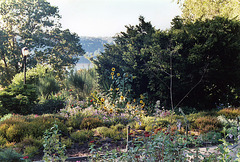
The Heather Garden in Fort Tryon Park, Oct. 2006
| 19 Nov 2006 |
|
Fort Tryon Park is a public park located in the Washington Heights neighborhood of the New York City borough of Manhattan, USA, 40°51.7′N 73°56′W. It is situated on a 67-acre (270,000 m²) ridge in Upper Manhattan, with a commanding view of the Hudson River, the George Washington Bridge, the New Jersey Palisades and the Harlem River. It is also site of The Cloisters, a branch of the Metropolitan Museum of Art devoted to medieval art and culture, and home to the Unicorn Tapistries, The Cloisters incorporates several medieval buildings that were purchased in Europe, brought to the United States, and reassembled, often stone by stone.
The park was the site of the American Revolutionary War Battle of Fort Washington, fought on November 16, 1776, between 2,900 American soldiers and 8,000 invading Hessian troops hired by Great Britain. Margaret Corbin became the first woman to fight in the war and was wounded during the battle. After the British won, the fortification was named after Sir William Tryon, the last British Governor of the New York colony.
Later it became the private residence of a succession of wealthy owners, including Dr. Samuel Watkins, founder of Watkins Glen, General Daniel Butterfield, Boss Tweed and C. K. G. Billings. John D. Rockefeller, Jr. purchased the Billings estate in 1917. He hired Frederick Law Olmsted, Jr., son of the designer of Central Park, to plan a park that he would give to the city. The park was constructed during the Great Depression, providing many jobs. The project included the 190th Street subway station on the IND Eighth Avenue Line (which is the closest station to the park). The park was completed in 1935. Olmstead included extensive flower plantings, including a Heather Garden that was restored in the 1980s. Besides the gardens and the Cloisters, the park has extensive walking paths and meadows, with views of the Hudson and Harlem Rivers.
The park is built on a formation of Manhattan schist and contains interesting examples of igneous intrusions and of glacial striations from the last Ice Age. The lower lying regions to the east and north of the park are built on Inwood marble.
Abandoned by the New York City Department of Parks and Recreation in the 1970s, Fort Tryon became a haven for the homeless, prostitutes, and drug dealers. In 1995, the New York Restoration Project, an organization founded by Bette Midler, took over the park, cleaning it up and returning it to its original glory.
Parts of the Clint Eastwood film Coogan's Bluff (including the final chase scene) were filmed in Fort Tryon Park.
Text from: en.wikipedia.org/wiki/Fort_Tryon_Park
190th St. Subway Sign, Oct. 2006
| 19 Nov 2006 |
|
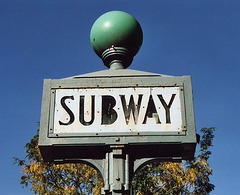
An old-fashioned subway sign at the 190th Street "A" train subway station near Fort Tryon Park, New York, NY.
The Langon Chapel in the Cloisters, Oct. 2006
| 21 Nov 2006 |
|
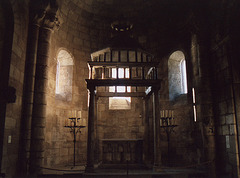
The Romanesque Langon Chapel, on the building’s [the Cloister's] west side, contains part of the interior stonework from a 12th century church in southwestern France.
Text from: www.washington-heights.us/history/archives/cloisters_fort...
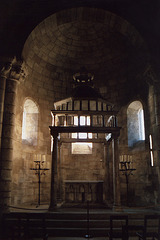
The Langon Chapel in the Cloisters, Oct. 2006
| 21 Nov 2006 |
|
The Romanesque Langon Chapel, on the building’s [the Cloister's] west side, contains part of the interior stonework from a 12th century church in southwestern France.
Text from: www.washington-heights.us/history/archives/cloisters_fort...
Jump to top
RSS feed- LaurieAnnie's latest photos with "WashingtonHeights" - Photos
- ipernity © 2007-2026
- Help & Contact
|
Club news
|
About ipernity
|
History |
ipernity Club & Prices |
Guide of good conduct
Donate | Group guidelines | Privacy policy | Terms of use | Statutes | In memoria -
Facebook
X
