
LaurieAnnie's photos with the keyword: Fauvism

Lucien Gilbert by Derain in the Metropolitan Museu…

Lucien Gilbert by Derain in the Metropolitan Museu…

Fishing Boats, Collioure by Derain in the Metropol…
| 08 Feb 2025 |
|
Title: Fishing Boats, Collioure
Artist: André Derain (French, Chatou 1880–1954 Garches)
Date: 1905
Medium: Oil on canvas
Dimensions: 31 7/8 × 39 3/8 in. (81 × 100 cm)
Classification: Paintings
Credit Line: Gift of Raymonde Paul, in memory of her brother, C. Michael Paul, and Purchase, Lila Acheson Wallace Gift, 1982
Object Number: 1982.179.29
In the summer of 1905 André Derain, then twenty-five, left Paris for a two-month sojourn with his friend Henri Matisse. They settled in the small fishing town of Collioure, on the southwest coast of France near the Spanish border. The painters had first met in Eugène Carrière's Paris studio in 1899, and it was with Matisse's help that Derain had received his parents' permission to pursue a career in art. During the summer in Collioure the two men discussed art theory and painted canvases filled with bright light, high color, and exuberant, often broken brushwork. Along with Maurice de Vlaminck, they were the major proponents of a short-lived movement known as Fauvism. (The term "Fauves"—"Wild Beasts"—was attached to these artists when their innovative work shocked and offended the sensibilities of viewers at the 1905 Salon d'Automne exhibition in Paris.)
Although Matisse and Derain worked closely in Collioure and painted similar scenes, their styles remained distinct. A painting like Fishing Boats, Collioure vividly illustrates Derain's characteristic use of dramatic perspective and diagonal recession into space. We take in the entire panorama from a high vantage point: busy figures on the shore, rocking boats and sails, and the majestic blue and green mountains anchored in the background and capped by billowy pink clouds. The curved shoreline and rhythmic arrangement of overlapping sails lead our eye into the picture. Two seated men, surrogates for the viewer, observe the energetic scene. Derain's palette is Fauvist: vibrant and unnatural. One senses, however, his growing dissatisfaction with this style of painting. The discordant mixture of divisionist brushwork and flat painting and the insistence on heavily outlined images to enhance volumetric form seem contrived and angry. Indeed, Derain was soon to purge himself of Fauvism's impetuosity and go on to produce austere, monochromatic, Cubist-inspired works, several of which are in the Museum's collection.
Text from: www.metmuseum.org/art/collection/search/482510

Fishing Boats, Collioure by Derain in the Metropol…
| 08 Feb 2025 |
|
Title: Fishing Boats, Collioure
Artist: André Derain (French, Chatou 1880–1954 Garches)
Date: 1905
Medium: Oil on canvas
Dimensions: 31 7/8 × 39 3/8 in. (81 × 100 cm)
Classification: Paintings
Credit Line: Gift of Raymonde Paul, in memory of her brother, C. Michael Paul, and Purchase, Lila Acheson Wallace Gift, 1982
Object Number: 1982.179.29
In the summer of 1905 André Derain, then twenty-five, left Paris for a two-month sojourn with his friend Henri Matisse. They settled in the small fishing town of Collioure, on the southwest coast of France near the Spanish border. The painters had first met in Eugène Carrière's Paris studio in 1899, and it was with Matisse's help that Derain had received his parents' permission to pursue a career in art. During the summer in Collioure the two men discussed art theory and painted canvases filled with bright light, high color, and exuberant, often broken brushwork. Along with Maurice de Vlaminck, they were the major proponents of a short-lived movement known as Fauvism. (The term "Fauves"—"Wild Beasts"—was attached to these artists when their innovative work shocked and offended the sensibilities of viewers at the 1905 Salon d'Automne exhibition in Paris.)
Although Matisse and Derain worked closely in Collioure and painted similar scenes, their styles remained distinct. A painting like Fishing Boats, Collioure vividly illustrates Derain's characteristic use of dramatic perspective and diagonal recession into space. We take in the entire panorama from a high vantage point: busy figures on the shore, rocking boats and sails, and the majestic blue and green mountains anchored in the background and capped by billowy pink clouds. The curved shoreline and rhythmic arrangement of overlapping sails lead our eye into the picture. Two seated men, surrogates for the viewer, observe the energetic scene. Derain's palette is Fauvist: vibrant and unnatural. One senses, however, his growing dissatisfaction with this style of painting. The discordant mixture of divisionist brushwork and flat painting and the insistence on heavily outlined images to enhance volumetric form seem contrived and angry. Indeed, Derain was soon to purge himself of Fauvism's impetuosity and go on to produce austere, monochromatic, Cubist-inspired works, several of which are in the Museum's collection.
Text from: www.metmuseum.org/art/collection/search/482510
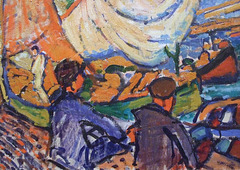
Detail of Fishing Boats, Collioure by Derain in th…
| 08 Feb 2025 |
|
Title: Fishing Boats, Collioure
Artist: André Derain (French, Chatou 1880–1954 Garches)
Date: 1905
Medium: Oil on canvas
Dimensions: 31 7/8 × 39 3/8 in. (81 × 100 cm)
Classification: Paintings
Credit Line: Gift of Raymonde Paul, in memory of her brother, C. Michael Paul, and Purchase, Lila Acheson Wallace Gift, 1982
Object Number: 1982.179.29
In the summer of 1905 André Derain, then twenty-five, left Paris for a two-month sojourn with his friend Henri Matisse. They settled in the small fishing town of Collioure, on the southwest coast of France near the Spanish border. The painters had first met in Eugène Carrière's Paris studio in 1899, and it was with Matisse's help that Derain had received his parents' permission to pursue a career in art. During the summer in Collioure the two men discussed art theory and painted canvases filled with bright light, high color, and exuberant, often broken brushwork. Along with Maurice de Vlaminck, they were the major proponents of a short-lived movement known as Fauvism. (The term "Fauves"—"Wild Beasts"—was attached to these artists when their innovative work shocked and offended the sensibilities of viewers at the 1905 Salon d'Automne exhibition in Paris.)
Although Matisse and Derain worked closely in Collioure and painted similar scenes, their styles remained distinct. A painting like Fishing Boats, Collioure vividly illustrates Derain's characteristic use of dramatic perspective and diagonal recession into space. We take in the entire panorama from a high vantage point: busy figures on the shore, rocking boats and sails, and the majestic blue and green mountains anchored in the background and capped by billowy pink clouds. The curved shoreline and rhythmic arrangement of overlapping sails lead our eye into the picture. Two seated men, surrogates for the viewer, observe the energetic scene. Derain's palette is Fauvist: vibrant and unnatural. One senses, however, his growing dissatisfaction with this style of painting. The discordant mixture of divisionist brushwork and flat painting and the insistence on heavily outlined images to enhance volumetric form seem contrived and angry. Indeed, Derain was soon to purge himself of Fauvism's impetuosity and go on to produce austere, monochromatic, Cubist-inspired works, several of which are in the Museum's collection.
Text from: www.metmuseum.org/art/collection/search/482510

Study for Luxe Calme et Volupte by Matisse in the…

Study for Luxe Calme et Volupte by Matisse in the…
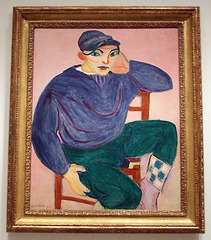
The Young Sailor II by Matisse in the Metropolitan…
| 22 Sep 2008 |
|
Young Sailor II
1906
Object Details
Title: Young Sailor II
Artist: Henri Matisse (French, Le Cateau-Cambrésis 1869–1954 Nice)
Date: 1906
Medium: Oil on canvas
Dimensions: 39 7/8 x 32 5/8 in. (101.3 x 82.9 cm)
Classification: Paintings
Credit Line: Jacques and Natasha Gelman Collection, 1998
Accession Number: 1999.363.41
During his short career as a clerk in a law office, Henri Matisse secretly took painting classes, eventually devoting himself to the pursuit of art full-time. He went to study in Paris, first at the Académie Julian and then at the École des Beaux-Arts, where he trained in the traditional academic style of his teachers Adolphe-William Bouguereau and Gustave Moreau. Under the influence of painters such as the Impressionists and Cézanne, as well as the light-filled landscapes of the French Riviera, Matisse forsook these conservative roots and developed a new style based on flat shapes of vivid color. In 1905, he exhibited work at the Salon d'Automne in Paris as the leader of the Fauves (French for "wild beasts"). This was an avant-garde movement that reduced painting to a bright palette, simple forms, and exuberant brushwork in order to communicate the fundamental elements of reality and sensation.
Matisse painted "The Young Sailor" in 1906, at the height of his involvement with the Fauves. The sitter of this picture is an eighteen-year-old fisherman, Germain Augustin Barthélémy Montargès, from the small Mediterranean village of Collioure, near the Spanish border. Against the flat, bright pink background, Germain wears typical fisherman's garb: a navy blue cap, a pullover over a white undershirt and blue-and-pink striped jersey, baggy green pants, green-and-white checked socks, and sturdy, laced-up shoes with rubber soles. His broad face is flat and mask-like, and the contours of his rounded limbs are crisp and defined, creating a sharp contrast to the loose brushstrokes that constitute them. Germain's rather theatrical looks and the work's bold palette, in which the figure's green and blue outfit is set against the pink, candy-colored ground, combine to make this painting one of Matisse's most decorative portraits in the Fauve manner.
Text from: www.metmuseum.org/art/collection/search/489994
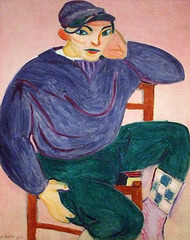
The Young Sailor II by Matisse in the Metropolitan…
| 22 Sep 2008 |
|
Young Sailor II
1906
Object Details
Title: Young Sailor II
Artist: Henri Matisse (French, Le Cateau-Cambrésis 1869–1954 Nice)
Date: 1906
Medium: Oil on canvas
Dimensions: 39 7/8 x 32 5/8 in. (101.3 x 82.9 cm)
Classification: Paintings
Credit Line: Jacques and Natasha Gelman Collection, 1998
Accession Number: 1999.363.41
During his short career as a clerk in a law office, Henri Matisse secretly took painting classes, eventually devoting himself to the pursuit of art full-time. He went to study in Paris, first at the Académie Julian and then at the École des Beaux-Arts, where he trained in the traditional academic style of his teachers Adolphe-William Bouguereau and Gustave Moreau. Under the influence of painters such as the Impressionists and Cézanne, as well as the light-filled landscapes of the French Riviera, Matisse forsook these conservative roots and developed a new style based on flat shapes of vivid color. In 1905, he exhibited work at the Salon d'Automne in Paris as the leader of the Fauves (French for "wild beasts"). This was an avant-garde movement that reduced painting to a bright palette, simple forms, and exuberant brushwork in order to communicate the fundamental elements of reality and sensation.
Matisse painted "The Young Sailor" in 1906, at the height of his involvement with the Fauves. The sitter of this picture is an eighteen-year-old fisherman, Germain Augustin Barthélémy Montargès, from the small Mediterranean village of Collioure, near the Spanish border. Against the flat, bright pink background, Germain wears typical fisherman's garb: a navy blue cap, a pullover over a white undershirt and blue-and-pink striped jersey, baggy green pants, green-and-white checked socks, and sturdy, laced-up shoes with rubber soles. His broad face is flat and mask-like, and the contours of his rounded limbs are crisp and defined, creating a sharp contrast to the loose brushstrokes that constitute them. Germain's rather theatrical looks and the work's bold palette, in which the figure's green and blue outfit is set against the pink, candy-colored ground, combine to make this painting one of Matisse's most decorative portraits in the Fauve manner.
Text from: www.metmuseum.org/art/collection/search/489994

Young Sailor II by Matisse in the Metropolitan Mus…
| 01 Mar 2020 |
|
Young Sailor II
1906
Object Details
Title: Young Sailor II
Artist: Henri Matisse (French, Le Cateau-Cambrésis 1869–1954 Nice)
Date: 1906
Medium: Oil on canvas
Dimensions: 39 7/8 x 32 5/8 in. (101.3 x 82.9 cm)
Classification: Paintings
Credit Line: Jacques and Natasha Gelman Collection, 1998
Accession Number: 1999.363.41
During his short career as a clerk in a law office, Henri Matisse secretly took painting classes, eventually devoting himself to the pursuit of art full-time. He went to study in Paris, first at the Académie Julian and then at the École des Beaux-Arts, where he trained in the traditional academic style of his teachers Adolphe-William Bouguereau and Gustave Moreau. Under the influence of painters such as the Impressionists and Cézanne, as well as the light-filled landscapes of the French Riviera, Matisse forsook these conservative roots and developed a new style based on flat shapes of vivid color. In 1905, he exhibited work at the Salon d'Automne in Paris as the leader of the Fauves (French for "wild beasts"). This was an avant-garde movement that reduced painting to a bright palette, simple forms, and exuberant brushwork in order to communicate the fundamental elements of reality and sensation.
Matisse painted "The Young Sailor" in 1906, at the height of his involvement with the Fauves. The sitter of this picture is an eighteen-year-old fisherman, Germain Augustin Barthélémy Montargès, from the small Mediterranean village of Collioure, near the Spanish border. Against the flat, bright pink background, Germain wears typical fisherman's garb: a navy blue cap, a pullover over a white undershirt and blue-and-pink striped jersey, baggy green pants, green-and-white checked socks, and sturdy, laced-up shoes with rubber soles. His broad face is flat and mask-like, and the contours of his rounded limbs are crisp and defined, creating a sharp contrast to the loose brushstrokes that constitute them. Germain's rather theatrical looks and the work's bold palette, in which the figure's green and blue outfit is set against the pink, candy-colored ground, combine to make this painting one of Matisse's most decorative portraits in the Fauve manner.
Text from: www.metmuseum.org/art/collection/search/489994

Young Sailor II by Matisse in the Metropolitan Mus…
| 01 Mar 2020 |
|
Young Sailor II
1906
Object Details
Title: Young Sailor II
Artist: Henri Matisse (French, Le Cateau-Cambrésis 1869–1954 Nice)
Date: 1906
Medium: Oil on canvas
Dimensions: 39 7/8 x 32 5/8 in. (101.3 x 82.9 cm)
Classification: Paintings
Credit Line: Jacques and Natasha Gelman Collection, 1998
Accession Number: 1999.363.41
During his short career as a clerk in a law office, Henri Matisse secretly took painting classes, eventually devoting himself to the pursuit of art full-time. He went to study in Paris, first at the Académie Julian and then at the École des Beaux-Arts, where he trained in the traditional academic style of his teachers Adolphe-William Bouguereau and Gustave Moreau. Under the influence of painters such as the Impressionists and Cézanne, as well as the light-filled landscapes of the French Riviera, Matisse forsook these conservative roots and developed a new style based on flat shapes of vivid color. In 1905, he exhibited work at the Salon d'Automne in Paris as the leader of the Fauves (French for "wild beasts"). This was an avant-garde movement that reduced painting to a bright palette, simple forms, and exuberant brushwork in order to communicate the fundamental elements of reality and sensation.
Matisse painted "The Young Sailor" in 1906, at the height of his involvement with the Fauves. The sitter of this picture is an eighteen-year-old fisherman, Germain Augustin Barthélémy Montargès, from the small Mediterranean village of Collioure, near the Spanish border. Against the flat, bright pink background, Germain wears typical fisherman's garb: a navy blue cap, a pullover over a white undershirt and blue-and-pink striped jersey, baggy green pants, green-and-white checked socks, and sturdy, laced-up shoes with rubber soles. His broad face is flat and mask-like, and the contours of his rounded limbs are crisp and defined, creating a sharp contrast to the loose brushstrokes that constitute them. Germain's rather theatrical looks and the work's bold palette, in which the figure's green and blue outfit is set against the pink, candy-colored ground, combine to make this painting one of Matisse's most decorative portraits in the Fauve manner.
Text from: www.metmuseum.org/art/collection/search/489994

The Seine at Chatou by Vlaminck in the Philadelphi…
| 13 Apr 2014 |
|
The Seine at Châtou
Maurice de Vlaminck, French, 1876 - 1958
Geography: Made in France, Europe
Date: c. 1908
Medium: Oil on panel
Dimensions: 14 1/2 x 18 1/4 inches (36.8 x 46.3 cm)
Copyright: © Artists Rights Society (ARS), New York / ADAGP, Paris
Curatorial Department: Modern Art
Object Location: Currently not on view
Accession Number: 1944-12-3
Credit Line: A. E. Gallatin Collection, 1944
Text from: www.philamuseum.org/collections/permanent/48673.html?mulR=1466877634|1

House Behind the Trees by Braque in the Metropolit…
| 26 Apr 2008 |
|
House behind Trees,1906–7
Object Details
Artist: Georges Braque (French, Argenteuil 1882–1963 Paris)
Date: 1906–7
Medium: Oil on canvas
Dimensions: Overall: 14 3/4 x 18 1/8 in. (37.5 x 46 cm)
Classification: Paintings
Credit Line: Robert Lehman Collection, 1975
Accession Number: 1975.1.159
In 1906–7, inspired by his first encounter with Fauvism at the 1905 Salon d’Automne, Braque experimented briefly with this novel technique. Here he uses Fauvism’s sharp, bright colors, broad dark outlines, flattened space, and untouched primed ground. At this time, Braque was painting in the south of France, particularly in the fishing villages of La Ciotat and l’Estaque. L’Estaque was also a favorite destination for Paul Cézanne.
Text from: www.metmuseum.org/art/collection/search/459142

Promenade among the Olive Trees by Matisse in the…
| 24 Apr 2008 |
|
Promenade among the Olive Trees, 1905–6
Henri Matisse (French, 1869–1954)
Oil on canvas; 17 1/2 x 21 3/4 in. (44.5 x 55.2 cm)
Robert Lehman Foundation, 1975 (1975.1.194)
Matisse painted this view of olive trees while at Collioure, a small fishing port on the Mediterranean near the Spanish border. At that time, early in his stay, he had not yet developed the Fauve style of constructing his pictures with flat areas of color. As shown here, he was still experimenting, combining Neo-Impressionist blocks of color and daubs and squiggles of pigment applied with variously sized brushstrokes.
Text from: www.metmuseum.org/toah/hd/fauv/ho_1975.1.194.htm

River Scene with Boat by Vlaminck in the Metropoli…
| 24 Apr 2008 |
|
Maurice de Vlaminck
French, 1876-1958
River Scene with Boat
From the Robert Lehman Collection, Accession # 1975.1.221
Text from the Metropolitan Museum of Art label.
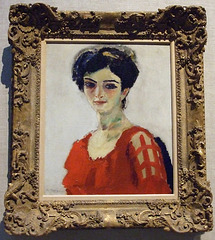
Maria by Kees van Dongen in the Metropolitan Museu…
| 24 Apr 2010 |
|
Kees van Dongen
Dutch, 1877-1968
Maria
Accession # 1975.1.230
From the Robert Lehman Collection.
Text from the Metropolitan Museum of Art label.

River Scene with Boat by Vlaminck in the Metropoli…
| 24 Apr 2008 |
|
Maurice de Vlaminck
French, 1876-1958
River Scene with Boat
From the Robert Lehman Collection, Accession # 1975.1.221
Text from the Metropolitan Museum of Art label.
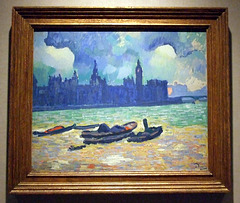
Houses of Parliament at Night by Derain in the Met…
| 23 Apr 2008 |
|
Houses of Parliament at Night, 1905-06
André Derain (Chatou 1880 - Paris 1954)
French
Oil on canvas; 31 x 39 in. (78.7 x 99.1 cm); framed: 40 3/8 x 47.5 x 3 in. (102.5 x 121 x 7.6 cm)
Robert Lehman Collection, 1975 (1975.1.168)
In 1905 and 1906 Derain traveled to London at the suggestion of the art dealer Ambroise Vollard, for whom he executed a number of views of the city, including this one. As the artist later recalled, these canvases were inspired by Claude Monet's views of London painted only a few years earlier, which had "made a very strong impression on Paris." The long broken brushstrokes of Derain's painting and the bright bold colors reflect the influence of the Neo-Impressionists Paul Signac and Henri-Edmond Cross (both well represented by works in the Robert Lehman Collection) as well as that of Matisse, with whom Derain spent the summer of 1905 in the south of France.
Text from: www.metmuseum.org/works_of_art/collection_database/the_ro...
Jump to top
RSS feed- LaurieAnnie's latest photos with "Fauvism" - Photos
- ipernity © 2007-2026
- Help & Contact
|
Club news
|
About ipernity
|
History |
ipernity Club & Prices |
Guide of good conduct
Donate | Group guidelines | Privacy policy | Terms of use | Statutes | In memoria -
Facebook
X
