

LaurieAnnie's photos with the keyword: Persephone
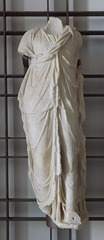
Statuette of Kore in the Museo Campi Flegrei, June…

Statuette of Kore in the Museo Campi Flegrei, June…
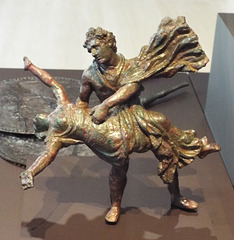
Rape of Proserpina from Baelo Claudia in the Archa…

Rape of Proserpina from Baelo Claudia in the Archa…
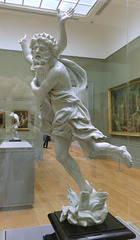
The Rape of Proserpina Porcelain in the Metropolit…
| 18 Jan 2023 |
|
Title: Rape of Proserpina
Manufactory: Doccia Porcelain Manufactory (Italian, 1737–1896)
Factory director: Marchese Carlo Ginori
Maker: Gaspero Bruschi (Italian, ca. 1710–1780, active 1737–80)
Modeler: After a model by Giovanni Battista Foggini (Italian, Florence 1652–1725 Florence)
Date: ca. 1750
Culture: Italian, Florence
Medium: Hard-paste porcelain
Dimensions: Overall (confirmed): 19 1/2 x 13 7/8 x 9 3/8 in. (49.5 x 35.2 x 23.8 cm)
Classification: Ceramics-Porcelain
Credit Line: Purchase, Gift of Irwin Untermyer, by exchange, 1997
Accession Number: 1997.377
In the 1740s Carlo Ginori, the founder of the porcelain factory at Doccia, acquired a number of sculptural models in wax, terracotta, and plaster made by some of the leading Florentine baroque sculptors. The challenge and reward for the porcelain modelers at the Ginori factory was to overcome the technical difficulties of this fragile new medium and to retain the dynamism and balance of the original models. This group, based on a bronze by Foggini, depicts Pluto stepping into the flames as he carries the struggling Proserpina off to the underworld.
Text from: www.metmuseum.org/art/collection/search/208847
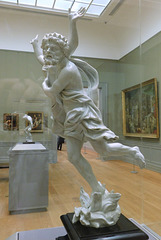
The Rape of Proserpina Porcelain in the Metropolit…
| 18 Jan 2023 |
|
Title: Rape of Proserpina
Manufactory: Doccia Porcelain Manufactory (Italian, 1737–1896)
Factory director: Marchese Carlo Ginori
Maker: Gaspero Bruschi (Italian, ca. 1710–1780, active 1737–80)
Modeler: After a model by Giovanni Battista Foggini (Italian, Florence 1652–1725 Florence)
Date: ca. 1750
Culture: Italian, Florence
Medium: Hard-paste porcelain
Dimensions: Overall (confirmed): 19 1/2 x 13 7/8 x 9 3/8 in. (49.5 x 35.2 x 23.8 cm)
Classification: Ceramics-Porcelain
Credit Line: Purchase, Gift of Irwin Untermyer, by exchange, 1997
Accession Number: 1997.377
In the 1740s Carlo Ginori, the founder of the porcelain factory at Doccia, acquired a number of sculptural models in wax, terracotta, and plaster made by some of the leading Florentine baroque sculptors. The challenge and reward for the porcelain modelers at the Ginori factory was to overcome the technical difficulties of this fragile new medium and to retain the dynamism and balance of the original models. This group, based on a bronze by Foggini, depicts Pluto stepping into the flames as he carries the struggling Proserpina off to the underworld.
Text from: www.metmuseum.org/art/collection/search/208847
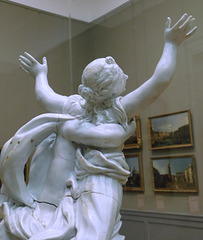
Detail of the The Rape of Proserpina Porcelain in…
| 18 Jan 2023 |
|
Title: Rape of Proserpina
Manufactory: Doccia Porcelain Manufactory (Italian, 1737–1896)
Factory director: Marchese Carlo Ginori
Maker: Gaspero Bruschi (Italian, ca. 1710–1780, active 1737–80)
Modeler: After a model by Giovanni Battista Foggini (Italian, Florence 1652–1725 Florence)
Date: ca. 1750
Culture: Italian, Florence
Medium: Hard-paste porcelain
Dimensions: Overall (confirmed): 19 1/2 x 13 7/8 x 9 3/8 in. (49.5 x 35.2 x 23.8 cm)
Classification: Ceramics-Porcelain
Credit Line: Purchase, Gift of Irwin Untermyer, by exchange, 1997
Accession Number: 1997.377
In the 1740s Carlo Ginori, the founder of the porcelain factory at Doccia, acquired a number of sculptural models in wax, terracotta, and plaster made by some of the leading Florentine baroque sculptors. The challenge and reward for the porcelain modelers at the Ginori factory was to overcome the technical difficulties of this fragile new medium and to retain the dynamism and balance of the original models. This group, based on a bronze by Foggini, depicts Pluto stepping into the flames as he carries the struggling Proserpina off to the underworld.
Text from: www.metmuseum.org/art/collection/search/208847
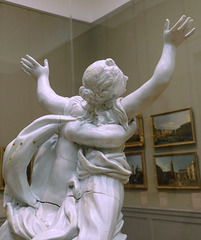
Detail of the The Rape of Proserpina Porcelain in…
| 18 Jan 2023 |
|
Title: Rape of Proserpina
Manufactory: Doccia Porcelain Manufactory (Italian, 1737–1896)
Factory director: Marchese Carlo Ginori
Maker: Gaspero Bruschi (Italian, ca. 1710–1780, active 1737–80)
Modeler: After a model by Giovanni Battista Foggini (Italian, Florence 1652–1725 Florence)
Date: ca. 1750
Culture: Italian, Florence
Medium: Hard-paste porcelain
Dimensions: Overall (confirmed): 19 1/2 x 13 7/8 x 9 3/8 in. (49.5 x 35.2 x 23.8 cm)
Classification: Ceramics-Porcelain
Credit Line: Purchase, Gift of Irwin Untermyer, by exchange, 1997
Accession Number: 1997.377
In the 1740s Carlo Ginori, the founder of the porcelain factory at Doccia, acquired a number of sculptural models in wax, terracotta, and plaster made by some of the leading Florentine baroque sculptors. The challenge and reward for the porcelain modelers at the Ginori factory was to overcome the technical difficulties of this fragile new medium and to retain the dynamism and balance of the original models. This group, based on a bronze by Foggini, depicts Pluto stepping into the flames as he carries the struggling Proserpina off to the underworld.
Text from: www.metmuseum.org/art/collection/search/208847
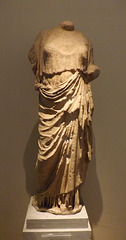
Statue of Aphrodite or Persephone from Athens in t…
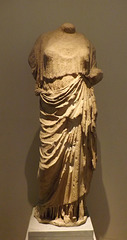
Statue of Aphrodite or Persephone from Athens in t…
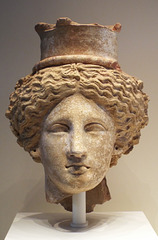
Sicilian Head of Demeter or Kore in the Getty Vill…
| 09 Jun 2018 |
|
Title: Head of a Woman
Artist/Maker: Unknown
Culture: Greek (Sicilian)
Place: Sicily, Italy, Europe (Place created)
Date: 350–300 B.C.
Medium: Terracotta with white slip and polychromy (pink, red, dark pink, white, purple)
Object Number: 76.AD.34
Dimensions: 28.8 × 19.1 × 15.1 cm (11 5/16 × 7 1/2 × 5 15/16 in.)
Credit Line: Gift of Dr. Max Gerchik
Alternate Titles: Head of a Goddess (Display Title)
Head of a Goddess (Display Title)
Object Type: Female figure
Frontal head of a female deity, perhaps Demeter or Kore, which may have been broken from a sculpture. Traces of white slip survive in many places. She wears a high polos with substantial remains of purple, pink and red polychromy. Her bushy, wavy hair is parted in the center. The ears are pierced for the addition of separately made earrings. The back of the head is unmodelled and undecorated and contains a large oval shaped vent hole.
Text from: www.getty.edu/art/collection/objects/7319/unknown-maker-head-of-a-woman-greek-sicilian-350-300-bc
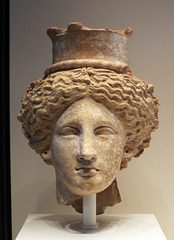
Sicilian Head of Demeter or Kore in the Getty Vill…
| 09 Jun 2018 |
|
Title: Head of a Woman
Artist/Maker: Unknown
Culture: Greek (Sicilian)
Place: Sicily, Italy, Europe (Place created)
Date: 350–300 B.C.
Medium: Terracotta with white slip and polychromy (pink, red, dark pink, white, purple)
Object Number: 76.AD.34
Dimensions: 28.8 × 19.1 × 15.1 cm (11 5/16 × 7 1/2 × 5 15/16 in.)
Credit Line: Gift of Dr. Max Gerchik
Alternate Titles: Head of a Goddess (Display Title)
Head of a Goddess (Display Title)
Object Type: Female figure
Frontal head of a female deity, perhaps Demeter or Kore, which may have been broken from a sculpture. Traces of white slip survive in many places. She wears a high polos with substantial remains of purple, pink and red polychromy. Her bushy, wavy hair is parted in the center. The ears are pierced for the addition of separately made earrings. The back of the head is unmodelled and undecorated and contains a large oval shaped vent hole.
Text from: www.getty.edu/art/collection/objects/7319/unknown-maker-head-of-a-woman-greek-sicilian-350-300-bc
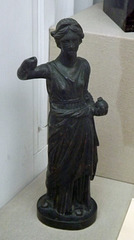
Persephone Statuette in the British Museum, April…
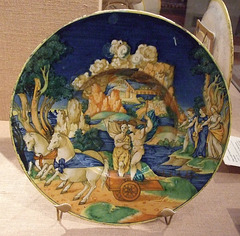
Plate with Pluto Abducting Persephone in the Phila…
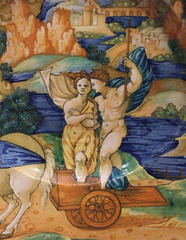
Detail of a Plate with Pluto Abducting Persephone…
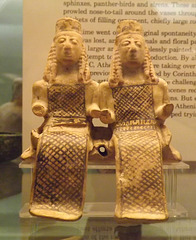
Terracotta Model of Two Figures, Perhaps Demeter a…
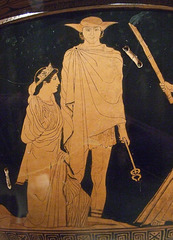
Detail of Persephone and Hermes on the Terracotta…
| 10 Jan 2011 |
|
Bell-krater (bowl for mixing wine and water) , ca. 440 b.c.; Red-figure
Attributed to the Persephone Painter
Greek, Attic
Terracotta
H. 16 1/8 in. (41 cm)
Fletcher Fund, 1928 (28.57.23)
Obverse: The return of Persephone
Reverse: Libation scene
This vessel, known as a bell-krater, was used for mixing wine and water at the Greek symposium.
The scene on the obverse of this bell-krater depicts the return of Persephone to her mother, the goddess Demeter. At the left, Persephone steps up from Hades through a cleft in the ground, as Hermes, messenger of the gods, stands back. The goddess Hekate, "daughter of dark-bosomed night" according to Bacchylides, a Greek poet of the fifth century B.C., occupies the center of the vase holding two flaming torches with which she illuminates Persephone's nighttime journey from the Underworld. Lastly, at the far right stands Demeter. The importance of the nocturnal setting of the scene is underscored by the prominent size of the torches held by Hekate, and emphasized by her central position within the composition.
The scene illustrates one episode from the myth of Persephone's abduction by Hades recounted in the sixth-century B.C. Homeric Hymn to Demeter. From the hymn we learn that Persephone is to spend one-third of the year with her husband in the realm of the dead, and two-thirds of it on earth with Demeter, the goddess who gave the gift of grain to mankind, and who is responsible for the growth of crops. This krater shows Persephone in the midst of her ascent, her return, heralding the arrival of spring and the beginning of growing season. Despite the positive allegorical significance of Persephone's return for ancient Greeks, it was not a well-developed theme in ancient literature. The vivid pictorial conception of this episode, including the deliberate reference to time on this bell-krater, it seems is a strictly visual convention. The root of this iconographical tradition may lie in the fact that the arrival of spring was viewed as an annual, ritual event, and such events were celebrated at night. A clearly defined time therefore was an essential element of the pictorial typology of Persephone's return. Such a detail would have reflected actual cult practice, which would have added a level of tangible realism to the scene for the ancient viewer.
Persephone is seen emerging out of the earth wearing a himation over her pleated linen chiton. Demeter also wears a chiton of crinkled fabric beneath a long himation. With his traveling staff in hand, Hermes dons his characteristic broad-rimmed traveling hat (petasos) and short cloak (chlamys). Hekate, dressed in an open-sided peplos, guides the way with lighted torches.
Women and men in ancient Greece wore the chiton, peplos, and himation in various configurations. With belting, girding, and different methods of draping, they were able to transform the essentially simple construction and configuration of these garments. Many of these variations became codified, and persisted as preferred styles for centuries.
Text from: www.metmuseum.org/toah/works-of-art/28.57.23
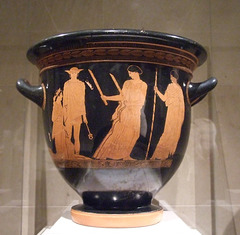
Terracotta Bell Krater Attributed to the Persephon…
| 10 Jan 2011 |
|
Bell-krater (bowl for mixing wine and water) , ca. 440 b.c.; Red-figure
Attributed to the Persephone Painter
Greek, Attic
Terracotta
H. 16 1/8 in. (41 cm)
Fletcher Fund, 1928 (28.57.23)
Obverse: The return of Persephone
Reverse: Libation scene
This vessel, known as a bell-krater, was used for mixing wine and water at the Greek symposium.
The scene on the obverse of this bell-krater depicts the return of Persephone to her mother, the goddess Demeter. At the left, Persephone steps up from Hades through a cleft in the ground, as Hermes, messenger of the gods, stands back. The goddess Hekate, "daughter of dark-bosomed night" according to Bacchylides, a Greek poet of the fifth century B.C., occupies the center of the vase holding two flaming torches with which she illuminates Persephone's nighttime journey from the Underworld. Lastly, at the far right stands Demeter. The importance of the nocturnal setting of the scene is underscored by the prominent size of the torches held by Hekate, and emphasized by her central position within the composition.
The scene illustrates one episode from the myth of Persephone's abduction by Hades recounted in the sixth-century B.C. Homeric Hymn to Demeter. From the hymn we learn that Persephone is to spend one-third of the year with her husband in the realm of the dead, and two-thirds of it on earth with Demeter, the goddess who gave the gift of grain to mankind, and who is responsible for the growth of crops. This krater shows Persephone in the midst of her ascent, her return, heralding the arrival of spring and the beginning of growing season. Despite the positive allegorical significance of Persephone's return for ancient Greeks, it was not a well-developed theme in ancient literature. The vivid pictorial conception of this episode, including the deliberate reference to time on this bell-krater, it seems is a strictly visual convention. The root of this iconographical tradition may lie in the fact that the arrival of spring was viewed as an annual, ritual event, and such events were celebrated at night. A clearly defined time therefore was an essential element of the pictorial typology of Persephone's return. Such a detail would have reflected actual cult practice, which would have added a level of tangible realism to the scene for the ancient viewer.
Persephone is seen emerging out of the earth wearing a himation over her pleated linen chiton. Demeter also wears a chiton of crinkled fabric beneath a long himation. With his traveling staff in hand, Hermes dons his characteristic broad-rimmed traveling hat (petasos) and short cloak (chlamys). Hekate, dressed in an open-sided peplos, guides the way with lighted torches.
Women and men in ancient Greece wore the chiton, peplos, and himation in various configurations. With belting, girding, and different methods of draping, they were able to transform the essentially simple construction and configuration of these garments. Many of these variations became codified, and persisted as preferred styles for centuries.
Text from: www.metmuseum.org/toah/works-of-art/28.57.23
Jump to top
RSS feed- LaurieAnnie's latest photos with "Persephone" - Photos
- ipernity © 2007-2026
- Help & Contact
|
Club news
|
About ipernity
|
History |
ipernity Club & Prices |
Guide of good conduct
Donate | Group guidelines | Privacy policy | Terms of use | Statutes | In memoria -
Facebook
X
