

LaurieAnnie's photos with the keyword: Moche

Moche Bird Jar in the Metropolitan Museum of Art,…
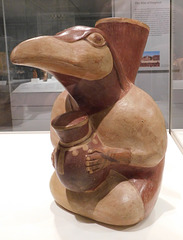
Moche Bird Jar in the Metropolitan Museum of Art,…

Decapitator Nose Ornament in the Metropolitan Muse…
| 03 Feb 2026 |
|
Title: Nose ornament with decapitator
Artist: Moche artist(s)
Date: 200–900 CE
Geography: Peru, North Coast
Culture: Moche
Medium: Gilded copper, silver, stone
Dimensions: H. 2 3/4 x W. 3 15/16 x D. 3/8 in. (7 x 10 x 1 cm)
Classification: Metal-Ornaments
Credit Line: The Michael C. Rockefeller Memorial Collection, Bequest of Nelson A. Rockefeller, 1979
Object Number: 1979.206.1247
Curatorial Department: The Michael C. Rockefeller Wing
This ornament is one of a large number of metal objects said to have been found at a site or sites now called Loma Negra, near Piura in the far north of Peru, close to the Ecuadorean border. The numerous small tabs in back suggest that it was once attached to a nose ornament, probably of silver (see MMA 1979.206.1236 for the type of construction). The overlay features a figure frequently depicted in Moche iconography known as the Decapitator.
This figure holds a trophy head in his left hand and a ceremonial knife, called a tumi, in his right hand. Cut from a sheet of gilded copper, the overlay was then worked from behind (repoussé) to add additional detail. The nose was formed from a separate piece of metal sheet, rounded out and attached by two tabs, one at the top and one at the bottom. The four rays, each bisected with an inscribed line, emanate outward from the figure; such rays are thought to represent the eight legs of a spider (Alva, 2008; Cordy-Collins, 1992). The figure wears a conical headdress with six curving flares. The eyes are inlaid with turquoise with black stone pupils, and his double earflares (sometimes called figure-eight ear ornaments) are decorated with turquoise inlays. He has an oval-shaped silver nose ornament adorned with a border of tiny spheres. The figure wears a sleeveless tunic with a fringe of alternating gold and inlaid turquoise triangles. Other elements were also likely inlaid, including the mouth, the figure’s loincloth, the tumi, the eye of the trophy head, and the end of each ray. The figure’s tunic and spider legs are covered with gilded dangles, each held by a thin wire loop that comes through from the back of the figure.
The significance of the association of the Decapitator with spiders is unknown, put perhaps the manner in which spiders trap their prey in a web and liquefy their internal organs was considered analogous to the Moche practice of prisoner capture and sacrifice by bloodletting (Alva, 2008; Cordy-Collins, 1992).
The Moche (also known as the Mochicas) flourished on Peru’s North Coast from 200-900 CE, centuries before the rise of the Inca (Castillo, 2017). Over the course of some seven centuries the Moche built thriving regional centers from the Nepeña River Valley in the south to perhaps as far north as the Piura River, developing coastal deserts into rich farmlands and drawing upon the abundant maritime resources of the Pacific Ocean’s Humboldt Current. Although the exact nature of Moche political organization is a subject of scholarly debate—some believe it was a single, unified state, others suggest there were multiple polities—it is clear they shared unifying cultural traits such as religious practices (Donnan, 2010).
Loma Negra was the most northern outpost of Moche culture. Loma Negra works in metal share similar iconography with ceramics and metalwork found at Moche sites farther to the south, such as Úcupe (Bourget, 2014). The precise relationship between the Loma Negra and the Moche “heartland” remains a subject of debate, however (Kaulicke, 2006).
References and Further Reading
Alva Meneses, Néstor Ignacio. “Spiders and Spider Decapitations in Moche Iconography: Identification from the Contexts of Sipán, Antecedents and Symbolism.” In The Art and Archeology of the Moche, edited by Steve Bourget and Kimberly L. Jones, pp. 247-261. Austin: University of Texas Press, 2008.
Bourget, Steve. Les rois mochica: Divinité et pouvoir dans le Pérou ancient. Paris: Somogy éditions d'art; Geneva: MEG, Musée d'ethnographie de Genève, 2014.
Castillo, Luis Jaime. “Masters of the Universe: Moche Artists and Their Patrons.” In Golden Kingdoms: Luxury Arts in the Ancient Americas, edited by Joanne Pillsbury, Timothy Potts, and Kim N. Richter, pp. 24-31. Los Angeles: J. Paul Getty Museum, 2017.
Cordy-Collins, Alana. “Archaism or Tradition? The Decapitation theme in Cupisnique and Early Moche Iconography.” Latin American Antiquity 3, 1992, pp. 207-219.
Disselhoff, Hans-Dietrich. "Metallschmuck aus der Loma Negra, Vicus (Nord-Peru)." Antike Welt vol. 3 (1972), pp. 43–53.
Donnan, Christopher B. “Moche State Religion.” In New Perspectives on Moche Political Organization, edited by Jeffrey Quilter and Luis Jaime Castillo, pp. 47-69. Washington D.C.: Dumbarton Oaks Research Library and Collection, 2010.
Jones, Julie. "Mochica Works of Art in Metal: A Review." In Pre-Columbian Metallurgy of South America, edited by Elizabeth P. Benson, pp. 53-104. Washington, DC: Dumbarton Oaks Research Library and Collection, 1979.
Kaulicke, Peter. “The Vicús-Mochica Relationship.” In Andean Archaeology III, edited by William H. Isbell and Helene H. Silverman, pp. 85-111. Boston, MA: Springer, 2006.
Lechtman, Heather, Antonieta Erling, and Edward J. Barry Jr. "New Perspectives on Moche Metallurgy: Techniques of Gilding Copper at Loma Negra, Northern Peru." American Antiquity vol. 47 (1982), pp. 3-30.
Ríos, Marcela and Enrique Retamozo. “Investigaciones sobre la metalurgia Vicús.” Gaceta Arqueológica Andina VII, no. 23 (1993), pp. 33-66.
Text from: www.metmuseum.org/art/collection/search/313417

Decapitator Nose Ornament in the Metropolitan Muse…
| 03 Feb 2026 |
|
Title: Nose ornament with decapitator
Artist: Moche artist(s)
Date: 200–900 CE
Geography: Peru, North Coast
Culture: Moche
Medium: Gilded copper, silver, stone
Dimensions: H. 2 3/4 x W. 3 15/16 x D. 3/8 in. (7 x 10 x 1 cm)
Classification: Metal-Ornaments
Credit Line: The Michael C. Rockefeller Memorial Collection, Bequest of Nelson A. Rockefeller, 1979
Object Number: 1979.206.1247
Curatorial Department: The Michael C. Rockefeller Wing
This ornament is one of a large number of metal objects said to have been found at a site or sites now called Loma Negra, near Piura in the far north of Peru, close to the Ecuadorean border. The numerous small tabs in back suggest that it was once attached to a nose ornament, probably of silver (see MMA 1979.206.1236 for the type of construction). The overlay features a figure frequently depicted in Moche iconography known as the Decapitator.
This figure holds a trophy head in his left hand and a ceremonial knife, called a tumi, in his right hand. Cut from a sheet of gilded copper, the overlay was then worked from behind (repoussé) to add additional detail. The nose was formed from a separate piece of metal sheet, rounded out and attached by two tabs, one at the top and one at the bottom. The four rays, each bisected with an inscribed line, emanate outward from the figure; such rays are thought to represent the eight legs of a spider (Alva, 2008; Cordy-Collins, 1992). The figure wears a conical headdress with six curving flares. The eyes are inlaid with turquoise with black stone pupils, and his double earflares (sometimes called figure-eight ear ornaments) are decorated with turquoise inlays. He has an oval-shaped silver nose ornament adorned with a border of tiny spheres. The figure wears a sleeveless tunic with a fringe of alternating gold and inlaid turquoise triangles. Other elements were also likely inlaid, including the mouth, the figure’s loincloth, the tumi, the eye of the trophy head, and the end of each ray. The figure’s tunic and spider legs are covered with gilded dangles, each held by a thin wire loop that comes through from the back of the figure.
The significance of the association of the Decapitator with spiders is unknown, put perhaps the manner in which spiders trap their prey in a web and liquefy their internal organs was considered analogous to the Moche practice of prisoner capture and sacrifice by bloodletting (Alva, 2008; Cordy-Collins, 1992).
The Moche (also known as the Mochicas) flourished on Peru’s North Coast from 200-900 CE, centuries before the rise of the Inca (Castillo, 2017). Over the course of some seven centuries the Moche built thriving regional centers from the Nepeña River Valley in the south to perhaps as far north as the Piura River, developing coastal deserts into rich farmlands and drawing upon the abundant maritime resources of the Pacific Ocean’s Humboldt Current. Although the exact nature of Moche political organization is a subject of scholarly debate—some believe it was a single, unified state, others suggest there were multiple polities—it is clear they shared unifying cultural traits such as religious practices (Donnan, 2010).
Loma Negra was the most northern outpost of Moche culture. Loma Negra works in metal share similar iconography with ceramics and metalwork found at Moche sites farther to the south, such as Úcupe (Bourget, 2014). The precise relationship between the Loma Negra and the Moche “heartland” remains a subject of debate, however (Kaulicke, 2006).
References and Further Reading
Alva Meneses, Néstor Ignacio. “Spiders and Spider Decapitations in Moche Iconography: Identification from the Contexts of Sipán, Antecedents and Symbolism.” In The Art and Archeology of the Moche, edited by Steve Bourget and Kimberly L. Jones, pp. 247-261. Austin: University of Texas Press, 2008.
Bourget, Steve. Les rois mochica: Divinité et pouvoir dans le Pérou ancient. Paris: Somogy éditions d'art; Geneva: MEG, Musée d'ethnographie de Genève, 2014.
Castillo, Luis Jaime. “Masters of the Universe: Moche Artists and Their Patrons.” In Golden Kingdoms: Luxury Arts in the Ancient Americas, edited by Joanne Pillsbury, Timothy Potts, and Kim N. Richter, pp. 24-31. Los Angeles: J. Paul Getty Museum, 2017.
Cordy-Collins, Alana. “Archaism or Tradition? The Decapitation theme in Cupisnique and Early Moche Iconography.” Latin American Antiquity 3, 1992, pp. 207-219.
Disselhoff, Hans-Dietrich. "Metallschmuck aus der Loma Negra, Vicus (Nord-Peru)." Antike Welt vol. 3 (1972), pp. 43–53.
Donnan, Christopher B. “Moche State Religion.” In New Perspectives on Moche Political Organization, edited by Jeffrey Quilter and Luis Jaime Castillo, pp. 47-69. Washington D.C.: Dumbarton Oaks Research Library and Collection, 2010.
Jones, Julie. "Mochica Works of Art in Metal: A Review." In Pre-Columbian Metallurgy of South America, edited by Elizabeth P. Benson, pp. 53-104. Washington, DC: Dumbarton Oaks Research Library and Collection, 1979.
Kaulicke, Peter. “The Vicús-Mochica Relationship.” In Andean Archaeology III, edited by William H. Isbell and Helene H. Silverman, pp. 85-111. Boston, MA: Springer, 2006.
Lechtman, Heather, Antonieta Erling, and Edward J. Barry Jr. "New Perspectives on Moche Metallurgy: Techniques of Gilding Copper at Loma Negra, Northern Peru." American Antiquity vol. 47 (1982), pp. 3-30.
Ríos, Marcela and Enrique Retamozo. “Investigaciones sobre la metalurgia Vicús.” Gaceta Arqueológica Andina VII, no. 23 (1993), pp. 33-66.
Text from: www.metmuseum.org/art/collection/search/313417

Moche Female Figure with a Cup and Disk in the Met…

Moche Female Figure with a Cup and Disk in the Met…

Moche Owl Shield in the Metropolitan Museum of Art…
| 04 Feb 2026 |
|
Title: Shield with owl figure
Artist: Moche artist(s)
Date: 500–800 CE
Geography: Peru, Piura region
Culture: Moche
Medium: Gilded copper, silvered copper, shell, beads, fibers
Dimensions: H. 10 1/2 × W. 10 1/2 × D. 1 in. (26.7 × 26.7 × 2.5 cm)
Classification: Metal-Ornaments
Credit Line: Bequest of Jane Costello Goldberg, from the Collection of Arnold I. Goldberg, 1986
Object Number: 1987.394.56
Curatorial Department: The Michael C. Rockefeller Wing
This gilded and silvered copper disk, featuring a nearly three-dimensional owl at it center, reveals the highly sophisticated metallurgical technologies developed by Moche artisans on Peru’s North Coast in the first millennium CE. The disk is among the most complex of its type, containing both silvered and gilded copper and five different and conjoined metal pieces (excluding the numerous dangles and wires) (Schorsch, 1998). The body of the gilded owl with outstretched wings and grasping talons is attached to a silvered copper disk by small tabs that go through to the back and are bent to prevent slippage. The wings, however, are not attached allowing them to “flutter” as the object was moved during use. The owl’s head, with its inlaid eyes of shell and turquoise, was made separately and does not directly attach to the backing. Instead, a small copper rod extends from the head into the bird’s body. This would have permitted the head to rotate from side to side when the object was moved. The circumferential surface of the disk is covered with a rim of gilded copper, cut from a separate sheet, and held in place by the wires that carry the dangles as well as small tabs. The dangles were also gilded copper. One can imagine the spectacular effect of light reflecting off of the contrasting silver and gold elements of this object as well as the movement of the head, wings and dangles. On the figure’s left side, as well as on the lower left of the owl’s body, there are remnants of a beaded textile that was once adjacent to the disk.
The function of disks such the present example is unclear. They may have served as shield frontals, attached to a cane backing, but the delicate nature of the design would have limited its protective function in actual battle. Thus, these objects may have been intended for ritual use as symbolic weapon adornments. Alternatively, they may have been attached to textile banners or hangings.
The Moche (also known as the Mochicas) flourished on Peru’s North Coast from 200-850 CE, centuries before the rise of the Inca. Over the course of some six centuries, the Moche built thriving regional centers from the Nepeña River Valley in the south to perhaps as far north as the Piura River, near the modern border with Ecuador, developing coastal deserts into rich farmlands and drawing upon the abundant maritime resources of the Pacific Ocean’s Humboldt Current. Although the Moche never formed a single centralized political entity, they shared unifying cultural traits such as religious practices (Donnan, 2010).
This object was said to have been found at the burial site of Loma Negra, which was one of the most northern outposts of Moche culture. Loma Negra works in metal share similar iconography with ceramics and metalwork found at Moche sites father to the south, such as Ucupe (Bourget, 2014). The precise relationship between the Loma Negra and the Moche “heartland” remains a subject of debate, however (Kaulicke, 2006).
As there was no tradition of writing in the Andes before the arrival of Europeans in the sixteenth century, the precise significance of owls in Moche art is unknown. Clearly, the owl was one of the more powerful birds in the Moche bestiary: owls are carnivores and prey on other animals, which may have been of symbolic importance. In addition, the owl’s ability to fly at night may have been seen as indicative of mystical or divine power. In this latter respect, the importance of the owl may be similar to that of the bat, which was also given high status in the pantheon of Moche art.
References
Jones, Julie. “Innovation and Resplendence: Metalwork for Moche Lords.” In Moche Art and Archaeology in Ancient Peru, edited by Joanne Pillsbury. Studies in the History of Art 63. Center for Advanced Study in the Visual Arts, Symposium Papers 15. Washington D.C.: National Gallery of Art, 2001, pp. 206-221. Illustrated on p. 214, fig. 4.
Schorsch, Deborah. "Silver-and-Gold Moche Artifacts from Loma Negra, Peru." Metropolitan Museum Journal vol. 33 (1998).
Further Reading
Bourget, Steve. Les rois mochica: Divinité et pouvoir dans le Pérou ancient. Paris: Somogy éditions d'art; Geneva: MEG, Musée d'ethnographie de Genève, 2014.
Castillo, Luis Jaime. “Masters of the Universe: Moche Artists and Their Patrons.” In Golden Kingdoms: Luxury Arts in the Ancient Americas, edited by Joanne Pillsbury, Timothy Potts, and Kim N. Richter. Los Angeles: J. Paul Getty Museum, 2017, pp. 24-31.
Donnan, Christopher B. “Moche State Religion.” In New Perspectives on Moche Political Organization, edited by Jeffrey Quilter and Luis Jaime Castillo. Washington D.C.: Dumbarton Oaks Research Library and Collection, 2010, pp. 47-69.
Kaulicke, Peter. “The Vicús-Mochica Relationship.” In Andean Archaeology III, edited by William H. Isbell and Helene H. Silverman. Boston, MA: Springer, 2006, pp. 85-111.
Lechtman, Heather, Antonieta Erling, and Edward J. Barry Jr. "New Perspectives on Moche Metallurgy; Techniques of Gilding Copper at Loma Negra, Northern Peru." American Antiquity vol. 47 (1982), pp. 3-30.
Schorsch, Deborah. "Silver-and-Gold Moche Artifacts from Loma Negra, Peru." Metropolitan Museum Journal vol. 33 (1998).
Schorsch, Deborah, Ellen G. Howe, and Mark T. Wypyski, “Silvered and Gilded Copper Metalwork from Loma Negra: Manufacture and Aesthetics.” Boletin Museo del Oro vol.4 (1996), pp. 145-163.
Text from: www.metmuseum.org/art/collection/search/315119

Moche Owl Shield in the Metropolitan Museum of Art…
| 04 Feb 2026 |
|
Title: Shield with owl figure
Artist: Moche artist(s)
Date: 500–800 CE
Geography: Peru, Piura region
Culture: Moche
Medium: Gilded copper, silvered copper, shell, beads, fibers
Dimensions: H. 10 1/2 × W. 10 1/2 × D. 1 in. (26.7 × 26.7 × 2.5 cm)
Classification: Metal-Ornaments
Credit Line: Bequest of Jane Costello Goldberg, from the Collection of Arnold I. Goldberg, 1986
Object Number: 1987.394.56
Curatorial Department: The Michael C. Rockefeller Wing
This gilded and silvered copper disk, featuring a nearly three-dimensional owl at it center, reveals the highly sophisticated metallurgical technologies developed by Moche artisans on Peru’s North Coast in the first millennium CE. The disk is among the most complex of its type, containing both silvered and gilded copper and five different and conjoined metal pieces (excluding the numerous dangles and wires) (Schorsch, 1998). The body of the gilded owl with outstretched wings and grasping talons is attached to a silvered copper disk by small tabs that go through to the back and are bent to prevent slippage. The wings, however, are not attached allowing them to “flutter” as the object was moved during use. The owl’s head, with its inlaid eyes of shell and turquoise, was made separately and does not directly attach to the backing. Instead, a small copper rod extends from the head into the bird’s body. This would have permitted the head to rotate from side to side when the object was moved. The circumferential surface of the disk is covered with a rim of gilded copper, cut from a separate sheet, and held in place by the wires that carry the dangles as well as small tabs. The dangles were also gilded copper. One can imagine the spectacular effect of light reflecting off of the contrasting silver and gold elements of this object as well as the movement of the head, wings and dangles. On the figure’s left side, as well as on the lower left of the owl’s body, there are remnants of a beaded textile that was once adjacent to the disk.
The function of disks such the present example is unclear. They may have served as shield frontals, attached to a cane backing, but the delicate nature of the design would have limited its protective function in actual battle. Thus, these objects may have been intended for ritual use as symbolic weapon adornments. Alternatively, they may have been attached to textile banners or hangings.
The Moche (also known as the Mochicas) flourished on Peru’s North Coast from 200-850 CE, centuries before the rise of the Inca. Over the course of some six centuries, the Moche built thriving regional centers from the Nepeña River Valley in the south to perhaps as far north as the Piura River, near the modern border with Ecuador, developing coastal deserts into rich farmlands and drawing upon the abundant maritime resources of the Pacific Ocean’s Humboldt Current. Although the Moche never formed a single centralized political entity, they shared unifying cultural traits such as religious practices (Donnan, 2010).
This object was said to have been found at the burial site of Loma Negra, which was one of the most northern outposts of Moche culture. Loma Negra works in metal share similar iconography with ceramics and metalwork found at Moche sites father to the south, such as Ucupe (Bourget, 2014). The precise relationship between the Loma Negra and the Moche “heartland” remains a subject of debate, however (Kaulicke, 2006).
As there was no tradition of writing in the Andes before the arrival of Europeans in the sixteenth century, the precise significance of owls in Moche art is unknown. Clearly, the owl was one of the more powerful birds in the Moche bestiary: owls are carnivores and prey on other animals, which may have been of symbolic importance. In addition, the owl’s ability to fly at night may have been seen as indicative of mystical or divine power. In this latter respect, the importance of the owl may be similar to that of the bat, which was also given high status in the pantheon of Moche art.
References
Jones, Julie. “Innovation and Resplendence: Metalwork for Moche Lords.” In Moche Art and Archaeology in Ancient Peru, edited by Joanne Pillsbury. Studies in the History of Art 63. Center for Advanced Study in the Visual Arts, Symposium Papers 15. Washington D.C.: National Gallery of Art, 2001, pp. 206-221. Illustrated on p. 214, fig. 4.
Schorsch, Deborah. "Silver-and-Gold Moche Artifacts from Loma Negra, Peru." Metropolitan Museum Journal vol. 33 (1998).
Further Reading
Bourget, Steve. Les rois mochica: Divinité et pouvoir dans le Pérou ancient. Paris: Somogy éditions d'art; Geneva: MEG, Musée d'ethnographie de Genève, 2014.
Castillo, Luis Jaime. “Masters of the Universe: Moche Artists and Their Patrons.” In Golden Kingdoms: Luxury Arts in the Ancient Americas, edited by Joanne Pillsbury, Timothy Potts, and Kim N. Richter. Los Angeles: J. Paul Getty Museum, 2017, pp. 24-31.
Donnan, Christopher B. “Moche State Religion.” In New Perspectives on Moche Political Organization, edited by Jeffrey Quilter and Luis Jaime Castillo. Washington D.C.: Dumbarton Oaks Research Library and Collection, 2010, pp. 47-69.
Kaulicke, Peter. “The Vicús-Mochica Relationship.” In Andean Archaeology III, edited by William H. Isbell and Helene H. Silverman. Boston, MA: Springer, 2006, pp. 85-111.
Lechtman, Heather, Antonieta Erling, and Edward J. Barry Jr. "New Perspectives on Moche Metallurgy; Techniques of Gilding Copper at Loma Negra, Northern Peru." American Antiquity vol. 47 (1982), pp. 3-30.
Schorsch, Deborah. "Silver-and-Gold Moche Artifacts from Loma Negra, Peru." Metropolitan Museum Journal vol. 33 (1998).
Schorsch, Deborah, Ellen G. Howe, and Mark T. Wypyski, “Silvered and Gilded Copper Metalwork from Loma Negra: Manufacture and Aesthetics.” Boletin Museo del Oro vol.4 (1996), pp. 145-163.
Text from: www.metmuseum.org/art/collection/search/315119

Moche Stirrup-Spout Bottle with a Combat Scene in…

Moche Stirrup-Spout Bottle with a Combat Scene in…

Detail of a Moche Stirrup-Spout Bottle with a Comb…

Moche Stirrup-spout Bottle with a Toad in the Metr…
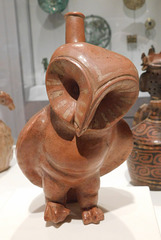
Moche Stirrup-spout Bottle with an Owl in the Metr…
| 04 Feb 2026 |
|
Title: Stirrup-spout bottle with owl
Artist: Moche artist(s)
Date: 200–500 CE
Geography: Peru, North Coast
Culture: Moche
Medium: Ceramic, slip
Dimensions: H. 9 1/2 × W. 4 5/8 × D. 5 3/4 in. (24.1 × 11.7 × 14.6 cm)
Classification: Ceramics-Containers
Credit Line: Gift of Nathan Cummings, 1966
Object Number: 66.30.5
Curatorial Department: The Michael C. Rockefeller Wing
Moche ceramists rendered naturalistic details of humans, animals, and plants with great anatomical precision. Exact species and even historical individuals can be recognized in sculptural images depicted with a high degree of realism. In Moche religion and iconography, birds of prey include falcons, eagles, condors, vultures, and owls. Naturalistic or anthropomorphized birds of prey perform a variety of ritual activities related to their natural behavior such as battles, hunts, and sacrifices. Perhaps because they are nocturnal, owls seem to be closely related to the funerary domain. Anthropomorphized owls prepare bodies and offerings for burials and also carry deceased warriors to the world of the dead. Many species of owls living in the desert environment of the Peruvian north coast are represented by Moche ceramists. This vessel probably shows a Tyto alba, recognizable by the heart-shaped facial disk and the absence of ear tufts.
Text from: www.metmuseum.org/art/collection/search/309388

Moche Stirrup-spout Bottle with an Owl in the Metr…
| 04 Feb 2026 |
|
Title: Stirrup-spout bottle with owl
Artist: Moche artist(s)
Date: 200–500 CE
Geography: Peru, North Coast
Culture: Moche
Medium: Ceramic, slip
Dimensions: H. 9 1/2 × W. 4 5/8 × D. 5 3/4 in. (24.1 × 11.7 × 14.6 cm)
Classification: Ceramics-Containers
Credit Line: Gift of Nathan Cummings, 1966
Object Number: 66.30.5
Curatorial Department: The Michael C. Rockefeller Wing
Moche ceramists rendered naturalistic details of humans, animals, and plants with great anatomical precision. Exact species and even historical individuals can be recognized in sculptural images depicted with a high degree of realism. In Moche religion and iconography, birds of prey include falcons, eagles, condors, vultures, and owls. Naturalistic or anthropomorphized birds of prey perform a variety of ritual activities related to their natural behavior such as battles, hunts, and sacrifices. Perhaps because they are nocturnal, owls seem to be closely related to the funerary domain. Anthropomorphized owls prepare bodies and offerings for burials and also carry deceased warriors to the world of the dead. Many species of owls living in the desert environment of the Peruvian north coast are represented by Moche ceramists. This vessel probably shows a Tyto alba, recognizable by the heart-shaped facial disk and the absence of ear tufts.
Text from: www.metmuseum.org/art/collection/search/309388

Moche Bottle with a Skeletal Family in the Metropo…

Moche Stirrup-spout Bottle with an Owl in the Metr…
| 04 Feb 2026 |
|
Title: Stirrup-spout bottle with owl
Artist: Moche artist(s)
Date: 200–500 CE
Geography: Peru, North Coast
Culture: Moche
Medium: Ceramic, slip
Dimensions: H. 9 1/2 × W. 4 5/8 × D. 5 3/4 in. (24.1 × 11.7 × 14.6 cm)
Classification: Ceramics-Containers
Credit Line: Gift of Nathan Cummings, 1966
Object Number: 66.30.5
Curatorial Department: The Michael C. Rockefeller Wing
Moche ceramists rendered naturalistic details of humans, animals, and plants with great anatomical precision. Exact species and even historical individuals can be recognized in sculptural images depicted with a high degree of realism. In Moche religion and iconography, birds of prey include falcons, eagles, condors, vultures, and owls. Naturalistic or anthropomorphized birds of prey perform a variety of ritual activities related to their natural behavior such as battles, hunts, and sacrifices. Perhaps because they are nocturnal, owls seem to be closely related to the funerary domain. Anthropomorphized owls prepare bodies and offerings for burials and also carry deceased warriors to the world of the dead. Many species of owls living in the desert environment of the Peruvian north coast are represented by Moche ceramists. This vessel probably shows a Tyto alba, recognizable by the heart-shaped facial disk and the absence of ear tufts.
Text from: www.metmuseum.org/art/collection/search/309388
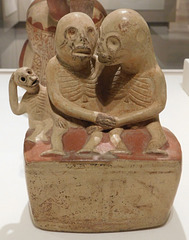
Moche Bottle with a Skeletal Family in the Metropo…

Moche Bottle with a Portrait Head in the Metropoli…
| 04 Feb 2026 |
|
Title: Bottle with portrait head
Artist: Moche artist(s)
Date: 500–800 CE
Geography: Peru, North Coast
Culture: Moche
Medium: Ceramic, slip
Dimensions: H. 10 3/8 × W. 6 3/8 × D. 7 in. (26.4 × 16.2 × 17.8 cm)
Classification: Ceramics-Containers
Credit Line: Gift of Henry G. Marquand, 1882
Object Number: 82.1.28
Curatorial Department: The Michael C. Rockefeller Wing
The Moche (also known as the Mochicas) flourished on Peru’s North Coast from 200-850 CE, centuries before the rise of the Incas. Over the course of some six centuries, the Moche built thriving regional centers from the Nepeña River Valley in the south to perhaps as far north as the Piura River, near the modern border with Ecuador, developing coastal deserts into rich farmlands and drawing upon the abundant maritime resources of the Pacific Ocean’s Humboldt Current. Although the precise nature of Moche political organization is a subject of debate, these centers shared unifying cultural traits such as religious practices (Donnan, 2010).
Moche potters produced tens of thousands of modeled and painted ceramic vessels over the course of some six centuries, and these were used in specific rituals; many, but not all, were ultimately placed in tombs. Portrait heads—so-called for their striking apparent resemblance to specific individuals—are a subset of this larger corpus. Their production was limited in time and space: they have been found only in the southern Moche region—south of the Pampa de Paiján, in the Chicama, Moche, and Virú valleys—and the most lifelike examples date to the later part of the Moche period, Phases III and IV (Donnan, 2001; 2004).
Created with the use of molds—multiple vessels were made with the use of a single mold or matrix—the bottles were then painted with cream and red slip in distinctive ways. The individual depicted here wears a head cloth, painted in a cream slip, over his hair and tied under the chin, and a headband decorated with a geometric pattern. The sclera of the eyes were highlighted with cream slip against the ochre red of the face, giving the portrait a lifelike appearance. Other details such as eyebrows and face painting on the chin were applied after firing, most likely with the use of an organic pigment that was then heated. A vessel now in the Fowler Museum at UCLA (X91.145; Donnan 1992:64) bears a very similar face, and may have been made from the same mold or matrix, but was painted differently and given a simple, tapered spout.
The stirrup-spout vessel—the shape of the spout recalls the stirrup on a horse's saddle—was a much-favored form on Peru's North Coast for about 2,500 years, from at least the beginning of the first millennium BCE through the early colonial period. The double-branch-single-spout configuration may have had practical advantages, as an ingenious handle, but it was also surely symbolic. As there was no tradition of writing in this region prior to the sixteenth century, however, the specific meanings of the shape remain unknown. The Moche shaped stirrup-spout bottles into a wide range of forms, including human figures, animals, and plants, and combinations of these.
It is difficult to state with certainty how portrait vessels were viewed in the past. Based on a comprehensive study of some 900 portrait heads and related archaeological data, Christopher Donnan (2001, 2004) has argued that they represented prominent individuals who would have been known by members of their community. Other scholars have emphasized their final contexts in burials, suggesting that such vessels are literal representations of decapitated heads, acts of reverence or devotion by kin (Weismantel, 2015). Interestingly, certain animals were depicted in ways akin to humans (see accession number 63.226.6).
Joanne Pillsbury, Andrall E. Pearson Curator, Arts of the Ancient Americas
Hugo C. Ikehara-Tsukayama, Andrew W. Mellon Curatorial/Collection Specialist Fellow, Arts of the Ancient Americas
2021
References and Further Reading
Castillo, Luis Jaime, Cecilia Pardo, and Julio Rucabado. Moche y sus vecinos: Reconstruyendo identidades. (Lima: Museo de Arte de Lima, 2016).
Donnan, Christopher B. “Moche State Religion,” in New Perspectives on Moche Political Organization, edited by Jeffrey Quilter and Luis Jaime Castillo (Washington D.C.: Dumbarton Oaks Research Library and Collection, 2010), pp. 47-69.
Donnan, Christopher B. Moche Portraits from Ancient Peru (Austin: University of Texas Press, 2003).
Donnan, Christopher B. “Moche Ceramic Portraits,” in Moche Art and Archaeology in Ancient Peru, edited by Joanne Pillsbury (Washington, D.C., New Haven: National Gallery of Art; Distributed by Yale University Press, 2001), pp. 126-139.
Donnan, Christopher B. and Donna McClelland. Moche Fineline Painting: Its Evolution and Its Artists (Los Angeles: Fowler Museum of Cultural History, University of California, Los Angeles, 1999).
Donnan, Christopher B. Ceramics of Ancient Peru (Los Angeles: Fowler Museum of Cultural History, University of California, Los Angeles, 1992).
Trever, Lisa. “A Moche Riddle in Clay: Object Knowledge and Art Work in Ancient Peru.” The Art Bulletin 101:4 (2019), pp. 18-38.
Weismantel, Mary. “Many Heads are Better than One: Mortuary Practice and Ceramic Art in Moche Society,” in Izumi Shimada and James L. Fitzsimmons, eds., Living with the Dead in the Andes, pp. 76-99. Tucson: University of Arizona Press, 2015.
Wołoszyn, Janusz Z., and Francisco Javier Villaverde González. Los rostros silenciosos: Los huacos retrato de la cultura moche. Lima, Peru: Fondo Editorial, Pontificia Universidad Católica del Perú, 2008.
Text from: www.metmuseum.org/art/collection/search/307472
Jump to top
RSS feed- LaurieAnnie's latest photos with "Moche" - Photos
- ipernity © 2007-2026
- Help & Contact
|
Club news
|
About ipernity
|
History |
ipernity Club & Prices |
Guide of good conduct
Donate | Group guidelines | Privacy policy | Terms of use | Statutes | In memoria -
Facebook
X
