

LaurieAnnie's photos with the keyword: Hades
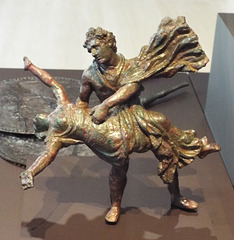
Rape of Proserpina from Baelo Claudia in the Archa…

Rape of Proserpina from Baelo Claudia in the Archa…
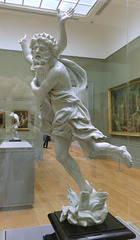
The Rape of Proserpina Porcelain in the Metropolit…
| 18 Jan 2023 |
|
Title: Rape of Proserpina
Manufactory: Doccia Porcelain Manufactory (Italian, 1737–1896)
Factory director: Marchese Carlo Ginori
Maker: Gaspero Bruschi (Italian, ca. 1710–1780, active 1737–80)
Modeler: After a model by Giovanni Battista Foggini (Italian, Florence 1652–1725 Florence)
Date: ca. 1750
Culture: Italian, Florence
Medium: Hard-paste porcelain
Dimensions: Overall (confirmed): 19 1/2 x 13 7/8 x 9 3/8 in. (49.5 x 35.2 x 23.8 cm)
Classification: Ceramics-Porcelain
Credit Line: Purchase, Gift of Irwin Untermyer, by exchange, 1997
Accession Number: 1997.377
In the 1740s Carlo Ginori, the founder of the porcelain factory at Doccia, acquired a number of sculptural models in wax, terracotta, and plaster made by some of the leading Florentine baroque sculptors. The challenge and reward for the porcelain modelers at the Ginori factory was to overcome the technical difficulties of this fragile new medium and to retain the dynamism and balance of the original models. This group, based on a bronze by Foggini, depicts Pluto stepping into the flames as he carries the struggling Proserpina off to the underworld.
Text from: www.metmuseum.org/art/collection/search/208847
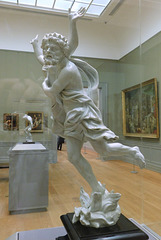
The Rape of Proserpina Porcelain in the Metropolit…
| 18 Jan 2023 |
|
Title: Rape of Proserpina
Manufactory: Doccia Porcelain Manufactory (Italian, 1737–1896)
Factory director: Marchese Carlo Ginori
Maker: Gaspero Bruschi (Italian, ca. 1710–1780, active 1737–80)
Modeler: After a model by Giovanni Battista Foggini (Italian, Florence 1652–1725 Florence)
Date: ca. 1750
Culture: Italian, Florence
Medium: Hard-paste porcelain
Dimensions: Overall (confirmed): 19 1/2 x 13 7/8 x 9 3/8 in. (49.5 x 35.2 x 23.8 cm)
Classification: Ceramics-Porcelain
Credit Line: Purchase, Gift of Irwin Untermyer, by exchange, 1997
Accession Number: 1997.377
In the 1740s Carlo Ginori, the founder of the porcelain factory at Doccia, acquired a number of sculptural models in wax, terracotta, and plaster made by some of the leading Florentine baroque sculptors. The challenge and reward for the porcelain modelers at the Ginori factory was to overcome the technical difficulties of this fragile new medium and to retain the dynamism and balance of the original models. This group, based on a bronze by Foggini, depicts Pluto stepping into the flames as he carries the struggling Proserpina off to the underworld.
Text from: www.metmuseum.org/art/collection/search/208847
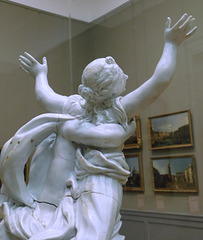
Detail of the The Rape of Proserpina Porcelain in…
| 18 Jan 2023 |
|
Title: Rape of Proserpina
Manufactory: Doccia Porcelain Manufactory (Italian, 1737–1896)
Factory director: Marchese Carlo Ginori
Maker: Gaspero Bruschi (Italian, ca. 1710–1780, active 1737–80)
Modeler: After a model by Giovanni Battista Foggini (Italian, Florence 1652–1725 Florence)
Date: ca. 1750
Culture: Italian, Florence
Medium: Hard-paste porcelain
Dimensions: Overall (confirmed): 19 1/2 x 13 7/8 x 9 3/8 in. (49.5 x 35.2 x 23.8 cm)
Classification: Ceramics-Porcelain
Credit Line: Purchase, Gift of Irwin Untermyer, by exchange, 1997
Accession Number: 1997.377
In the 1740s Carlo Ginori, the founder of the porcelain factory at Doccia, acquired a number of sculptural models in wax, terracotta, and plaster made by some of the leading Florentine baroque sculptors. The challenge and reward for the porcelain modelers at the Ginori factory was to overcome the technical difficulties of this fragile new medium and to retain the dynamism and balance of the original models. This group, based on a bronze by Foggini, depicts Pluto stepping into the flames as he carries the struggling Proserpina off to the underworld.
Text from: www.metmuseum.org/art/collection/search/208847
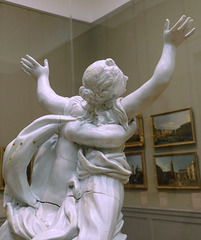
Detail of the The Rape of Proserpina Porcelain in…
| 18 Jan 2023 |
|
Title: Rape of Proserpina
Manufactory: Doccia Porcelain Manufactory (Italian, 1737–1896)
Factory director: Marchese Carlo Ginori
Maker: Gaspero Bruschi (Italian, ca. 1710–1780, active 1737–80)
Modeler: After a model by Giovanni Battista Foggini (Italian, Florence 1652–1725 Florence)
Date: ca. 1750
Culture: Italian, Florence
Medium: Hard-paste porcelain
Dimensions: Overall (confirmed): 19 1/2 x 13 7/8 x 9 3/8 in. (49.5 x 35.2 x 23.8 cm)
Classification: Ceramics-Porcelain
Credit Line: Purchase, Gift of Irwin Untermyer, by exchange, 1997
Accession Number: 1997.377
In the 1740s Carlo Ginori, the founder of the porcelain factory at Doccia, acquired a number of sculptural models in wax, terracotta, and plaster made by some of the leading Florentine baroque sculptors. The challenge and reward for the porcelain modelers at the Ginori factory was to overcome the technical difficulties of this fragile new medium and to retain the dynamism and balance of the original models. This group, based on a bronze by Foggini, depicts Pluto stepping into the flames as he carries the struggling Proserpina off to the underworld.
Text from: www.metmuseum.org/art/collection/search/208847
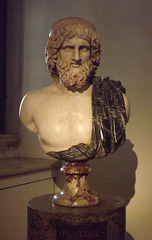
Bust of Pluto in the Palazzo Altemps, June 2012
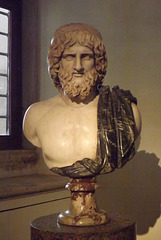
Bust of Pluto in the Palazzo Altemps, June 2012
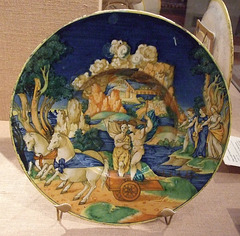
Plate with Pluto Abducting Persephone in the Phila…
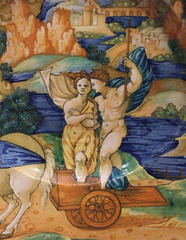
Detail of a Plate with Pluto Abducting Persephone…
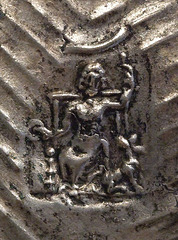
Detail of a Silver Votive Plaque in the Metropolit…
| 20 Jul 2010 |
|
Silver Votive Plaque
Roman, late 2nd-3rd century AD
Accession # 1981.61
Similar votives, made of thin sheets of silver, cut and impressed to look like leaves or feathers, are known from many different provinces of the Roman Empire. They were pinned up in temples or shrines as votives to a variety of deities, who are usually named in a dedication. This example, however, in uninscribed, but the seated god can be identified as Pluto, God of the Underworld because he is accompanied by the three-headed guard dog Cerberus.
Text from the Metropolitan Museum of Art label.
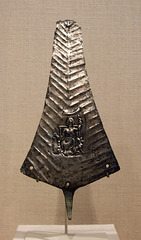
Silver Votive Plaque in the Metropolitan Museum of…
| 20 Jul 2010 |
|
Silver Votive Plaque
Roman, late 2nd-3rd century AD
Accession # 1981.61
Similar votives, made of thin sheets of silver, cut and impressed to look like leaves or feathers, are known from many different provinces of the Roman Empire. They were pinned up in temples or shrines as votives to a variety of deities, who are usually named in a dedication. This example, however, in uninscribed, but the seated god can be identified as Pluto, God of the Underworld because he is accompanied by the three-headed guard dog Cerberus.
Text from the Metropolitan Museum of Art label.
Terracotta Fragment of a Votive Relief in the Metr…
| 19 Jul 2010 |
|
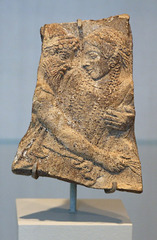
Terracotta fragment of a votive relief
Greek, South Italian, Locrian, ca. 470-460 BC
Hades abducting Persephone
Accession # 1989.281.60
When Hades, the god of the underworld, carried Persephone to his kingdom of the dead, Demeter, her mother brought all growth on earth to a standstill until Persephone was allowed to return to the earth for part of each year. Since antiquity, this myth has been understood as an allegory for the seasonal cycle of vegetation.
Text from the Metropolitan Museum of Art label.
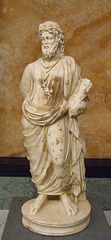
Pluto Sculpture in the Getty Villa, July 2008
| 10 Jul 2009 |
|
Pluto
Roman, 1-100 AD
Marble
Inventory # 71.AA.438
Pluto (Hades to the Greeks) was the Roman god of the Underworld. He is depicted here in the guise of Plouton, a Greek deity associated with wealth and agrarian abundance. The mature, bearded figure stands draped in a long cloak. A large cornucopia (now broken) rests in his left arm as a symbol of prosperity. Although sculpted in the Roman era, this statuette is modeled after a Greek work of the Hellenistic period (323-31 BC).
Text from the Getty Villa museum label.
Jump to top
RSS feed- LaurieAnnie's latest photos with "Hades" - Photos
- ipernity © 2007-2026
- Help & Contact
|
Club news
|
About ipernity
|
History |
ipernity Club & Prices |
Guide of good conduct
Donate | Group guidelines | Privacy policy | Terms of use | Statutes | In memoria -
Facebook
X
