

LaurieAnnie's photos with the keyword: kantharos

Kantharos by Nikosthenes in the Boston Museum of F…
| 12 Apr 2025 |
|
High-handled drinking cup (kantharos)
the Nikosthenes Painter
Potter: Nikosthenes
Greek
Archaic Period
about 520–510 B.C.
Place of Manufacture: Greece, Attica, Athens
Medium/Technique Ceramic, Red Figure
Dimensions Height: 23 cm (9 1/16 in.)
Credit Line Henry Lillie Pierce Fund
Accession Number: 00.334
Collections: Ancient Greece and Rome
Classifications: Vessels
Catalogue Raisonné Caskey-Beazley, Attic Vase Paintings (MFA), no. 118.
DescriptionThis kantharos is decorated in four areas: the front and back of the flare of the cup, and the front and back of the lower bowl of the cup.
Upper side A: Here the god of wine, Dionysus, is shown reclining on the ground, bracing himself on two striped cushions. He wears a headdress (sakkos), and his cloak (himation) is pulled down to his waist. He holds an ivy branch in one hand and a drinking-horn (rhyton) in the other. He appears to be conversing with the satyr on the right, who carries a wine bag. The satyr on the left carries a garlanded pointed amphora. An animal skin flute-case hangs on the left.
Lower side A: This panel shows the often depicted scene of Herakles' first labor: the fight with the Nemean lion. Herakles is shown as a beardless youth. The lion reaches out with a hind leg to scratch his opponent's face. The action occurs in front of two trees. Herakles' companion, Iolaos, stands on the right, and gestures towards the conflict. Herakles' bow and quiver hang on a tree on the right. His cloak hangs on the left.
Upper Side B: Dionysus and three maenads perform a liquid sacrifice at an altar. Dionysos stands, setting one foot forward, at a lighted altar, over which he pours wine from his kantharos. A woman, a maenad, stands facing him, looking down and stretching her arms straight downwards, with the hands open - she may be tossing handfuls of groats (olai) on the altar. A flat basket with scooped-out side (kanoun) stands on the ground at her feet. To left of this pair, a maenad dances; to right of them, another, less vigorously. Behind the left-hand maenad is a thyrsus.
Lower Side B: Herakles fighting the Cretan bull. Herakles kneels, holding the bull by one horn. The binding is nearly completed. On the right are his bow and quiver, suspended. To right of them, under the handle, is a tree, with the hero's mantle spread out on it.
Painted Greek inscription on foot contains the signature of the potter. "Nikosthenes made [it]" (NIKOSTHENESEPOIESEN) The painter has therefore been attributed to the "Nikosthenese Painter".
Signed: Signed by the potter: "Nikosthenes made [it]" (NIKOSTHENESEPOIESEN)
Inscriptions"Nikosthenes made [it]" (NIKOSTHENESEPOIESEN)
ΝΙΚΟSΘΕΝΕSΕΠΟΙΕSΕΝ
Provenance: By 1888: Bruschi Collection, Tarquinia; by 1900: with Edward Perry Warren (according to Warren's records: Bruschi Collection); purchased by MFA from Edward Perry Warren, February 1900
Text from: collections.mfa.org/objects/153643/highhandled-drinking-cup-kantharos

Detail of a Kantharos by Nikosthenes in the Boston…
| 12 Apr 2025 |
|
High-handled drinking cup (kantharos)
the Nikosthenes Painter
Potter: Nikosthenes
Greek
Archaic Period
about 520–510 B.C.
Place of Manufacture: Greece, Attica, Athens
Medium/Technique Ceramic, Red Figure
Dimensions Height: 23 cm (9 1/16 in.)
Credit Line Henry Lillie Pierce Fund
Accession Number: 00.334
Collections: Ancient Greece and Rome
Classifications: Vessels
Catalogue Raisonné Caskey-Beazley, Attic Vase Paintings (MFA), no. 118.
DescriptionThis kantharos is decorated in four areas: the front and back of the flare of the cup, and the front and back of the lower bowl of the cup.
Upper side A: Here the god of wine, Dionysus, is shown reclining on the ground, bracing himself on two striped cushions. He wears a headdress (sakkos), and his cloak (himation) is pulled down to his waist. He holds an ivy branch in one hand and a drinking-horn (rhyton) in the other. He appears to be conversing with the satyr on the right, who carries a wine bag. The satyr on the left carries a garlanded pointed amphora. An animal skin flute-case hangs on the left.
Lower side A: This panel shows the often depicted scene of Herakles' first labor: the fight with the Nemean lion. Herakles is shown as a beardless youth. The lion reaches out with a hind leg to scratch his opponent's face. The action occurs in front of two trees. Herakles' companion, Iolaos, stands on the right, and gestures towards the conflict. Herakles' bow and quiver hang on a tree on the right. His cloak hangs on the left.
Upper Side B: Dionysus and three maenads perform a liquid sacrifice at an altar. Dionysos stands, setting one foot forward, at a lighted altar, over which he pours wine from his kantharos. A woman, a maenad, stands facing him, looking down and stretching her arms straight downwards, with the hands open - she may be tossing handfuls of groats (olai) on the altar. A flat basket with scooped-out side (kanoun) stands on the ground at her feet. To left of this pair, a maenad dances; to right of them, another, less vigorously. Behind the left-hand maenad is a thyrsus.
Lower Side B: Herakles fighting the Cretan bull. Herakles kneels, holding the bull by one horn. The binding is nearly completed. On the right are his bow and quiver, suspended. To right of them, under the handle, is a tree, with the hero's mantle spread out on it.
Painted Greek inscription on foot contains the signature of the potter. "Nikosthenes made [it]" (NIKOSTHENESEPOIESEN) The painter has therefore been attributed to the "Nikosthenese Painter".
Signed: Signed by the potter: "Nikosthenes made [it]" (NIKOSTHENESEPOIESEN)
Inscriptions"Nikosthenes made [it]" (NIKOSTHENESEPOIESEN)
ΝΙΚΟSΘΕΝΕSΕΠΟΙΕSΕΝ
Provenance: By 1888: Bruschi Collection, Tarquinia; by 1900: with Edward Perry Warren (according to Warren's records: Bruschi Collection); purchased by MFA from Edward Perry Warren, February 1900
Text from: collections.mfa.org/objects/153643/highhandled-drinking-cup-kantharos

Detail of a Kantharos by Nikosthenes in the Boston…
| 12 Apr 2025 |
|
High-handled drinking cup (kantharos)
the Nikosthenes Painter
Potter: Nikosthenes
Greek
Archaic Period
about 520–510 B.C.
Place of Manufacture: Greece, Attica, Athens
Medium/Technique Ceramic, Red Figure
Dimensions Height: 23 cm (9 1/16 in.)
Credit Line Henry Lillie Pierce Fund
Accession Number: 00.334
Collections: Ancient Greece and Rome
Classifications: Vessels
Catalogue Raisonné Caskey-Beazley, Attic Vase Paintings (MFA), no. 118.
DescriptionThis kantharos is decorated in four areas: the front and back of the flare of the cup, and the front and back of the lower bowl of the cup.
Upper side A: Here the god of wine, Dionysus, is shown reclining on the ground, bracing himself on two striped cushions. He wears a headdress (sakkos), and his cloak (himation) is pulled down to his waist. He holds an ivy branch in one hand and a drinking-horn (rhyton) in the other. He appears to be conversing with the satyr on the right, who carries a wine bag. The satyr on the left carries a garlanded pointed amphora. An animal skin flute-case hangs on the left.
Lower side A: This panel shows the often depicted scene of Herakles' first labor: the fight with the Nemean lion. Herakles is shown as a beardless youth. The lion reaches out with a hind leg to scratch his opponent's face. The action occurs in front of two trees. Herakles' companion, Iolaos, stands on the right, and gestures towards the conflict. Herakles' bow and quiver hang on a tree on the right. His cloak hangs on the left.
Upper Side B: Dionysus and three maenads perform a liquid sacrifice at an altar. Dionysos stands, setting one foot forward, at a lighted altar, over which he pours wine from his kantharos. A woman, a maenad, stands facing him, looking down and stretching her arms straight downwards, with the hands open - she may be tossing handfuls of groats (olai) on the altar. A flat basket with scooped-out side (kanoun) stands on the ground at her feet. To left of this pair, a maenad dances; to right of them, another, less vigorously. Behind the left-hand maenad is a thyrsus.
Lower Side B: Herakles fighting the Cretan bull. Herakles kneels, holding the bull by one horn. The binding is nearly completed. On the right are his bow and quiver, suspended. To right of them, under the handle, is a tree, with the hero's mantle spread out on it.
Painted Greek inscription on foot contains the signature of the potter. "Nikosthenes made [it]" (NIKOSTHENESEPOIESEN) The painter has therefore been attributed to the "Nikosthenese Painter".
Signed: Signed by the potter: "Nikosthenes made [it]" (NIKOSTHENESEPOIESEN)
Inscriptions"Nikosthenes made [it]" (NIKOSTHENESEPOIESEN)
ΝΙΚΟSΘΕΝΕSΕΠΟΙΕSΕΝ
Provenance: By 1888: Bruschi Collection, Tarquinia; by 1900: with Edward Perry Warren (according to Warren's records: Bruschi Collection); purchased by MFA from Edward Perry Warren, February 1900
Text from: collections.mfa.org/objects/153643/highhandled-drinking-cup-kantharos

Kantharos by Nikosthenes in the Boston Museum of F…
| 12 Apr 2025 |
|
High-handled drinking cup (kantharos)
the Nikosthenes Painter
Potter: Nikosthenes
Greek
Archaic Period
about 520–510 B.C.
Place of Manufacture: Greece, Attica, Athens
Medium/Technique Ceramic, Red Figure
Dimensions Height: 23 cm (9 1/16 in.)
Credit Line Henry Lillie Pierce Fund
Accession Number: 00.334
Collections: Ancient Greece and Rome
Classifications: Vessels
Catalogue Raisonné Caskey-Beazley, Attic Vase Paintings (MFA), no. 118.
DescriptionThis kantharos is decorated in four areas: the front and back of the flare of the cup, and the front and back of the lower bowl of the cup.
Upper side A: Here the god of wine, Dionysus, is shown reclining on the ground, bracing himself on two striped cushions. He wears a headdress (sakkos), and his cloak (himation) is pulled down to his waist. He holds an ivy branch in one hand and a drinking-horn (rhyton) in the other. He appears to be conversing with the satyr on the right, who carries a wine bag. The satyr on the left carries a garlanded pointed amphora. An animal skin flute-case hangs on the left.
Lower side A: This panel shows the often depicted scene of Herakles' first labor: the fight with the Nemean lion. Herakles is shown as a beardless youth. The lion reaches out with a hind leg to scratch his opponent's face. The action occurs in front of two trees. Herakles' companion, Iolaos, stands on the right, and gestures towards the conflict. Herakles' bow and quiver hang on a tree on the right. His cloak hangs on the left.
Upper Side B: Dionysus and three maenads perform a liquid sacrifice at an altar. Dionysos stands, setting one foot forward, at a lighted altar, over which he pours wine from his kantharos. A woman, a maenad, stands facing him, looking down and stretching her arms straight downwards, with the hands open - she may be tossing handfuls of groats (olai) on the altar. A flat basket with scooped-out side (kanoun) stands on the ground at her feet. To left of this pair, a maenad dances; to right of them, another, less vigorously. Behind the left-hand maenad is a thyrsus.
Lower Side B: Herakles fighting the Cretan bull. Herakles kneels, holding the bull by one horn. The binding is nearly completed. On the right are his bow and quiver, suspended. To right of them, under the handle, is a tree, with the hero's mantle spread out on it.
Painted Greek inscription on foot contains the signature of the potter. "Nikosthenes made [it]" (NIKOSTHENESEPOIESEN) The painter has therefore been attributed to the "Nikosthenese Painter".
Signed: Signed by the potter: "Nikosthenes made [it]" (NIKOSTHENESEPOIESEN)
Inscriptions"Nikosthenes made [it]" (NIKOSTHENESEPOIESEN)
ΝΙΚΟSΘΕΝΕSΕΠΟΙΕSΕΝ
Provenance: By 1888: Bruschi Collection, Tarquinia; by 1900: with Edward Perry Warren (according to Warren's records: Bruschi Collection); purchased by MFA from Edward Perry Warren, February 1900
Text from: collections.mfa.org/objects/153643/highhandled-drinking-cup-kantharos
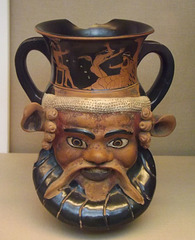
Double-headed Kantharos in the British Museum, Apr…
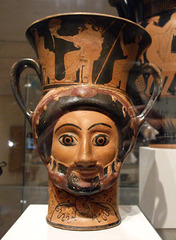
Terracotta Kantharos in the Form of the Head of He…
| 13 May 2011 |
|
Title: Terracotta kantharos (drinking cup) in the form of the heads of Herakles and of a woman
Medium; Technique: Terracotta; red-figure
Culture: Greek, Attic
Period: Classical
Date: ca. 470 B.C.
Artist or Maker: Attributed to the Syriskos Painter; Attributed to the Vatican Class of Head Vases
Dimensions: H. 8 1/2 in. (21.6 cm)
Classification: Vases
Credit Line: Purchase by subscription, 1896
Accession Number: 96.18.77
Description:
Obverse, Athena seated between two women
Reverse, symposium (drinking party)
Athena, flanked by two seated women who must also be deities, overlooks the head of her favorite hero, Herakles, identifiable by the lion's skin around his neck. This amusing cup would have enlivened drinking parties like the one shown on the other side above the female head.
Text from: www.metmuseum.org/Works_of_Art/collection_database/greek_...
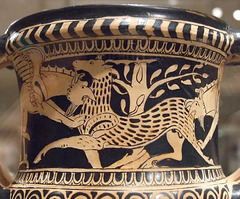
Detail of an Etruscan Terracotta Kantharos in the…
| 12 Nov 2011 |
|
Terracotta kantharos (drinking cup)
Period: Late Classical
Date: ca. 325–300 B.C.
Culture: Etruscan
Medium: Terracotta
Dimensions: H. 6 3/16 in. (15.7 cm)
Classification: Vases
Credit Line: Rogers Fund, 1951
Accession Number: 51.11.10
Description:
Obverse and reverse, griffins attacking a deer
The subject of griffins attacking a deer has a long history and remained popular during the Hellenistic period throughout the Mediterranean area. It may be a symbol of the inevitability of death. The handles are ribbon-like and include so-called Herakles knots, a square knot symbolic of love and power in the ancient world. In the Roman Imperial period, Herakles knots were believed to heal wounds.
Text from: www.metmuseum.org/Collections/search-the-collections/1300...
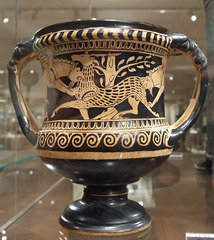
Etruscan Terracotta Kantharos in the Metropolitan…
| 12 Nov 2011 |
|
Terracotta kantharos (drinking cup)
Period: Late Classical
Date: ca. 325–300 B.C.
Culture: Etruscan
Medium: Terracotta
Dimensions: H. 6 3/16 in. (15.7 cm)
Classification: Vases
Credit Line: Rogers Fund, 1951
Accession Number: 51.11.10
Description:
Obverse and reverse, griffins attacking a deer
The subject of griffins attacking a deer has a long history and remained popular during the Hellenistic period throughout the Mediterranean area. It may be a symbol of the inevitability of death. The handles are ribbon-like and include so-called Herakles knots, a square knot symbolic of love and power in the ancient world. In the Roman Imperial period, Herakles knots were believed to heal wounds.
Text from: www.metmuseum.org/Collections/search-the-collections/1300...
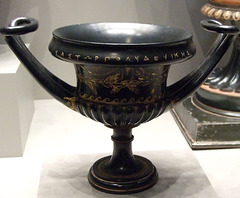
Rattling Wine Cup in the Getty Villa, July 2008
| 31 Aug 2009 |
|
Rattling Wine Cup
Greek, from South Italy, 400-300 BC
Terracotta and gold
Black-glazed kantharos
Inventory # 86.AE.702
Metal vessels inspired several features of this terracotta cup: the high foot, the sharply bent handles, the ridged rim, and the lobes on the lower body. The body of this cup was probably made in a mold. Decoration in gold includes a wreath encircling the vessel and garlands hanging from bucrania (skulls of sacrificial cattle). Stars fill the areas above the garlands, and a wave pattern runs below. The gold inscription on the rim indicates that the cup was given as an offering to Kastor and Polydeukes, the twin sons of Leda (a Spartan queen) and Zeus (king of the gods). The hollow rim contains two clay pellets that make a rattling sound when the cup is lifted or tipped.
Text from the Getty Villa museum label.
Jump to top
RSS feed- LaurieAnnie's latest photos with "kantharos" - Photos
- ipernity © 2007-2026
- Help & Contact
|
Club news
|
About ipernity
|
History |
ipernity Club & Prices |
Guide of good conduct
Donate | Group guidelines | Privacy policy | Terms of use | Statutes | In memoria -
Facebook
X
