

LaurieAnnie's photos with the keyword: Burne-Jones
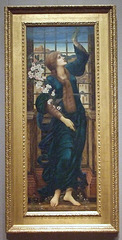
Hope by Burne-Jones in the Boston Museum of Fine A…
| 30 Sep 2023 |
|
Hope
Sir Edward Coley Burne-Jones (English, 1833–1898)
1896
Medium/Technique Oil on canvas
Dimensions 179 x 63.5 cm (70 1/2 x 25 in.)
Credit Line Given in memory of Mrs. George Marston Whitin by her four daughters, Mrs. Lawrence
Murray Keeler, Mrs. Sydney Russell Mason, Mrs. Elijah Kent Swift and Mrs. William Carey Crane
Accession Number: 40.778
Collections: Europe
Classifications: Paintings
Hope, one of the three theological Virtues, is symbolized here as a prisoner chained indoors, holding a branch of apple blossoms and reaching upward to pull the blue sky down toward her. The slender, vertical format of this painting recalls the fact that many of Burne-Jones's designs were successfully translated into stained-glass windows and textiles. Burne-Jones painted this work for Mrs. Whitin, of Whitinsville, Massachusetts. He had previously worked on a large watercolor version of the same subject.
Inscriptions: Lower right: E:BURNE:JONES: / Finished 1896:
Provenance1896, Mrs. George Marston Whitin (Catharine Whitin Lasell) (b. 1856), Whitinsville, MA (original commission) [see note 1]; by descent to her daughters, Mrs. Lawrence Murray Keeler (Elizabeth Klock Whitin, b. 1880), Mrs. Sydney Russell Mason (Elsa Whitin, b. 1884), Mrs. Elijah Kent Swift (Katharine Leland Whitin, b. 1887), and Mrs. William Carey Crane (Lois Haven Whitin, b. 1896), Whitinsville; 1940, gift of Mrs. Lawrence Murray Keeler, Mrs. Sydney Russell Mason, Mrs. Elijah Kent Swift and Mrs. William Carey Crane to the MFA. (Accession Date: November 14, 1940)
NOTES:
[1] Edward Burne-Jones had been commissioned by Mrs. Whitin, through Christine Barrington, an intermediary, to paint a dancing figure. A letter from Ms. Barrington to Mrs. Whitin (July 29, 1896; typed transcript in the MFA curatorial file) indicates that by mid-1896, work on the commission was proceeding poorly. She wrote: "This picture that he is at now is the figure of 'Hope' (oils of course) 'a girl [I quote from him now] in prison, reaching up one hand, and pulling the blue sky down to her. Flowers are springing up between the stone flags of her cell, and a branch of apple tree is in full blossom in her other hand. Will you let me know if this will be liked, and I will go on with it quickly, and undertake to finish it within the year.' " A letter from Ms. Barrington to Mrs. Whitin (September 9, 1896) confirms her acceptance of his offer for the painting of Hope; correspondence from 1897 between Mrs. Whitin and the artist discusses shipment and payment.
Text from: collections.mfa.org/objects/32751/hope
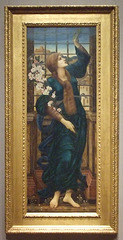
Hope by Burne-Jones in the Boston Museum of Fine A…
| 30 Sep 2023 |
|
Hope
Sir Edward Coley Burne-Jones (English, 1833–1898)
1896
Medium/Technique Oil on canvas
Dimensions 179 x 63.5 cm (70 1/2 x 25 in.)
Credit Line Given in memory of Mrs. George Marston Whitin by her four daughters, Mrs. Lawrence
Murray Keeler, Mrs. Sydney Russell Mason, Mrs. Elijah Kent Swift and Mrs. William Carey Crane
Accession Number: 40.778
Collections: Europe
Classifications: Paintings
Hope, one of the three theological Virtues, is symbolized here as a prisoner chained indoors, holding a branch of apple blossoms and reaching upward to pull the blue sky down toward her. The slender, vertical format of this painting recalls the fact that many of Burne-Jones's designs were successfully translated into stained-glass windows and textiles. Burne-Jones painted this work for Mrs. Whitin, of Whitinsville, Massachusetts. He had previously worked on a large watercolor version of the same subject.
Inscriptions: Lower right: E:BURNE:JONES: / Finished 1896:
Provenance1896, Mrs. George Marston Whitin (Catharine Whitin Lasell) (b. 1856), Whitinsville, MA (original commission) [see note 1]; by descent to her daughters, Mrs. Lawrence Murray Keeler (Elizabeth Klock Whitin, b. 1880), Mrs. Sydney Russell Mason (Elsa Whitin, b. 1884), Mrs. Elijah Kent Swift (Katharine Leland Whitin, b. 1887), and Mrs. William Carey Crane (Lois Haven Whitin, b. 1896), Whitinsville; 1940, gift of Mrs. Lawrence Murray Keeler, Mrs. Sydney Russell Mason, Mrs. Elijah Kent Swift and Mrs. William Carey Crane to the MFA. (Accession Date: November 14, 1940)
NOTES:
[1] Edward Burne-Jones had been commissioned by Mrs. Whitin, through Christine Barrington, an intermediary, to paint a dancing figure. A letter from Ms. Barrington to Mrs. Whitin (July 29, 1896; typed transcript in the MFA curatorial file) indicates that by mid-1896, work on the commission was proceeding poorly. She wrote: "This picture that he is at now is the figure of 'Hope' (oils of course) 'a girl [I quote from him now] in prison, reaching up one hand, and pulling the blue sky down to her. Flowers are springing up between the stone flags of her cell, and a branch of apple tree is in full blossom in her other hand. Will you let me know if this will be liked, and I will go on with it quickly, and undertake to finish it within the year.' " A letter from Ms. Barrington to Mrs. Whitin (September 9, 1896) confirms her acceptance of his offer for the painting of Hope; correspondence from 1897 between Mrs. Whitin and the artist discusses shipment and payment.
Text from: collections.mfa.org/objects/32751/hope
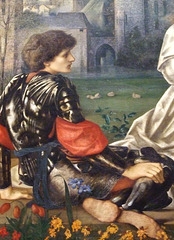
Detail of The Love Song by Burne-Jones in the Metr…
| 28 Jun 2008 |
|
Artist
Sir Edward Burne-Jones (English, 1833–1898)
Title
The Love Song
Date
1868–77
Medium
Oil on canvas
Dimensions
45 x 61 3/8 in. (114.3 x 155.9 cm)
Credit Line
The Alfred N. Punnett Endowment Fund, 1947
Accession Number
47.26
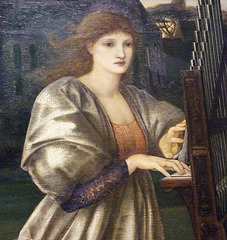
In 1846, the painter and poet Dante Gabriel Rossetti was a founding member of the circle of artists known as the Pre-Raphaelite Brotherhood. Nine years later he assembled a group of seven friends to help him decorate the Oxford Union Building with scenes from Sir Thomas Malory's "Morte d'Arthur." One of the driving forces of this "second Brotherhood" was Edward Burne-Jones. His "Love Song," with its figures reminiscent of the fifteenth-century Venetian painter Vittore Carpaccio and its "Arthurian" landscape bathed in evening light, reflects the profound influence of both the Italian Renaissance and the gothicizing Pre-Raphaelite movement.
This painting is the definitive version of several works that Burne-Jones based on a refrain from an old Breton song: "Hélas! je sais un chant d'amour, / Triste ou gai, tour à tour" (Alas, I know a love song, / Sad or happy, each in turn).
Text from: www.metmuseum.org/works_of_art/collection_database/europe...
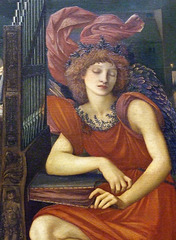
Detail of The Love Song by Burne-Jones in the Metr…
| 28 Jun 2008 |
|
Artist
Sir Edward Burne-Jones (English, 1833–1898)
Title
The Love Song
Date
1868–77
Medium
Oil on canvas
Dimensions
45 x 61 3/8 in. (114.3 x 155.9 cm)
Credit Line
The Alfred N. Punnett Endowment Fund, 1947
Accession Number
47.26
In 1846, the painter and poet Dante Gabriel Rossetti was a founding member of the circle of artists known as the Pre-Raphaelite Brotherhood. Nine years later he assembled a group of seven friends to help him decorate the Oxford Union Building with scenes from Sir Thomas Malory's "Morte d'Arthur." One of the driving forces of this "second Brotherhood" was Edward Burne-Jones. His "Love Song," with its figures reminiscent of the fifteenth-century Venetian painter Vittore Carpaccio and its "Arthurian" landscape bathed in evening light, reflects the profound influence of both the Italian Renaissance and the gothicizing Pre-Raphaelite movement.
This painting is the definitive version of several works that Burne-Jones based on a refrain from an old Breton song: "Hélas! je sais un chant d'amour, / Triste ou gai, tour à tour" (Alas, I know a love song, / Sad or happy, each in turn).
Text from: www.metmuseum.org/works_of_art/collection_database/europe...
Detail of The Love Song by Burne-Jones in the Metr…
| 28 Jun 2008 |
|
Artist
Sir Edward Burne-Jones (English, 1833–1898)
Title
The Love Song
Date
1868–77
Medium
Oil on canvas
Dimensions
45 x 61 3/8 in. (114.3 x 155.9 cm)
Credit Line
The Alfred N. Punnett Endowment Fund, 1947
Accession Number
47.26
In 1846, the painter and poet Dante Gabriel Rossetti was a founding member of the circle of artists known as the Pre-Raphaelite Brotherhood. Nine years later he assembled a group of seven friends to help him decorate the Oxford Union Building with scenes from Sir Thomas Malory's "Morte d'Arthur." One of the driving forces of this "second Brotherhood" was Edward Burne-Jones. His "Love Song," with its figures reminiscent of the fifteenth-century Venetian painter Vittore Carpaccio and its "Arthurian" landscape bathed in evening light, reflects the profound influence of both the Italian Renaissance and the gothicizing Pre-Raphaelite movement.
This painting is the definitive version of several works that Burne-Jones based on a refrain from an old Breton song: "Hélas! je sais un chant d'amour, / Triste ou gai, tour à tour" (Alas, I know a love song, / Sad or happy, each in turn).
Text from: www.metmuseum.org/works_of_art/collection_database/europe...

Detail of The Love Song by Burne-Jones in the Metr…
| 28 Jun 2008 |
|
Artist
Sir Edward Burne-Jones (English, 1833–1898)
Title
The Love Song
Date
1868–77
Medium
Oil on canvas
Dimensions
45 x 61 3/8 in. (114.3 x 155.9 cm)
Credit Line
The Alfred N. Punnett Endowment Fund, 1947
Accession Number
47.26
In 1846, the painter and poet Dante Gabriel Rossetti was a founding member of the circle of artists known as the Pre-Raphaelite Brotherhood. Nine years later he assembled a group of seven friends to help him decorate the Oxford Union Building with scenes from Sir Thomas Malory's "Morte d'Arthur." One of the driving forces of this "second Brotherhood" was Edward Burne-Jones. His "Love Song," with its figures reminiscent of the fifteenth-century Venetian painter Vittore Carpaccio and its "Arthurian" landscape bathed in evening light, reflects the profound influence of both the Italian Renaissance and the gothicizing Pre-Raphaelite movement.
This painting is the definitive version of several works that Burne-Jones based on a refrain from an old Breton song: "Hélas! je sais un chant d'amour, / Triste ou gai, tour à tour" (Alas, I know a love song, / Sad or happy, each in turn).
Text from: www.metmuseum.org/works_of_art/collection_database/europe...
Jump to top
RSS feed- LaurieAnnie's latest photos with "Burne-Jones" - Photos
- ipernity © 2007-2026
- Help & Contact
|
Club news
|
About ipernity
|
History |
ipernity Club & Prices |
Guide of good conduct
Donate | Group guidelines | Privacy policy | Terms of use | Statutes | In memoria -
Facebook
X
