

Jonathan Cohen's photos with the keyword: American Civil War
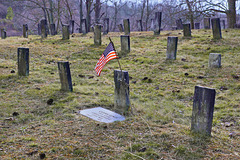
Private Casper Lewis' Grave – The Ridges, Athens,…
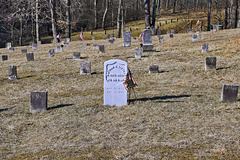
Sergeant Major Nathan Littler's Grave – The Ridges…
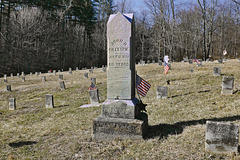
John R. Gillespie's Grave – The Ridges, Athens, Oh…
| 09 Mar 2014 |
|
The Ridges was a formal mental health hospital and it has a place were they buried the deceased patients. Locals say that there are two or three asylum cemeteries at the Ridges. Yet the most famous of them is the one located at the rear corner of the grounds of the asylum. It is the only part of the Ridges that is still in the property of the state Department of Menthal Health.
What is extremely strange about this cemetery is that the gravestones bear no names, but numbers instead. Very few of them have been substituted with some stones that are engraved with dates and names. This only happened when some relatives of the deceased decided to bear the expenses for the gravestone. The state only offered the deceased persons a white stone with a number and that was pretty much all that was on it.The hospital records keep the record of the names that are connected to each number and this is the reason several unmarked stones have some metalic veterans’ plaques.
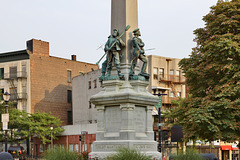
"The Union Saved" – Warburton Avenue, Yonkers, New…
| 26 Aug 2013 |
|
The Soldiers and Sailors’ Monument … was erected under the auspices of the Soldiers and Sailors’ Monument Association and was dedicated on September 17, 1891, with elaborate ceremonies in the presence of 20,000 spectators. It was given by the Monument Association to the city of Yonkers and is included in the deed to the State of Now York with the other Manor House property.
The monument consists of a base, die plinth, (lie, cap, pedi-ment cap, shaft plinth, shaft and capital of dark blue Barre granite, thirty-five feet high, surmounted by a granite statue of a Color Bearer eleven feet high, making the total height forty-six feet. Around the base of the shaft are four bronze statues, each seven feet high, representing the Infantry, Artillery, Cavalry and Naval services. The monument is inclosed with a low granite coping about seventeen feet square.
Under the Infantryman is the inscription:
"Patriotism —To honor the men of Yonkers who fought to save the Union.
1861-1865.— Slavery Abolished."
Under the Artilleryman:
"Endurance — The Union is the Palladium of our Safety and Prosperity. (Washington.) —Credit Maintained."
Under the Cavalryman:
"Valor — My paramount Object is to save the Union. (Lincoln.) — Let us Have Peace. (Grant.)"
Under the Navyman:
"Courage —The Union Must and Shall be Preserved. (Jackson.) —The Union Saved."
The monument was planned by Mr. George H. Mitchell, of Chicago. The four bronze statues were modeled by Mr. Lorado Taft, after the designs for the first three by Mr. J. E. Kelly, of New York, and after a design for the fourth by Lieutenant Wash-ington Irving Chambers, U. S. N.
The monument cost $10,500; the granite inclosure, $1,000; and the dedicatory exercises, contingent expenses, and the publication of a memorial volume, $3,500, making a total of $15,000 raised by the association. This sum was contributed by about 550 individuals and by fifty organizations and entertainments. The individual subscriptions ranged from three cents to $1,050. The names of those who contributed their means and services to the erection of this memorial, together with the names of those in whose memory it was erected and an account of the dedicatory exercises, are to be found in a volume entitled " Yonkers in the Rebellion," by Hon. Thomas Astley Atkins and Mr. John Wise Oliver.
- Documents of the Assembly of the State of New York, Volume 24, pages 233-234
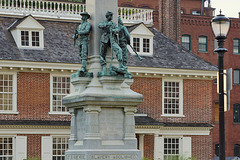
"Slavery Abolished" – Warburton Avenue, Yonkers, N…
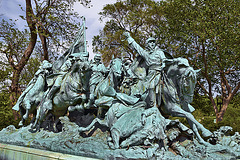
Ulysses Grant Memorial: Cavalry Group – United Sta…
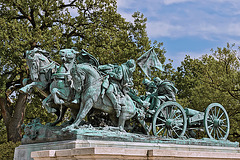
Ulysses S. Grant Memorial: The Artillery Group – U…
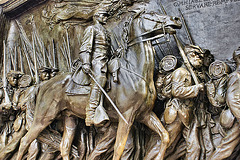
Memorial to Robert Gould Shaw and the 54th Regimen…
| 13 Nov 2011 |
|
The 54th Regiment Massachusetts Volunteer Infantry was an infantry regiment that saw extensive service in the Union Army during the American Civil War. The regiment was one of the first official black units in the United States during the Civil War. Commanded by Colonel Robert Gould Shaw, it sprang to life after the passage of the Emancipation Proclamation. Secretary of War Edwin M. Stanton decided white officers would be in charge of all "colored" units.
The Memorial to Robert Gould Shaw and the Massachusetts Fifty-Fourth Regiment is a bronze relief sculpture, by Augustus Saint-Gaudens, located at 24 Beacon Street, adjacent to the Boston Common. The sculpture depicts the 54th Regiment marching down Beacon Street on May 28, 1863
By most accounts, the 54th left Boston with very high morale. This was despite the fact that Jefferson Davis’ proclamation of December 23, 1862 effectively put both African-American enlisted men and white officers under a death sentence. The proclamation was affirmed by the Confederate Congress in January 1863 and turned both enlisted soldiers and their white officers over to the states from which the enlisted soldiers had been slaves. As most Southern states had enacted draconian measures for "servile insurrection" after Nat Turner’s Rebellion the likely sentence was a capital one.
Robert Gould Shaw was born in Boston to a prominent abolitionist family. The 54th Regiment was sent to Charleston, South Carolina, to take part in the operations against the Confederates stationed there. On July 18, 1863, along with two brigades of white troops, the 54th assaulted Confederate Battery Wagner. As the unit hesitated in the face of fierce Confederate fire, Shaw led his men into battle by shouting, "Forward, Fifty-Fourth Forward!" He mounted a parapet and urged his men forward, but was shot through the heart and he died almost instantly. According to the color sergeant of the 54th Mass, he was shot and killed trying to lead the unit forward and fell on the outside of the fort.
The victorious Confederates buried him in a mass grave with many of his men, an act they intended as an insult. Shaw's father publicly proclaimed that he was proud to know that his son was interred with his troops, befitting his role as a soldier and a fighter for social justice.
The story of Shaw and the 54th Massachusetts was dramatized in the 1989 film "Glory," with Shaw portrayed by Matthew Broderick. The film also starred Denzel Washington and Morgan Freeman,
Jump to top
RSS feed- Jonathan Cohen's latest photos with "American Civil War" - Photos
- ipernity © 2007-2026
- Help & Contact
|
Club news
|
About ipernity
|
History |
ipernity Club & Prices |
Guide of good conduct
Donate | Group guidelines | Privacy policy | Terms of use | Statutes | In memoria -
Facebook
X
